
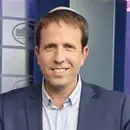
Rabbi Dr. Josh Joseph, Executive Vice President of the Orthodox Union (OU), spoke to Arutz Sheva - Israel National News during a visit to Israel about the strengthening of Jewish identity since October 7, rising antisemitism in the US, the OU's growing activities in Israel and the Diaspora, and the legacy of his close friend and colleague Rabbi Moshe Hauer.
Joseph's visit to Israel was also a personal one. His daughter, who made aliyah (immigrated to Israel -ed.) several years ago, married another oleh (immigrant to Israel -ed.) in Jerusalem last week.
"It's really a miracle of aliyah," Joseph said, describing the wedding under the Jerusalem sky. He recalled that Nefesh B'Nefesh co-founder Rabbi Yehoshua Fass told him the wedding could mark "the beginning of the Joseph Aliyah."
Asked whether he might follow his daughter to Israel, Joseph laughed. "We have some work to do still in America and worldwide," he said, adding, "If it were up to my wife, we wouldn't be going home from this trip."
Joseph explained that the OU, founded 128 years ago, began as an organization intended to bring synagogues together and strengthen Jewish communities through cooperation.
Over the years, its activities expanded significantly, including into the field of kashrut (relating to kosher food - ed.). Today, approximately 1.5 million products around the world bear the OU symbol, with operations in more than 100 countries and thousands of kosher supervisors.
Joseph stressed, however, that kashrut is only one part of the organization's broader mission.
"We're a nonprofit. The money that comes in from our services goes back to the community," he explained.
The OU's goal, he said, can ultimately be summarized as "more Jews growing closer to Hashem."
Joseph noted that while the organization once focused primarily on serving Orthodox Jews, it is increasingly reaching out to Jews who do not define themselves as Orthodox or affiliate with any particular denomination.
That effort has accelerated dramatically since the October 7 massacre.
Joseph pointed to the OU's Jewish Student Union (JSU), which operates Jewish clubs in public schools across the US: On October 6, 2023, the organization had 304 clubs reaching between 25,000 and 30,000 Jewish teenagers. Within months of the massacre, the number of clubs had grown to 515.
The most striking development, Joseph said, was what the teenagers themselves were asking for.
"They didn't want us to come in and talk to them about antisemitism and how to combat antisemitism," he recalled.
Instead, they told the organization: "We're being criticized, we're being attacked for being Jewish. Tell us what it is. What's our connection? What does it mean to be Jewish?"
Joseph described the response as "pro-Semitism" - strengthening Jewish knowledge, pride and identity rather than allowing Jewish life to be defined by those who hate Jews.
The OU currently reaches approximately 40,000 Jewish teenagers and hopes to eventually reach 100,000.
Joseph said the organization is also trying to move beyond labels that have traditionally divided Jewish communities, but added, "Sometimes we get stuck in those labels." He also noted that many American Jews today do not identify as Orthodox, Conservative or Reform.
"We've lost that ability to say, okay, we disagree. We agree to disagree," he said. "I'll hear your opinion. Even if I don't agree, I'm still going to love you."
Pointing to IDF soldiers from very different backgrounds fighting together in Gaza and Lebanon as an example of the ability to put disagreements aside when necessary, he asked, "How do we see the connecting points? How do we see the 80% that we actually do agree on?"
Joseph also addressed the relationship between American Jewry and Israel more than two years after October 7.
For a long period, he said, American Jews began their mornings by immediately checking what had happened overnight in Israel, following updates and praying for the country. As the war continued, however, he began to detect a degree of fatigue.
"Let's not forget our family and friends," Joseph urged Diaspora Jews. "Reach out, text, call, go visit, go buy something in the shuk."
At the same time, he said, OU has been expanding its activities inside Israel.
Joseph highlighted the organization's work with at-risk youth through programs including the Zula of Harel, as well as its growing investment in English-speaking communities.
The OU has identified more than 400 synagogues in Israel with significant English-speaking populations and is working to better understand the needs of those communities. Its activities have also expanded on Israeli university campuses. A decade ago, the OU had one couple working with students at what is now Reichman University. Today, Joseph said, 17 couples operate on 11 campuses and reach approximately 3,500 English-speaking students. The goal is to provide students with a "bayit cham" - a warm home - including Shabbat meals, Torah learning and a sense of community.
Joseph recalled visiting a Torah study event in Tel Aviv attended by approximately 85 to 90 young professionals after a full day of work. When he asked about one participant whom he assumed came from an English-speaking background, he was told that the young man was Israeli. Joseph was told that he had joined an Anglo-oriented program because "he likes the warmth of the community."
Joseph also spoke emotionally about Rabbi Moshe Hauer, the late Executive Vice President of the OU, whom he described as a close friend, mentor and "brother."
The two grew up near one another in Montreal but only developed their close friendship decades later, during the COVID pandemic. Even today, Joseph said he still finds it difficult to listen to Hauer's old voice messages or look through their correspondence.
"It's very hard to hear his voice," he said.
Hauer's unique strength, Joseph explained, was his ability to bring Torah into every issue, not merely by offering a Torah thought but by allowing Torah to frame the entire discussion. Today, the OU is working to continue the direction Hauer helped establish.
Asked about the rising antisemitism in New York, Joseph said that although he regularly rides the New York subway wearing a visible kippah and has not personally been physically or verbally attacked, the statistics tell a disturbing story.
"The numbers of antisemitic incidents have increased tremendously in New York," he said, criticizing New York City's Mayor Zohran Mamdani over his rhetoric toward Israel and Prime Minister Benjamin Netanyahu.
"The violent rhetoric - is it a surprise that it leads to violence?" Joseph asked.
At the same time, he praised US President Donald Trump and his administration for their actions against antisemitism on American university campuses, explaining, "What they've done with universities, and what they've called out on universities, has helped lower the temperature on antisemitism on university campuses."
Joseph also argued that Jews should acknowledge those who stand with them regardless of partisan politics, urging, "We have to remember our friends."
For Joseph, strengthening Jewish communities in America and encouraging a connection with Israel are not contradictory goals. Different Jews have different journeys, he explained, but Israel remains at the heart of Jewish identity.
In his own family, that journey has already brought the next generation to Jerusalem. And after watching his daughter marry another oleh under the Jerusalem sky, Joseph acknowledged that Rabbi Fass' prediction may yet prove correct: This could be "the beginning of the Joseph Aliyah."