
Dr. Inna Rogatchi is a well-known fine art photographer and artist, and also an internationally known writer, film-maker, scholar, historian and public figure. She is the author of "The Lessons of Survival," the internationally acclaimed film on Simon Wiesenthal, and many essays, some of which, such as her articles on the Polish Holocaust issue, were written for Arutz Sheva.
A Special Shabbat Night
As we were recently returning from a special Shabbat dinner in Jurmala, a well-known resort in Latvia near its capital Riga, I noticed an unusual moon. It was shining in a special way. It was a July full moon, on the third day after Tu b’Av.
My initial thought was that my impression of such a shining full moon was caused by our uplifted mood after a very nice Shabbat night organised by the Chabad Lubavich there.
From 2023 on, the young schluhim couple of Rabbi Mendel and Shoshi Zilbershtrom have been working in Jurmala, recently opening the Chabad house in the very centre of it, and this was the first time we attended the Shabbat dinner organised by them.
Warm, well-attended, with more than sixty people from all over the world, from Israel to Switzerland, including France, Canada, the US and Finland, the evening was very friendly and it generated a special atmosphere of quiet happiness. That feeling was certainly enforced by the presence and participation in the Shabbat dinner of Rabbi Mendel’s parents, distinguished teacher from Kfar Chabad Rabbi Dovid Zilbersthrom and his wife Rabbanit Bella.
Although many guests at that Shabbat in Jurmala were from so many different countries, most of them had their origins in Soviet Latvia or other parts of the former Soviet Union.
Many of them were not particularly religious or observant, and some of them did not know the customs or its details. But all of them celebrated their Jewishness and our tradition in the most gratifying way.
During that Shabbat evening, there were so many grateful smiles, so much understanding and brightened from inside eyes, so much quiet happiness in celebrating the Shabbat together, that these feelings of shared tradition and belonging warmed us all.
It was a very humane and enlightening gift, such a warm and gentle Shabbat, full of goodness and kindness. As in any of Chabad Lubavitch gatherings, including Shabbat celebrations, the leading Rabbis, in this case, both Rabbi Mendel Zilbershtrom and his father Rabbi Dovid Zilbershtrom in their introductions and addressings mentioned the Rebbe.
I felt spontaneously that it was appropriate to share , very briefly, the story of my family and its connection with the Rebbe and the Schneerson family back in Ukraine from the beginning of the XX century onward. None of the many people present at the Shabbat table, apart from my husband Michael knew about it, and it was perceived with great interest, especially on the part of Rabbi Dovid Zilbershtrom, whose family members, such as the Rabbi’s father, had their own relations with the Rebbe’s cousin Zalman Schneerson and encounters with the Rebbe in the 1930s in France. We know that the world is small, but when one encounters this closeness personally, it always ignites a special effect.
Post-Shabbat Miracle
After the Shabbes, I opened my working materials for the volume of the comments for the Torah that I am working on currently.
The very first phrase which appeared on my screen was the following one: “The essence of the soul exists no matter of a Jew’s level of observance, knowledge, or sense of devotion to G-d. [...] And there is no need to wait until achieving perfection in the aforementioned areas before beginning to live in harmony with this essence."
These were the Rebbe’s words from his last public address made in 1991 , in early November, four months before his first stroke in early March 1992.
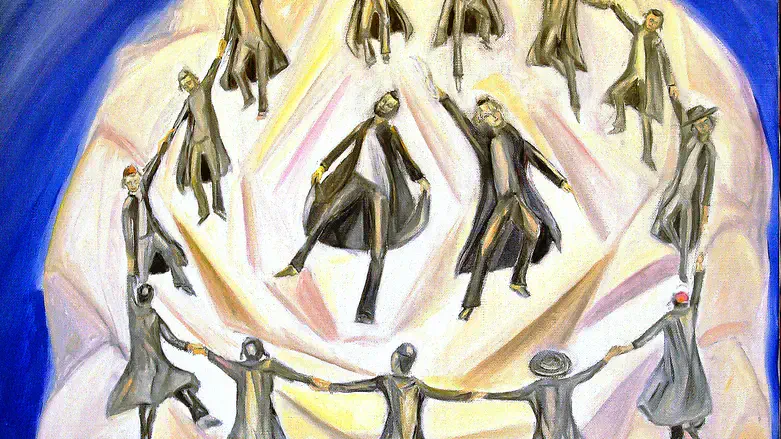
This was also an absolute direct comment on what we had seen the night before at the Shabbat dinner in Jurmala, when many people celebrated their Jewishness in the warm, quiet and beautiful way, literally from the bottom of their hearts and with the lights in their eyes coming from generations of belonging and devotion, quiet and innermost.
I was - and still am - stunned on the timing of the phrases that appeared in front of me without my effort to search for anything in this particular connection. Not only did the phrases convey the essence of Jewish belonging and an immense understanding of it, but they were also said by the Rebbe, whose schluhim organised the Shabbes dinner in Juramala, said about all schluhim all over the world as they were speaking, mentioning and citing during the dinner, but not the phrases that arrived on my screen by the only trajectory possible in such purely miraculous instances.
Plus - the phrases were from the Rebbe’s last public address. What a grace. And what a message.
Full Moon after Tu b’Av: Uniqueness of Affirmity
And then I remembered that unusual moon that we saw while returning from the Shabbat dinner. It was shining especially powerfully, and I started to make the calculations, in a backward motion. That moon was the July full moon, which is known as a Thunder Moon referring to possible summer thunder storms that routinely occur around the time.
At the same time, it was the full moon after Tu b’Av, which is special in the understanding of Judaism, as it comes from several weighty sources.
There is the phrase in the Talmud, and the similar one in Mishnah that states: “The greatness of Tu b’Av is that it coincides with the full-moon" -without any further explanations .
Why is that? - I was pondering.
The annual Jewish holiday cycle ordinarily has at least six important holidays that fall on the 15th of the corresponding month, including Pesach. So why is Tu b'Av different from all of them, more intense in its message? Uncharacteristically, neither the Talmud or Mishna explains this emphatic statement.
What we know, thanks to the great and very long Jewish astronomic tradition, including the knowledge and works of the luminous representatives of my paternal family from Toledo, all of them distinguished doctors , physical scientists and astronomers there, before the Bujanover family, escaping the fierce anti-Jewish prosecutions, moved first to the Netherlands, then to Austria (with part of the family left, thriving there until the 1930s, with terrible consequences thereafter ), and further on to Lithuania before some part of it eventually came to Ukraine. We know a general astronomic fact that the moon gathers its full luminescent potency by 15th of every month according to Jewish lunar calendar.
From this perspective, there is no surprise - when you learn the fact - that as many as six major Jewish holidays fall on the 15th of various months during an annual circle.
But it does not end there. There is another explicit mention in both the Talmud and Mishnah stating that “ Tu b’Av more than any festival captures the essence of the full moon’. Quite an important statement, from the Judaic point of view, and again, it comes with no explanations, quite uncharacteristically so.
It was quite a puzzle to crack. But the reward came after an intense search through the major Judaic sources that provide the information on Jewish knowledge of astronomy, one of my favourite disciplines, along with pharmaceutical science, medicine, archaeology and history. All my life I have had a strong inclination to all of them, following my both maternal and paternal families' traditions.
According to the knowledge, during an annual lunar circle, the full moon that appears in the middle of the Jewish month of Av is the one that appears after the period of the most intense darkness preceding it. This is a unique phenomenon every given year.
This unique phenomenon explains why both the Talmud and Mishnah mention the unique characteristics of the post Tu b’Av full moon, but perhaps yet more significantly, it explains the spiritual mechanism and the logic of this once-in-the-year moment of the most powerful, annual intensity of light that comes after the period of the most intense darkness preceding it. And from that perspective, it is also understandable otherwise inexplicable mentioning in the Talmud and Mishnah that Tu b’Av along with Yom Kippur does have a special strength and status among Jewish annual holidays.
In a disarming heartfulness of Jewish understanding of life, this revelation of the power of light occurs immediately after none of the other important Jewish dates in our annual calendar but Tu b’Av, the day of love which, in its turn, is the annual day of meaningful, deep consolation for us all six days after traditionally psychologically demanding Three Weeks of reflection and sorrow between the Seventeenth of Tammuz and Tisha b’Av. Indeed, the period of the most intense darkness for Jewish people for many generations, not only historically and psychologically, but also astronomically, literally, as it happens.
Moreover, in an amazing design from the High, even the period of six days between the end of the period of the most intense darkness and the appearance of the brightest of the full moons in the Jewish calendars does not leave anything to chance. According to an astronomic knowledge, the period of six days - and nights - is the time when the moon’s phase during the period, in the month of Av, a summer period of July or August, stabilises gradually but surely, with its switch from the invisible period of darkness to the most steady period of a full moon which gets to its affirmed position.
The Gift of Light: Consolation, Balance and Harmony of Love
There is a reason that the first Shabbat after the Tisha b’Av is known in the Jewish tradition as the Shabbat of Consolation. There are many reasons and ways to explain it and to see the healthy process of balancing the psychologically demanding period of the Three Weeks with the beginning of the process and the enlightened time of consolation after its ending.
What’s more, the Jewish tradition also has an option of starting to say the blessing for a sweet New Year six weeks before its arrival - which coincides with the first Shabbat after the Tisha b’Av which was truly quite a special Shabbes for all lucky us, over sixty people from over ten countries who happened to be at this meaningful Shabbat in our Jewish year in Jurmala this year.
We all were blessed with a comforting, gentle and friendly gathering. We all were united through the message of light which was shining extraordinarily from that unique post-Tu b’Av full moon. We all were embraced by the wisdom, understanding and that incredible vision of the Rebbe conveyed in the warm way by his schluhim who bear his message through generations.
It all has made so many people from all different countries with their Jewish hearts - and their Jewish essence, in the wise words of the Rebbe - to hear this music, to perceive the quiet but steady and unwavering melody of light. And to live by it.