
Leo Pearlmanis a London based producer and a loud and proud Zionist. His recent film about the Oct 7 Nova Music Festival massacre, ‘We Will Dance Again’ won the 2025 Emmy of the 46th Annual News & Documentary Awards for most ‘Outstanding Current Affairs Documentary’.
This week, the Community Security Trust published its latest figures on antisemitism in Britain.
The report makes for sobering reading. Nearly two thousand antisemitic incidents were recorded in just the first six months of 2026. Every statistic represents a Jewish person abused, threatened or attacked simply because they were Jewish.
Reports like these are incredibly important, the CST does that work on behalf of all of us. Every incident deserves to be recorded, every victim deserves to be heard and every act of hatred deserves to be challenged. Behind every statistic is a person, a family or a community, and those numbers must always be humanised, but their sheer volume alone speaks to the scale of the challenge now facing British Jewry.
Perhaps most tellingly, this latest increase has come during a period of relative calm in the conflicts so often invoked to explain, if not excuse, spikes in antisemitism. A ceasefire remains in place with Hamas and direct hostilities between Israel and Iran have subsided, yet attacks on British Jews have risen regardless. It is becoming increasingly difficult to maintain the fiction that antisemitism simply ebbs and flows with events in the Middle East. Something far more troubling, far older and indeed more recognisable has taken root here at home.
But there is another danger, perhaps just as great, that if we spend too long reading about those who hate Jews, we begin to believe that hatred is the defining feature of Jewish life.
It isn’t.
One of the great gifts of Shabbat is perspective. It reminds us that whilst antisemitism demands our attention, it must never become the author of our story. Antisemitism may describe what others choose to do to us, it does not describe who we are, how we live or what we contribute.
The Jewish story has never belonged to those who tried to end it. Empires have conquered us, kingdoms have expelled us, terrorists have murdered us and antisemites have spent centuries trying to make us smaller, quieter or disappear altogether and still we are here.
Survival alone has never been the Jewish response, we did not endure simply to endure. Again and again, confronted by those determined to destroy, exclude or diminish us, we answered by creating something greater than what they sought to take away. We rebuilt, returned, discovered, contributed, created.
They tried to make the Jewish story smaller, our response was to make our contribution to the world even greater, even larger, even louder.
This Shabbat I thought of those who refuse to allow hatred to define them, who choose pride over fear, bridges over division and creation over destruction. To those who remind us that whilst others may seek to write the Jewish story through what they do to us, its defining chapters will always be written by what we continue to do despite them.
Dor Turgeman, reminding us that dignity is often the strongest answer to hatred.
This week, the young Israeli footballer was subjected to antisemitic abuse from the stands during an MLS match.
Sadly, this sort of abuse no longer feels remarkable. Over the past year, sport has become one of the most performative stages for antisemitism. Throughout the World Cup we watched football, perhaps the world’s greatest unifying force, repeatedly hijacked by conspiracy theories, antisemitic chants and political hatred directed at Jews and Israel alike.
Hatred rarely remains confined to politics, eventually it finds every stage willing to host it. Against that backdrop, perhaps it was inevitable that even an ordinary league fixture would become another opportunity for abuse.
Dor Turgeman couldn’t silence the crowd or change the minds of those shouting abuse. What he could control was what happened next on the pitch. So he scored, and then celebrated proudly and unapologetically in front of those who had spent the evening hating him simply for who he was.
There is something wonderfully Jewish about that response. Not because success somehow erases hatred, but because refusing to allow hatred to dictate your future, your performance or your success has always been one of the defining characteristics of Jewish history.
The hatred didn’t disappear when he scored, in fact, his goal forced it further into the light. By scoring, celebrating and refusing to shrink from those abusing him, Dor ensured that their racism could not remain anonymous background noise from the stands.
They wanted him to feel ashamed of who he was, instead, he made sure the world saw exactly who they were. One young Jewish man, confronted by hatred, refusing to make himself smaller because of it. Sometimes, that is the perfect response.
Kol Hakavod (kudos) to Dor Turgeman and all those who refuse to let other people write their story.
The Israeli forward Dor Turgeman after scoring against CF Montreal
Kol Hakavod (kudos) to the young athletes competing at the JCC Maccabi Games in Toronto, for reminding us that Jewish pride is itself an act of resilience.
What Dor demonstrated as an individual, thousands of young Jews demonstrated collectively in Toronto. For the first time in more than forty years, Canada hosted the JCC Maccabi Games. There was a time when that would have been little more than a sporting story, but today it feels like something much bigger.
Over the past two years, Canada has witnessed one of the most alarming surges in antisemitism anywhere in the Jewish diaspora. Jewish schools have been shot at, synagogues have been firebombed, community centres have been attacked and university campuses have become increasingly hostile for Jewish students. For many Canadian Jews, openly displaying their identity no longer feels safe.
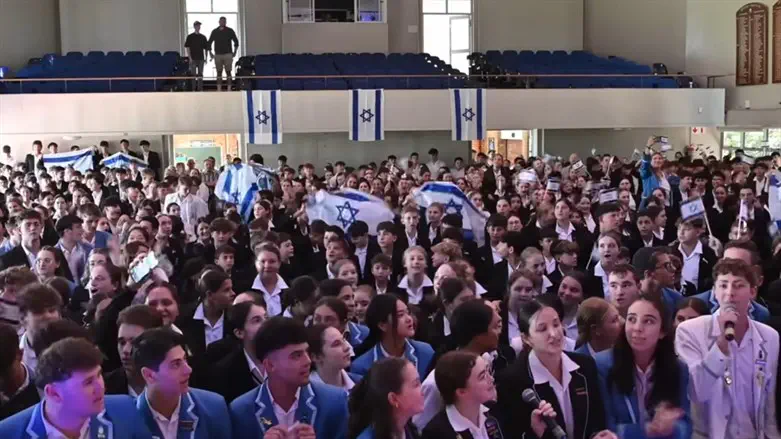
Yet this week, more than 1,600 Jewish teenagers from North America, Israel and across the world gathered in Toronto to do exactly the opposite of what hatred demands. They gathered openly, they competed proudly, they celebrated being Jewish without apology.
For many of those teenagers, this was the only week of the year when they weren’t the only Jewish pupil in their school or the only Jewish player on their team. This was their moment to share with other Jews, to be part of something far greater than themselves, a moment to inspire and to be inspired.
The Maccabi Torch, crafted from thousands of hostage-awareness tags and pins, captured the spirit of the Games perfectly. It transformed symbols of pain into a symbol of unity, a journey that global Jewry has been on since October 7th 2023, never better encapsulated than by this enduring symbol of light.
Pain transformed into pride, fear answered with joy, isolation answered with community. At precisely the moment when hatred tells Jewish children to hide, thousands chose instead to be seen. That too is the response.
Kol hakavod to every single one of the young competitors at the JCC Maccabi Games and to an entire generation being inspired to choose pride over fear.
JCC Maccabi Games 2026 opening ceremony
Kol Hakavod to Dr. Reda Mansour, for reminding us that the strongest answer to prejudice is often an invitation.
From an individual refusing to hide, to a community refusing to retreat, sometimes the response is broader still, to invite those who have judged you to see the reality for themselves.
Following Hackney Council’s decision to end its fifty-eight-year twinning arrangement with Haifa, many expected anger. Instead, Dr. Reda Mansour offered something far more powerful, an invitation.
“Come over, meet us, see what we’re doing."
As an Israeli Druze diplomat and senior leader at the Technionin Haifa, he challenged Hackney’s leaders to look beyond slogans and see the reality of one of Israel’s most remarkable cities. A city where Jews, Muslims, Christians and Druze study together. Where around a quarter of Technion’s students are Arab Israelis. Where many of those students, particularly women, are the first in their families to study engineering or computer science before going on to work at global companies.
His argument was beautifully simple, that if you genuinely care about coexistence, come and learn from one of the places trying to make it work. Sadly, and perhaps inevitably, they didn’t come.
As far as anyone can tell, not a single councillor accepted the invitation. Not one travelled to Haifa, not one chose to see the city they had already decided to condemn. Instead, they proceeded with severing the relationship anyway.
There is a lesson in that, and it is one those who display such naked prejudice would do well to heed. Prejudice is rarely strengthened by evidence because it is rarely built upon evidence in the first place.
Dr. Mansour responded with curiosity, Hackney responded with certainty. The kind of certainty that appears unwilling to risk deeply ingrained assumptions being challenged by realities that might not fit the worldview through which Israel has already been judged.
Bridges are always built by people prepared to cross them, sadly in this case, only one side appeared willing to take the first step. Yet still the invitation was extended, still the door remained open, still the bridge was offered. That too is the response.
Kol Hakavod to Dr. Mansour and to all those who continue extending a hand, even when others refuse to take it.
and
Kol Hakavod to Dr. Zechariah Haber ז"ל, whose greatest legacy may be feeding people he would never live to meet.
Perhaps the greatest response of all is to reach a point where those who hate us cease to be relevant to the story and that is what this final example seeks to recognise.
Dr. Zechariah Haber was a husband, a father of three, an IDF reservist and an extraordinary scientist. There is a profound irony that whilst Hamas devoted itself to destroying life, one of the Israeli soldiers who fought against them had already devoted his own life to sustaining it.
During his doctoral research at Tel Aviv University, he identified the gene responsible for controlling wheat seed size. Building upon his work, researchers have developed wheat with larger, more nutritious and more resilient grains, a breakthrough that could help feed millions as climate change and population growth place increasing pressure on the world’s food supply.
When October 7th arrived, despite being ill, he packed his equipment and immediately reported to his reserve unit. He served until he was killed in action in northern Gaza on January 16, 2024. Months later, Tel Aviv University posthumously awarded him the doctorate he had earned.
Some people leave behind memories, some leave behind knowledge, Dr. Haber left behind both. Knowledge that could improve countless lives long after his own was taken.
Hamas sought to leave behind death, Dr. Haber left behind life. One legacy ends with those it killed, the other may one day be measured by those it feeds. Perhaps that is no longer simply a response to hatred at all, it is something much greater.
It is the Jewish insistence that whatever is done to us, we will continue trying to leave the world better than we found it.
Our respect goes to Dr. Haber, a man whose service to Israel may one day become a gift to humanity.
Zechariah Haber, left, with his wife, Talia
The CST report tells us something deeply troubling about Britain. These four stories tell us something far more enduring about the Jewish people.
When hatred enters the stands, a footballer refuses to shrink from it and instead shines a light on those abusing him. When Jewish teenagers are made to feel increasingly unwelcome, thousands gather to celebrate their identity with pride. When politicians sever bridges between communities, an Israeli Druze academic continues offering to rebuild them. When terrorists dedicate themselves to taking life, a Jewish scientist leaves behind knowledge that may one day sustain millions.
Each, in their own way, is a response, but perhaps that is not quite the point. We cannot allow Judaism to simply be a response to antisemitism. Jewish identity cannot be defined by the people who hate Jews any more than Israel can be defined by those who seek its destruction.
For thousands of years, our response to those trying to make the Jewish story smaller has been to make our contribution to the world larger. We built families when they tried to destroy them, communities when they expelled them, a country after centuries of exile. Universities, hospitals, businesses, art, science and still we build.
Antisemitism tells the story of what others choose to do to Jews, it does not tell the story of the Jews. That story is being written every day by people like Dor Turgeman, by thousands of Jewish teenagers in Toronto, by Dr. Reda Mansour and by Dr. Zechariah Haber.
That has been the Jewish response for thousands of years, but more importantly, it is who we are and perhaps that is the most important perspective Shabbat offers us. Not simply the strength to confront those who hate us, but the wisdom to remember that they have never had the power to define us.
This week, may we spend a little less time seeing ourselves through the eyes of those who hate the Jewish people, and a little more time celebrating those who show us who we really are.