
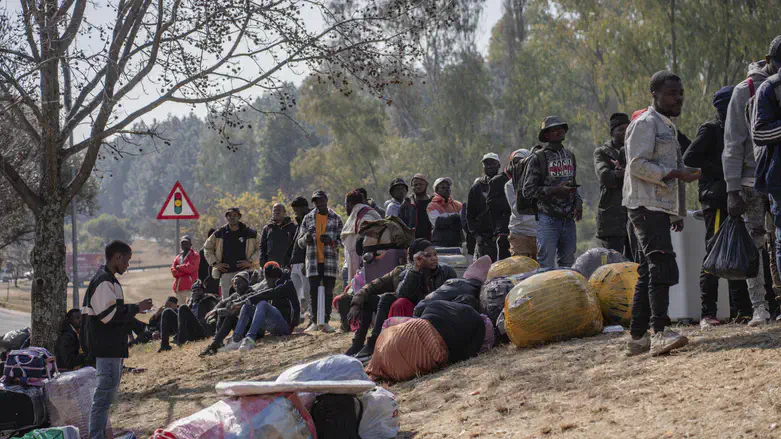
The latest immigration crisis centered on Spain is administratively connected to Europe, but geographically it is taking place in the Spanish enclaves of Ceuta and Melilla in northern Morocco, attorney Yonatan Jakubowicz, founder and director of the Israeli Immigration Policy Center, told Arutz Sheva-Israel National News.
Jakubowicz described the events as a mass incursion of migrants, primarily from Morocco, into territory considered part of the European Union.
According to Jakubowicz, attempts to infiltrate the enclaves have occurred in the past, but never on the scale of the latest assault, in which tens of thousands of illegal migrants attempted to enter. Previously, he said, the numbers involved were in the hundreds or low thousands, with only some managing to enter and remain in the territory.
Jakubowicz argued that the main factor driving the phenomenon is Spanish immigration policy, which he said allows illegal migrants to obtain residency and eventually gain the ability to integrate into EU countries.
"The main reason is Spain's almost crazy policy of granting residency, which allows people in the future to move to Europe, obtain employment there, and eventually receive permanent status in the European Union," he said.
He added that the very understanding that Spain is carrying out what amounts to mass legalization of illegal migrants serves as a significant incentive for continued immigration.
Jakubowicz noted that Spain's policy has led Italy and other countries to call for a freeze on the open-border agreement with Spain, although he said it remains unclear whether such a move will actually be implemented.
He said frustration with Spanish policy is growing across Europe, particularly at a time when many countries on the continent are tightening their immigration policies.
Regarding the Spanish government's motivations, Jakubowicz said the decision is difficult to explain and raised several possible factors, including political considerations, while stressing that these remain speculation.
Addressing developments inside Spain, he said that clashes between residents and migrants were reported in the Ceuta enclave, while Spain itself has not seen reports of protests similar to those taking place in England. According to him, differences in the composition of migrant populations between the countries may explain part of the gap in public tensions.
In conclusion, Jakubowicz warned that Europe may wake up too late, when returning migrants to their countries of origin becomes nearly impossible.
"Europeans do not know how to stop the problem, and in some cases there is already no way to prevent it without a severe violent incident. This is the main lesson Israel should learn: prevent the problem before reaching that point. It does not take very large numbers of migrants for the situation to become extremely difficult to stop," he said.