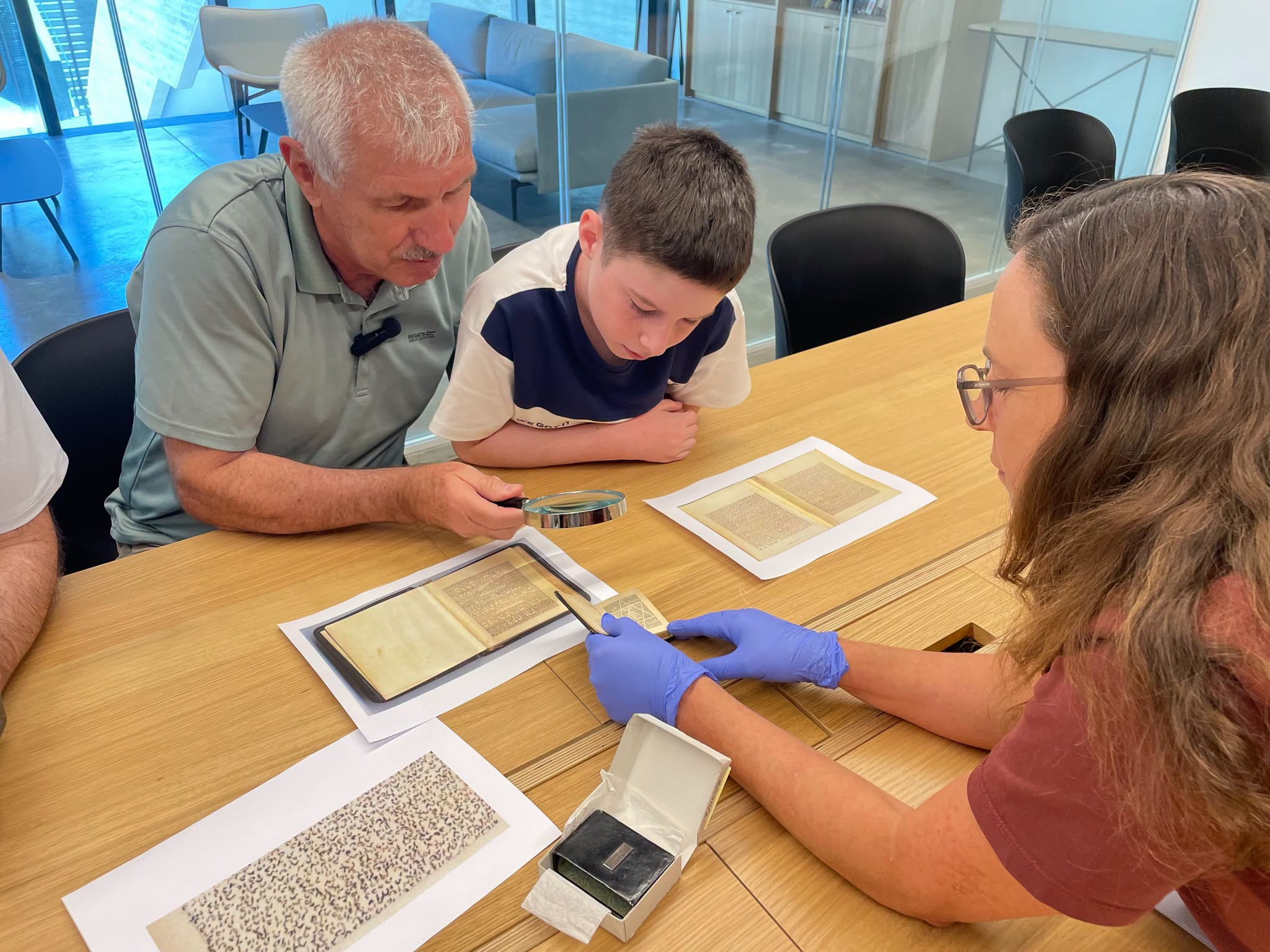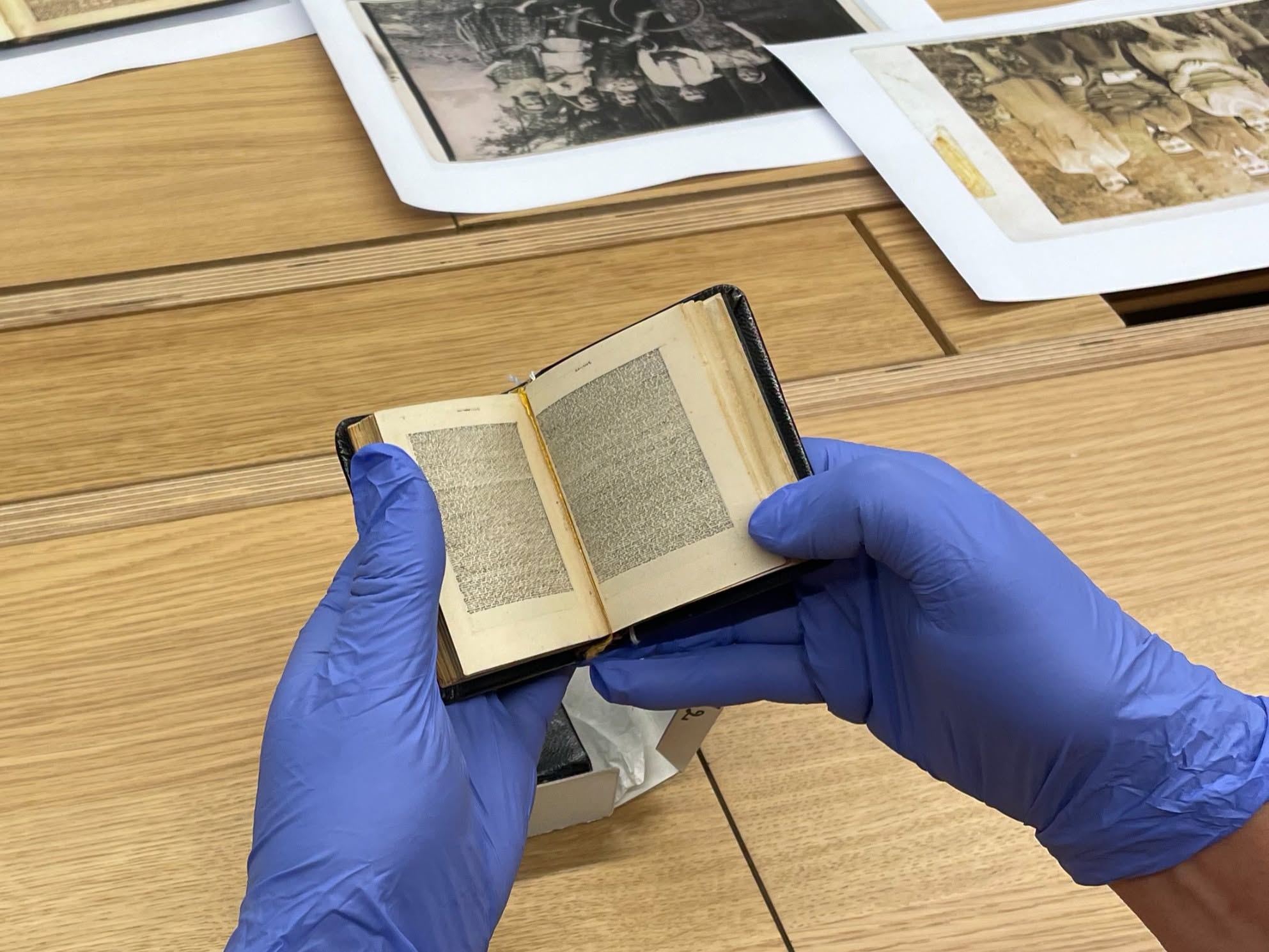
A moving family reunion recently took place at Yad Vashem, where the son, grandson and great-grandson of Holocaust survivor Shlomo Kanobol viewed the extraordinary miniature Bible he painstakingly wrote while imprisoned in the Łódź Ghetto.
The matchbox-sized Bible, written entirely in micrographic script over the course of nearly three years, is one of the unique artifacts preserved in Yad Vashem's collections. Kanobol, who lived in the ghetto with his wife, Shifra, and their young son, Chaim Alter, worked in a factory producing military boots. During his scarce free time, he devoted himself to writing the Bible in tiny script in a corner of their home, using ink purchased with the family's bread ration. Their toddler proudly told others, "My father writes a Bible."
Kanobol completed the work in 1943, binding it into an 85-page volume that also featured intricate micrographic illustrations, including a portrait of Łódź Ghetto Judenrat leader Chaim Rumkowski composed entirely of miniature Bible verses. He later presented the book to Rumkowski as a gift.
The family's first son was murdered during the Holocaust, but Shlomo and Shifra survived the war and later had another child. After immigrating to Israel in 1972, Kanobol believed the tiny Bible had been lost forever.
Following the liberation, Holocaust survivor Bella Bialik returned to the Łódź Ghetto and discovered the miniature Bible alongside a small folding menorah. She donated both items to Yad Vashem in 1983, although the identity of the Bible's creator was unknown at the time.
A year later, after the artifacts were presented at a conference for Łódź Ghetto survivors, Yad Vashem received a phone call identifying Kanobol as the author. Forty-one years after handing over the Bible, he was reunited with the remarkable work, an emotional moment documented by Israeli television in 1984.
Earlier this month, three generations of the Kanobol family visited Yad Vashem ahead of the bar mitzvah of Shlomo's great-grandson, allowing the younger members of the family to see the Bible for the first time.
"We came to Yad Vashem ahead of the bar mitzvah of the great-grandson, and the encounter with the Bible, and, in essence, with the family story, completed a circle," said Avi Kanobol, Shlomo's son. "The younger generation knew the story only in broad terms, but seeing the Bible itself moved everyone deeply."