
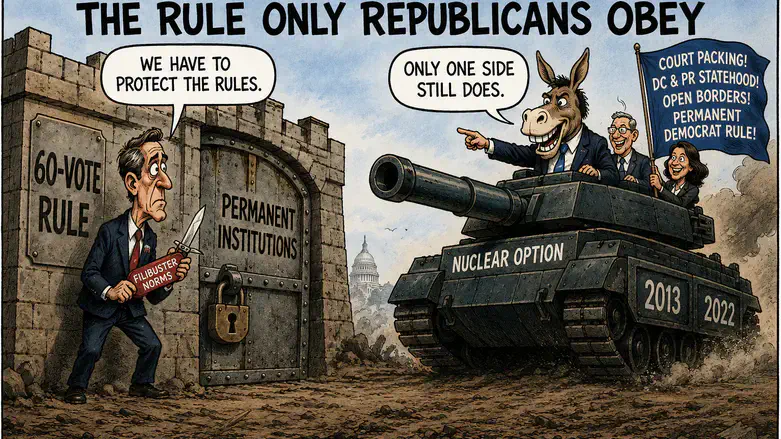
In March, the United States Senate spent three days debating the SAVE America Act and then stopped. The bill had cleared the House of Representatives on February 11 by a vote of 218 to 213, with exactly one Democrat, Henry Cuellar of Texas, crossing the aisle. In the Senate it needed sixty votes to proceed. Republicans hold fifty-three seats. No Democrats volunteered to buck the party line. By May, Majority Leader John Thune had quietly shelved the bill rather than schedule further votes, and by June he was explaining on Fox News that the only route to passage runs through eliminating the legislative filibuster, which he described as something his conference is nowhere close to having the votes to do.
That sentence deserves a second reading, because it is not a statement about Democrats. It is a statement about Republicans. Thune was not saying the opposition is too strong. He was saying that his own members will not do the one thing that would prevent the opposition from a possible permanent seizure of congressional power in the near future. The obstacle is not the Democratic caucus. The obstacle is a Senate rule that Republicans have chosen to treat as a commandment given at Sinai, and that Democrats have already demonstrated, on the record and more than once, they regard as a temporary inconvenience.
The standard defense of Republican restraint is that the filibuster is a load-bearing wall of the American constitutional order and that tearing it out would be an act of vandalism. There is a serious argument buried in there, and I will come back to it. But the argument only works if both parties are bound by the same restraint. The historical record on that question is not ambiguous and the evidence is not speculative.
In November 2013, Democrat Majority Leader Harry Reid eliminated the filibuster for executive branch and lower court judicial nominees, using the parliamentary maneuver that everyone now calls the nuclear option. He did it because he wanted President Obama's appointees confirmed and Republicans were blocking them. Republicans warned him he would regret it. He did it anyway. In 2017, Republican Mitch McConnell extended the same rule to Supreme Court nominees in order to seat Neil Gorsuch, which is the step conservatives now cite as proof that both sides play this game. McConnell was walking through a door Reid had already kicked open.
Then came January 2022, and this is the episode that ought to end the debate. Senate Democrats, holding fifty seats and the vice president's tiebreaker, attempted to carve out an exception to the legislative filibuster specifically for voting legislation. Not for judges. Not for nominees. For election law, which is the exact category of legislation now at issue. The attempt failed by a vote of forty-eight to fifty-two, and it failed for one reason only: Joe Manchin and Kyrsten Sinema refused. Every other Democratic senator voted yes. Both of those renegade senators are now gone from the chamber.
So the question facing Senate Republicans is not whether Democrats might someday abolish the legislative filibuster to pass election legislation. Democrats already tried, four years ago, and came two votes short. The next Democratic majority will not have Manchin and Sinema to restrain it. Republicans are preserving a rule that the other side has publicly attempted to destroy, and they are preserving it on the theory that their forbearance will somehow be reciprocated by people who have already announced, by recorded vote, that it will not be.
What the arithmetic actually protects
It is worth being concrete about what sits behind that door. The Judiciary Act of 2021 would have expanded the Supreme Court from nine justices to thirteen. It went nowhere, not because it was unpopular within the Democratic caucus but because sixty votes were unreachable. House Democrats passed District of Columbia statehood in 2021, which would deliver two permanent Democratic senators, and Puerto Rico statehood has been a live proposal for years, which would likely deliver two more. Every one of these requires only a simple majority in a Senate without a filibuster. None of them can be undone afterward. You cannot unpack a court. You cannot un-admit a state.
This is the structural point that makes the current Republican posture so difficult to defend on its own terms. The filibuster is not a mutual security arrangement. It is a unilateral restraint that binds whichever party currently believes in it. Republicans are treating it as an insurance policy against a future Democratic majority, when the plain reading of 2013 and 2022 is that a future Democratic majority will cancel the policy the morning it takes office and then use its newly unrestrained majority to make future Republican majorities arithmetically impossible.
The honest counterargument, and why it fails
Thune and the members who agree with him are not fools, and their position is not merely cowardice. Their argument runs like this: the filibuster has in fact blocked court expansion, it has in fact blocked the addition of new states, it has in fact killed the sweeping federal election bills Democrats have pushed since 2019. The restraint has produced results. Abandoning it now, to pass one bill in one Congress, would trade a durable defensive asset for a temporary offensive gain. There is also the uncomfortable internal politics, in which several Republicans have acknowledged privately and a few publicly, that the SAVE America Act as currently drafted has been a political liability for the party rather than an asset.
The answer to this is not that the counterargument is stupid. The answer is that it assumes a symmetry that does not exist. A shield only protects you if your opponent has agreed to respect it. When one side treats a procedural norm as sacred and the other treats it as an obstacle to be removed at the first opportunity, the norm has stopped functioning as a norm. It has become a handicap that one team has voluntarily and naively accepted and the other has discarded with Machiavellian abandon. Republicans are not maintaining a mutual arrangement. They are unilaterally observing a ceasefire the other party stopped observing in 2013.
Why Israelis should recognize this immediately
Anyone who has followed the Israeli judicial argument for the past three decades knows this pattern in their bones. We watched a Supreme Court expand its own jurisdiction, invent standing where none existed, and read the subjectivie word "reasonableness" into an unlimited veto over elected government, while the political right spent years insisting that the proper response was to respect institutional norms and win the next election. We were told that restraint was statesmanship. We were told that fighting back would damage the institutions. And we discovered, slowly and expensively, that institutional norms are only norms when they are enforced against everyone, and that a rule which binds only the people who believe in it is not a rule at all. It is a strategy, and it belongs to whoever is willing to break it.
There is a version of the SAVE America Act debate that is genuinely about the merits, about whether documentary proof of citizenship imposes real burdens on real voters, about whether a system that has built no serious mechanism to detect noncitizen registration can credibly announce that it has found nothing. Those are arguments worth having, and the bill's supporters would be better served by making the verification case cleanly rather than reaching for numbers they cannot substantiate.
But that is not the argument the Senate is having. The Senate is having an argument about whether Republicans are willing to use power they possess to prevent an outcome they claim to fear. So far the answer is no.
They should understand what they are actually preserving. It is not the filibuster. It is their own reputation for being the party that lost gracefully and handed the Democrats a path to a permanent legislative and judicial majority on a silver platter.
Daniel Winston is an American-Israeli therapist, lecturer and author. He volunteers in the IDF reserves, as an MDA medic, in ZAKA, and in the Israel Police Search and Rescue Team.