

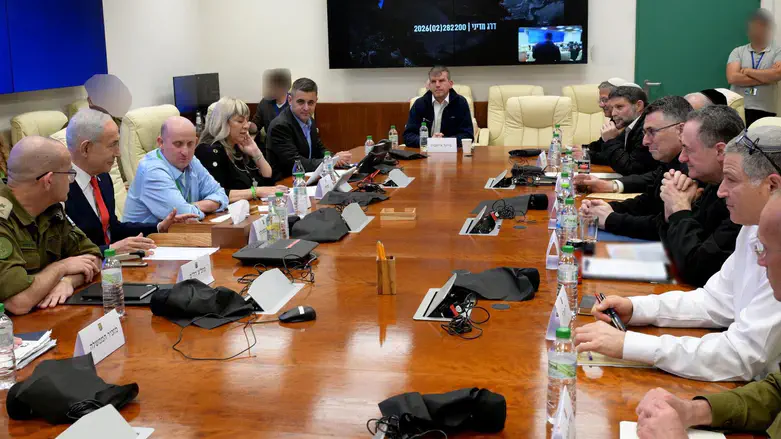
In a major step toward regulating the civilian administration of the Gaza Strip, the Security Cabinet has granted authorization to the Board of Peace to enter the enclave. National Security Minister Itamar Ben-Gvir (Otzma Yehudit) opposed the decision, while Finance Minister Bezalel Smotrich (Religious Zionists) voted in support of it.
The decision grants the board a special status and expresses official Israeli approval of the experimental pilot, which will see the rehabilitation of vital services, the transfer of humanitarian aid, and the creation of a shelter facility in areas cut off from Hamas control.
The first stage of the plan is expected to be implemented in the Rafah sector. As part of the framework, temporary housing facilities will be established for the local residents. To prevent the infiltration of terrorist entities, it was determined that every resident who wishes to move to these areas would be required to undergo strict inspection and vetting processes designed to ensure the applicant has no affiliation with Hamas.
The area will be taken over by the Palestinian Arab technocratic National Committee for the Administration of Gaza, which will lead its civilian management. The civilian activity will receive defense backing by the International Stabilization Force, which is currently being established and is expected to consist of military forces from several countries.
A senior Israeli diplomatic official clarified that the principle of approving the entry of the International Stabilization Force (ISF) into the Gaza Strip was established under President Donald Trump's 20-point plan, which led to the release of all the hostages.
He stressed that Israel insists on the principle that the IDF will continue to hold the Yellow Line, and there will be no withdrawal as long as Hamas has not been completely disarmed and the Gaza Strip has not been fully demilitarized.
The official explained that “the Security Cabinet today approved granting immunity to the ISF under the Immunities for International Organizations Law. The force will operate in full coordination with the IDF in areas beyond the Yellow Line that are not under IDF control."
“In practice, the deployment of any ISF personnel will require the specific approval of the prime minister, the defense minister, and the foreign minister," he added.
He noted that the cabinet also decided that Israel will determine which countries are permitted to contribute forces. Only countries that have peace agreements with Israel and do not act against the State of Israel or its officials in the international arena will be eligible. At this stage, the force is expected to consist of approximately 200 personnel from friendly countries such as Uganda and Morocco."