
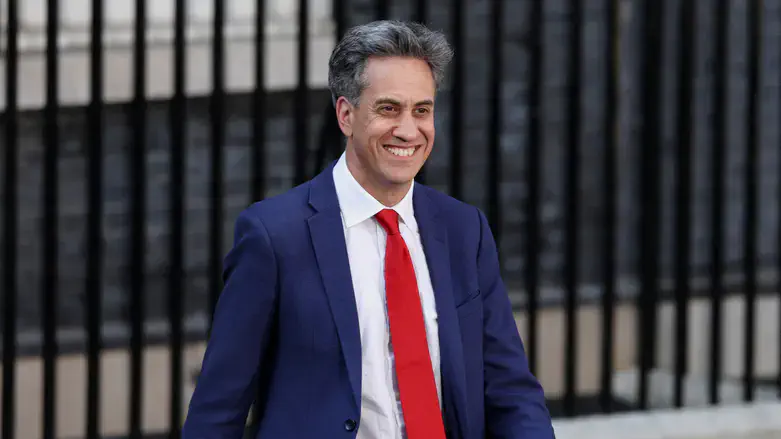
Andy Burnham’s first major foreign policy appointment tells us a great deal about the direction of his government.
By appointing Ed Miliband as Britain’s new Foreign Secretary, he has chosen a politician with little direct diplomatic experience but with long-held and deeply entrenched views on one issue above almost any other, Israel and the wider Middle East.
Throughout his political career, Miliband has consistently adopted a more critical position on Israel than many of his predecessors. As Labour leader he described Israel’s actions during the 2014 Gaza conflict as “wrong and unjustifiable", led Labour’s support for the symbolic recognition of a Palestinian Arab state and repeatedly argued that Britain should take a harder line towards successive Israeli governments.
He is perfectly entitled to those views on Israel. Less so, perhaps, his decision to whip Labour MPs against action by David Cameron's government after Syrian dictator Bashar al-Assad used sarin gas to murder 1,400 civilians. But his appointment raises a far more important question than whether one agrees with either position.
What if some of the assumptions upon which those views on Israel and much of Britain’s wider political debate, have been built are beginning to unravel?
Foreign policy should never be built upon ideology, it should be built upon evidence and evidence has an awkward habit of changing.
Every journalist understands the principle. If you publish something that later proves to be wrong, you issue a correction. Sometimes that means a clarification, sometimes an apology, sometimes a full retraction.
The theory is simple, truth matters more than ego. The problem, of course, is that almost nobody remembers the correction. Millions remember the headline, very few remember the retraction. The damage has already been done.
Over the past three years something even more troubling has happened. When it comes to Israel, the evidence has begun to change, the narrative hasn’t. We never see the retraction or the clarification, we certainly never see the apology.
Since 7th October, four accusations have come to dominate almost every discussion about Israel.
-Genocide
-Starvation
-The deliberate targeting of journalists
-The deliberate targeting of hospitals and doctors
These were never merely allegations. They became the moral architecture through which much of the world came to understand this war.
Genocide transformed Israel into the modern equivalent of Nazi Germany. Starvation portrayed it as a state deliberately killing babies through hunger. The targeting of journalists suggested it was murdering those exposing its crimes. The targeting of hospitals depicted a military that had abandoned every recognised boundary of civilisation.
Together, these four accusations did something far more profound than criticise Israeli conduct, they redefined Israel’s identity. Once Israel became uniquely evil, everything else became easier.
Diplomatic isolation, sanctions, boycotts, campus occupations, corporate divestment and, increasingly, violence not simply towards Israelis or Zionists but, in far too many cases, Jews themselves.
Not because every critic of Israel is antisemitic, but because once Israel had been recast as the embodiment of absolute evil, opposition to Israel increasingly ceased to be viewed as political disagreement and became a moral obligation.
These four accusations became the foundation upon which governments, institutions and millions of ordinary people built their understanding of the war. If that foundation is beginning to crack, surely we have a duty to revisit the conclusions built upon it.
Genocide
No accusation has shaped this conflict more profoundly than genocide. Not simply because it is the gravest allegation recognised under international law, but because of where the word came from.
Raphael Lemkin coined the term after the Holocaust because existing language proved incapable of describing the systematic destruction of European Jewry. The murder of six million Jews required a new word, that history is not incidental. It is precisely why attaching that word to the world’s only Jewish state carries such extraordinary moral force.
One of the defining characteristics of modern antisemitism is not only Holocaust denial, but Holocaust inversion. The moral vocabulary created to describe history’s greatest crime against the Jewish people is turned back upon the Jewish people themselves.
The victim becomes the perpetrator, the Jew becomes the Nazi, the Jewish state becomes the Third Reich.
That is why those determined to demonise Israel have fought so hard to attach this particular word to this particular conflict. The accusation moved from legal argument to accepted truth with astonishing speed.
29th December 2023, South Africa files proceedings against Israel at the International Court of Justice alleging genocide. Within hours the headlines had escaped the courtroom.
“South Africa launches genocide case against Israel."
“Is Israel committing genocide?"
“UN experts warn of genocide."
The ICJ did not rule that Israel was committing genocide, it ordered provisional measures while the case proceeded. Yet in the court of public opinion, the verdict had already been delivered, the accusation had become fact.
Throughout the war, Hamas’s Health Ministry consistently reported the total number of Gazans killed as somewhere between 70,000 and 80,000. Those figures were widely accepted internationally as a reasonable estimate of the overall death toll. What Hamas never did was distinguish civilians from combatants.
For almost three years, the world was presented with one number and invited to assume that almost everyone within it was an innocent civilian. Increasingly, Hamas itself has begun publishing the names of its own operatives killed during the war. Other terrorist organisations have done the same. The emerging picture points to many thousands of Hamas fighters among the dead, in fact, about two-thirds of them.
That does not diminish the tragedy of civilian deaths, nor does it answer every legal question surrounding Israel’s conduct. But it fundamentally weakens the simplistic argument that casualty figures alone somehow prove genocidal intent. The terrorist organisation whose statistics helped construct the accusation has itself begun producing evidence that complicates it.
The extraordinary irony is this, that the word created because the world failed the Jews has become the word used to convince the world that the Jews have become history’s greatest criminals.
Whether that accusation still withstands the evidence increasingly seems almost beside the point, the word has already done its work.
Starvation
The accusation of starvation followed a different path. Nobody denied that Gazans were suffering, the question was always why.
From the beginning, Israel and the United States argued that substantial quantities of humanitarian aid were entering Gaza but that Hamas was systematically stealing it, diverting it and controlling its distribution. Those claims were widely dismissed. Instead, the dominant narrative became that Israel was deliberately starving Gaza’s civilian population.
Then came one of the defining headlines of the war.
20th May 2025, Tom Fletcher, the United Nations’ humanitarian chief, told the BBC: “There are 14,000 babies that will die in the next 48 hours unless we can reach them."
Within hours the figure was everywhere. Celebrities such as Nicola Coughlan, Miss Rachel and Mark Ruffalo amplified it across their social media platforms, politicians repeated it in Parliament, hashtags sent the statement viral.
It became another exhibit in the case that Israel was committing crimes unlike any other democracy. Forty-eight hours passed, then another, the prediction never came to pass.
Priti Patel was among the very few senior British politicians to publicly challenge the misinformation and criticise its amplification, but then something even more significant happened.
July 2026, the United Nations itself publicly accused Hamas of obstructing humanitarian operations.
Its Deputy Special Coordinator, Ramiz Alakbarov, condemned Hamas for intimidating aid workers, assaulting truck drivers, forcing its way into World Food Programme facilities and disrupting the delivery of humanitarian aid.
These were not described as isolated incidents, they were described as an increasingly dangerous pattern. In other words, the United Nations had acknowledged the very mechanism Israel and the United States had described from the outset.
None of this diminishes the suffering of Gaza’s civilians. But it does fundamentally change the certainty with which the world was told there was only one explanation.
For almost three years Israel insisted Hamas was stealing aid, much of the world dismissed that claim as propaganda. Today, the United Nations is describing precisely that behaviour.
The story changed, public memory did not.
Journalists
Every journalist killed during war is a tragedy, but that was never the allegation. The allegation was that Israel was deliberately targeting journalists because they were journalists.
That accusation carried enormous moral force. It implied not only disregard for civilian life but a deliberate attempt to silence those documenting Israeli crimes. One case after another appeared to reinforce that narrative.
UNESCO condemned the killing of Mohammed Abu Huwaidi. International organisations mourned Ahmed Abu Eisha. The Committee to Protect Journalists added names to its database of journalists killed in Gaza.
Months later, another story emerged.
Palestinian Islamic Jihad identified Mohammed Abu Huwaidi not simply as a journalist, but as one of its operatives. Ahmed Abu Eisha was acknowledged as a commander within Islamic Jihad. Hamas identified Yaqoub al-Bursh as one of its military media operatives.
Following further evidence, the Committee to Protect Journalists quietly removed a number of names from its database after concluding that they had participated in combat or belonged to armed organisations.
Some of the most internationally cited examples used to support the accusation that Israel was deliberately targeting journalists turned out to involve members of armed terrorist organisations.
International humanitarian law does not grant combatants immunity because they also carry cameras. A journalist who is also a Hamas operative undoubtedly presents a difficult legal question. A headline that describes him only as a journalist presents a different problem altogether.
It doesn’t merely simplify reality, it changes it.
Hospitals and Doctors
Perhaps no images proved more powerful than hospitals, nor any individual more symbolic than a doctor. Hospitals became evidence that Israel had abandoned every moral restraint. Doctors became evidence that Israel criminalised medicine itself.
The detention of Dr Hussam Abu Safiya became one of the defining examples. Headlines described him as a hospital director, a doctor, a humanitarian. The United Nations declared his detention arbitrary.
Those facts are incomplete.
According to Hamas itself, Abu Safiya held the rank of colonel within Hamas’s Military Medical Services, while Israel alleges he was a senior Hamas operative.
Whether those allegations ultimately withstand judicial scrutiny is a matter for due process, but they fundamentally alter the picture presented to the world.
The question was never whether doctors deserve protection, of course they do. The question is whether membership of a terrorist organisation disappears because someone also practices medicine.
Similarly, hospitals enjoy extraordinary protection under international law, but those protections are not unconditional. When hospitals are used as command centres, weapons depots, military infrastructure or illegal prisons and torture chambers for hostages, the legal picture changes dramatically.
Hospitals deserve extraordinary protection under international law, so do doctors. Nobody serious disputes that, but those protections were never intended to shield military activity conducted behind humanitarian identities.
Throughout this war, evidence has repeatedly emerged of Hamas using hospitals in breach of international law. Reality proved considerably more complicated than the headlines suggested. The world was repeatedly invited to choose between two identities, doctor or Hamas, hospital or military base.
Reality refused to be that simple, headlines usually are.
When the Facts Change
This is not an argument that Israel has fought a perfect war. Thousands of civilians have died, mistakes have undoubtedly been made and every democracy should expect its military to face scrutiny. But scrutiny, certainty and pre-determination are not the same thing.
Each of these four stories is different. One concerns international law, one humanitarian aid, one journalism, one medicine. Yet they all expose the same uncomfortable pattern: initial certainty, later complexity, very little reassessment.
That should concern anyone who believes evidence, not ideology, should shape public opinion and foreign policy.
Yet almost nobody seems interested, because these were never simply newspaper stories. They became the foundations upon which governments built policy. They shaped parliamentary debates, they shaped public opinion and now, perhaps, the outlook of Britain’s new Foreign Secretary.
Democracies are supposed to revisit yesterday’s conclusions in light of today’s evidence. That is how science, medicine and justice works and it should be how foreign policy works too.
Which brings us back to Ed Miliband. As Britain’s new Foreign Secretary, he will help shape Britain’s response to one of the defining geopolitical issues of our time. He is entitled to reach whatever conclusions he believes the evidence supports, but the office he now holds demands something more than conviction. It demands intellectual humility.
Foreign policy cannot be built on headlines, it cannot be built on activist slogans and it cannot be built on assumptions that are never revisited when new evidence emerges. It has to be built on the fullest and most honest assessment of the facts available, however inconvenient they may prove to be.
This article was never really about four accusations, it was about something much deeper. It was about the moral operating system through which we process evidence.
If that operating system has already decided who is permanently victim and who is permanently villain, no amount of contradictory evidence will ever be enough. If a new fact reinforces the story, we amplify it. If it complicates the story, we explain it away.
The responsibility that now rests with Ed Milliband is not to defend yesterday’s narratives, it is to test them against today’s evidence. That is what serious government requires, because when a moral operating system becomes incapable of questioning its own assumptions, it stops evaluating evidence.
The evidence was never really on trial, only the conclusion was.