
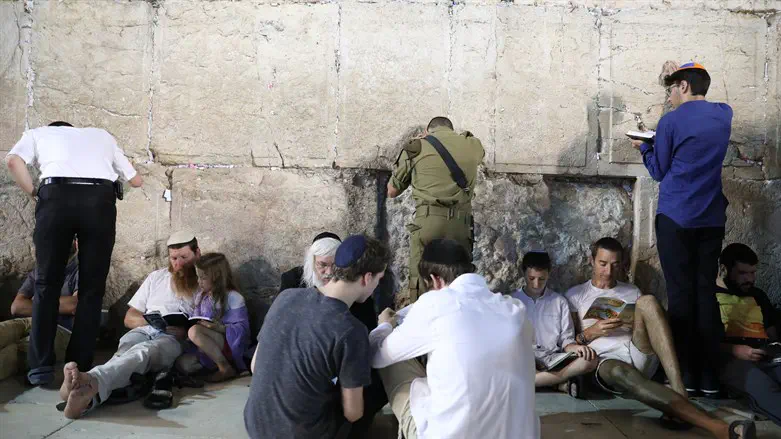
This Wednesday evening, Jews around the world will gather in synagogues, sit on the floor and mourn the destruction of Jerusalem.
For 25 hours, we will fast, recite the Book of Lamentations and contemplate the suffering that has accompanied our people throughout history.
Tisha B’Av is the saddest day on the Jewish calendar. And yet, Jewish law describes it in a manner that appears almost impossible to comprehend.
The Shulchan Aruch (Orach Chaim 559:4) rules that Tachanun, the penitential prayer normally recited on weekdays, is omitted on Tisha B’Av “because it is called a mo’ed," an appointed festival.
But how can this possibly be?
The term mo’ed evokes celebration, joy and closeness to G-d. How can the day on which both Temples were destroyed bear that designation?
Indeed, the list of calamities associated with Tisha B’Av is mind-numbing.
The Mishnah recounts five national tragedies on the ninth of Av. The generation of the Exodus accepted the Spies’ slander of the Land of Israel, prompting G-d to make it a night of weeping for generations.
Both Temples were destroyed on Tisha B’Av. Beitar, the final stronghold of the Bar Kochba revolt, fell to the Romans, and Jerusalem and the Temple Mount were subsequently plowed over, symbolizing the apparent obliteration of Jewish national life.
But the sorrow did not end in ancient times.
-On Tisha B’Av in 1290, King Edward I expelled the Jews of England.
-Two centuries later, the Jews of Spain were driven into exile in the days surrounding Tisha B’Av.
Don Isaac Abarbanel, the great Jewish philosopher and statesman expelled from Spain, saw the timing as anything but coincidental. He suggested that the king had been guided from Above to link another national catastrophe with the ninth of Av.
Other disasters clustered around the date as well.
-The Roman Ghetto was established in 1555.
-Germany entered World War I on the ninth of Av in 1914, unleashing a conflict that shattered European Jewry and helped create the conditions that led to the Holocaust.
-On Tisha B’Av in 1941, SS Commander Heinrich Himmler received authorization to carry out the Final Solution.
-A year later, mass deportations from the Warsaw Ghetto to Treblinka began during the same period.
-And on the day after Tisha B’Av in 2005, the Israeli government began uprooting more than 8,000 Jews from Gush Katif and northern Samaria. Twenty-one flourishing Jewish communities in Gaza were destroyed, their synagogues emptied and their families torn from their homes. The terrible consequences continue to reverberate until this very day.
Tisha B’Av therefore does not commemorate one tragedy. It is the focal point of Jewish national grief, the day on which the anguish of millennia seems to converge.
So why call it a mo’ed?
A mo’ed is not merely a holiday. It is an appointed encounter between G-d and the Jewish people.
Ordinarily, that encounter takes place through joy. On Passover, Shavuot and Sukkot, we celebrate G-d’s presence in history and His enduring covenant with us.
But there are other encounters as well.
Sometimes G-d is found not only in celebration but in absence, not only in revelation but in concealment, and not only in triumph but amid the ruins of destruction.
Tisha B’Av is a mo’ed because even on the day of our greatest suffering, the relationship between G-d and Israel was never severed.
The Temple was destroyed, but the Jewish people survived.
Jerusalem was razed, but it was never forgotten.
We were driven from country after country yet refused to disappear. We carried Jerusalem wherever we went, turning toward it in prayer and ending every Passover Seder with, “Next year in Jerusalem."
Our enemies repeatedly mistook destruction for finality. They assumed that by burning our sanctuaries, expelling our communities and scattering us across the earth, they could bring the Jewish story to an end.
They were wrong.
The survival of the Jewish people testifies that destruction was never the last chapter.
This is reflected in one of the most remarkable teachings of Jewish tradition: that the Messiah is born on Tisha B’Av.
It teaches that when destruction appears complete, the seeds of redemption have already been planted.
Even as the Temple burned, the possibility of rebuilding was born. Even as exile began, the path toward return was set in motion.
That is why the prophet Zechariah (8:19) declares that the fasts commemorating Jerusalem’s destruction will one day become “joy and gladness and cheerful festivals for the house of Judah."
Maimonides (Laws of Fasts 19:19) codifies this promise, writing that in the days of the Messiah, the fasts will be transformed into holidays and days of rejoicing.
Significantly, they will not simply disappear.
We might have expected that after redemption, the darkest chapters of Jewish history would be swept aside. Yet Zechariah tells us that the days themselves will remain, though their character will be transformed.
Redemption will enable us to understand history differently.
We will see that suffering did not destroy us but revealed our indestructibility. Exile did not sever our connection to the Land of Israel but intensified our longing for it. The destruction of Jerusalem did not erase it from Jewish consciousness but placed it at the center of our national identity.
And perhaps we will also recognize that our enemies repeatedly reminded us of a truth we too often forget: the Jewish people are one.
Neither the Crusaders nor the Nazis stopped to ask whether a Jew was Ashkenazi or Sephardi, religious or secular, conservative or liberal. Nor does a terrorist pause to determine whether his intended victim wears a black velvet kippa, a crocheted kippa or no head covering at all.
The calamities of Tisha B’Av struck Jews regardless of their political, social, economic or religious standing.
Amid the suffering, Jews were forced to remember that we are bound together by a shared identity and destiny.
But we should not wait for our enemies to remind us.
The lesson of Tisha B’Av is not merely that baseless hatred destroyed the Temple. It is that Jewish unity, faith and national purpose are essential to rebuilding it.
Perhaps that is why Tisha B’Av is already called a mo’ed.
Not because we minimize its pain or pretend that destruction is worthy of celebration.
It is called a mo’ed because Judaism refuses to concede that tragedy is final. Even on the darkest day of the year, we affirm that G-d has not abandoned His people, that Jerusalem will be rebuilt and that sorrow will yet give way to joy.
Tisha B’Av is both a day of mourning and an appointed encounter with hope.
As we sit on the floor and contemplate the ashes of our past, Jewish tradition reminds us that redemption has already been woven into the day itself.
The darkness is real. The pain must be felt.
But it is not the end of the story.
And if we can embrace one another, strengthen our attachment to Jerusalem and reaffirm our shared national destiny, perhaps this Tisha B’Av will be the last one we observe in sorrow.