
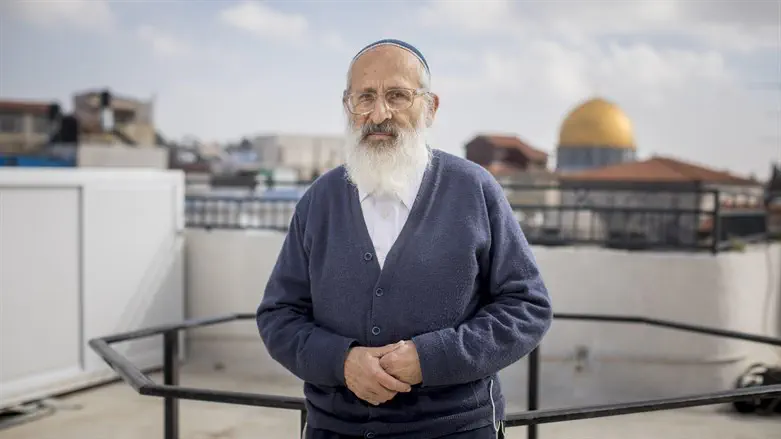
Rabbi Shlomo Aviner is Head of Yeshivat Ateret Yerushalayim.
Question: Is the Mashiach an extraordinary individual, or is he an “era of Redemption" called the Messianic Age?
Answer: Both. The Rambam in Chapter 11 discusses the Mashiach himself. Chapter 12 discusses the Messianic Age. Whether the Mashiach will come at the beginning of the Messianic Age, in the middle of it, or at its end, we do not know. The Rambam states: "All these matters and similar things, no person will know how they will come about until they actually occur" (12:2).
Question: What is the role of the Mashiach? What will he do? Will he bring people to repentance? Will he spread Torah?
Answer: He will be a king, like David his forefather. This is what is meant by the King Mashiach - a true and ideal king who fulfills the will of Hashem. He will restore the Davidic monarchy to its former state (11:1).
Question: What will happen during the Messianic Age?
Answer: Three things:
- There will be no difference between this world and the Messianic Age except for Israel’s freedom from foreign domination - that is, national freedom and national independence in the Land of Israel.
- There will be the War of Gog and Magog. Maimonides (the Rambam) does not explain what this is, but from many sacred sources it is clear that it is a war of the nations against the Kingdom of Israel. With Hashem's help, we will be victorious.
- Elijah the Prophet will come and bring the people back to Hashem through repentance.
In what order these three events will occur is unclear, because the words of the prophets are obscure, and we will not know how these matters will unfold until they actually happen. In any case, these details are not essential, and one should not become absorbed in studying them, because they do not lead to fear of Hashem or love of Hashem (12:2).
Question: Will there be miracles during the Messianic Age?
Answer: No. The world will continue according to its natural order. The verse, "The wolf shall dwell with the lamb," is an allegory referring to Israel and the nations of the world (12:1). Of course, miracles may occur, and we believe in miracles, but miracles are not a requirement of the Messianic Age, and we do not rely upon miracles.
Question: Is it a requirement that the Mashiach perform miracles?
Answer: No. The Mashiach is not required to perform miracles. Rabbi Akiva and all the sages of his generation believed that Bar Kochba was the Mashiach, even though he performed no miracles (11:3). As mentioned above, miracles may occur, and we believe in them, but they are not a condition for identifying the Mashiach, and we do not rely upon miracles.
Question: When will the Mashiach come, and when will the Messianic Age begin?
Answer: We do not know. The verses dealing with this subject are obscure, and the sages have no tradition concerning them, just as they have no tradition regarding the other details mentioned above. Therefore, one should not calculate the end of the exile. The sages said: "May the spirit of those who calculate the end expire." Rather, one should wait and believe in a general way (12:2).
Question: How will we know who the Mashiach is?
Answer: There are six conditions:
- He must be a king - that is, the sole and absolute ruler over the Kingdom of Israel.
- He must be from the House of David. Temporarily there may be a king from another family, but the Mashiach will come from the House of David.
- He must be immersed in Torah study. Earlier, the Rambam explains that every king is obligated to study Torah during every free moment when he is not occupied with governing the kingdom: "He shall read from it all the days of his life." All the more so, this applies to the King Mashiach.
- He must be devoted to the mitzvot like David his forefather, according to both the Written Torah and the Oral Torah. In the first chapter of the Laws of Kings, Maimonides rules that fear of Heaven is an indispensable requirement for every king. In the Laws of the Temple Vessels, he rules that if a king who feared Heaven ceases to do so, he is removed from office. All the more so, the King Mashiach must be God-fearing and observant of Torah and mitzvot.
- He will compel all Israel to follow the path of the Torah and he will strengthen its observance. Not only will he personally observe the Torah, but he will govern the kingdom according to the Torah, and the laws of the kingdom will be the laws of the Torah.
- He will fight the wars of Hashem - that is, wars commanded by Hashem, as explained in the earlier chapters concerning every king, such as coming to Israel's defense against an enemy, namely, defensive wars.
If he fulfills these six conditions, he has the status of a presumed Mashiach (bechezkat Mashiach). At that point we regard him as the Mashiach, although it is not yet certain that he is the confirmed Mashiach (11:4).
Question: And how will we know that he is certainly the Mashiach?
Answer: There are four additional conditions:
- He succeeds in his mission-for example, by establishing a kingdom that is governed according to the Torah.
- He defeats all the surrounding enemies.
- He builds the Temple in its proper place.
- He gathers in the dispersed exiles of Israel (11:4).
Of course, this does not mean that the mitzvah of making Aliyah to the Land of Israel is suspended until there is a confirmed Mashiach. After all, the first requirement is that there already be a king ruling a kingdom. Therefore, a large Jewish nation must already be dwelling in Zion. The Mashiach completes the ingathering - he doesn’t start it (11:1).
Question: Has there ever been someone who was regarded as a presumed Mashiach but ultimately was not the confirmed Mashiach?
Answer: Yes. Bar Kochba.
"Rabbi Akiva, the great sage among the sages of the Mishnah, was the armor-bearer of King Ben Koziba. He declared that he was the King Mashiach, and he and all the sages of his generation believed that he was the King Mashiach until he was killed because of his sins. Once he was killed, it became known to them that he was not the Mashiach" (11:3).
Question: Will there be peace during the Messianic Age?
Answer: At the beginning of the Messianic Age there will be wars (11:4). Later, once his kingdom is firmly established, there will be peace (11:5). There will also be no poverty but abundant prosperity, and "the sole occupation of the entire world will be to know Hashem alone" (ibid.).