
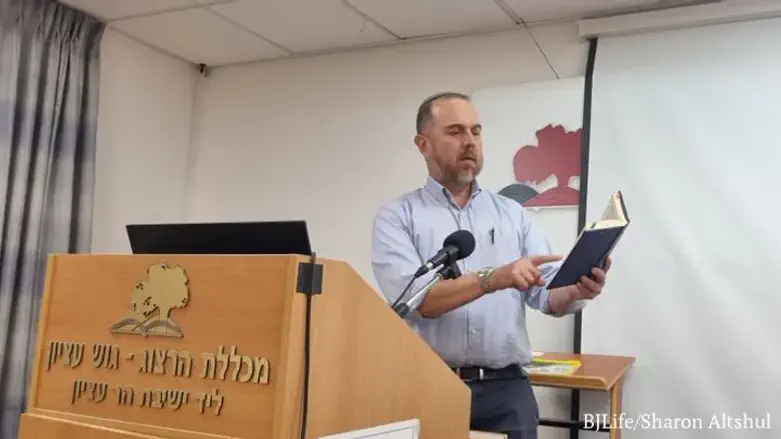
Thousands flocked to the Har Etzion Yeshiva campus in Alon Shvut last week for the 31st annual Herzog College Yemei Iyun beTanakh - Bible Study Days, four days of Tanakh lectures which took place from Sunday, July 12, to Wednesday, July 15 this year. As is the case every year, participants chose from a widely varied and impressive list of lectures, and could sign up for a fifth day of tours to sites connected to the Tanakh that left those who took part eager for more.
Attending were young teachers and experienced educators, new and veteran immigrants, teens, undergraduates and retirees, multi-generational family members, who came to be enriched by the insightful analyses of famous Tanakh scholars.
Lecturing were renowned Tanakh scholars from the yeshiva, as well as Tanakh faculty and educators from Israeli colleges and universities who were joined by colleagues from abroad including Drs. Nechama Price, Ilana Turetsky, and Moshe Sokolow from Yeshiva University and Prof. Mira Morganstern from New York’s City College. And while most of the glowing atmosphere was due to the inspiring classes, delighted smiles of recognition as old friends bumped into one another played a part as well.
An all-day English program was offered on Sunday and Tuesday parallel to the Hebrew classes. This English language project began ten years ago and offers a choice of two lectures per session, filling both classrooms with Tanakh-loving English speakers who find it easier to follow complex ideas in their mother tongue. And for those abroad or those who could not come to the college, lectures were livestreamed to more than one thousand people, with recordings made available afterward on YouTube to registered participants.
All in all, it was a massive operation engaging mind and spirit - and it ran like clockwork, with transportation, meals and even snacks available to all.
Arutz Sheva spoke with Rabbi Reuven Spolter, Director of English Programming at Herzog College, a former US pulpit rabbi and teacher, who graduated YU’s Azrieli College in Jewish Education and gained a masters degree in Talmud at Bar Ilan University after making aliya.
Rabbi Spolter led the English programs this year (Shalom Berger, who began the English programs ten years ago, has stepped down) and is a creative and inspiring educator in his own right. His original thought-provoking multi-leveled Kitah video series on the Mishna, the Weekly Parasha and holidays, for youngsters who are not enrolled in Jewish day schools, including lessons to do during the week and Zoom learning on Sunday, also reaching out to parents and the family Shabbat table, have been featured on Arutz Sheva.
And Herzog College’s Kitah digital learning platform for teachers operates in Jewish schools around the world, including the USA, the UK, Australia, S. Africa, Canada and more. Kitah shows teachers how to move beyond the necessary emphasis on vocabulary and translation that Tanakh study entails in the Diaspora.
Q. What are the goals of Herzog College’s emphasis on Tanakh and the vision motivating the choice of programming?
Rabbi Spolter: You can get an idea of our vision from seeing the elements of this year’s English program. On Sunday - the day Israel’s next election date was announced - the English-language program featured a track dedicated to episodes in Tanakh that address political and electoral issues which we thought would interest participants this year. The enrollment and feedback showed that we were right. On Tuesday, the English track was dedicated to lectures exemplifying bringing Tanakh to life with a closing discussion of how to do that in the classroom.
We chose relevant topics: tefilla and politics. In a way of thinking, Tanakh is an intersection of politics and prayer.
Q. Is that the vision guiding the Bible Study Days as well as Herzog’s Tanakh programs?
Rabbi Spolter: One could certainly say that. We want people to be able to explore these and other topics through appropriate sources in Tanakh.
In addition to the Bible Study Days and the Tanakh track in our teacher’s college, we have a division called Herzog Global for Judaic studies and curriculum development that has travelled around the world, engaging and enriching programs that reach hundreds of teachers from Western Europe to Australia, in the USA, in Canada. It all started with programs in Spanish run by our own Shmuel Kornblit who saw the lack of educational Judaic programs for Latin American Jewry and then expanded to English speaking countries.
The vast majority of our work is in professional development for teachers, giving practical tips and tools for Jewish educators, and that is exactly the topic discussed at the study days by Dr. Ilana Turetsky from Yeshiva University in conversation with Sarah Golubtchik from Herzog Global on Sunday afternoon.
We have been stressing Tanakh teaching for many years and the Bible Study Days have articulated that to the general public.
Q.. What makes that special? After all, Jews have been studying Chumash, with the parasha read each week in shul and other parts of Tanakh read as Haftorahs, the Megillot on holidays and the Book of Psalms serving as an accompaniment to the joys and travails of life - for thousands of years.
Rabbi Spolter: As author/lecturer Yael Ziegler of Matan and Herzog College said at the start of her lecture/conversation on Teaching Tanakh with Herzog Global’s Sarah Golubtchik, the Haskalah (the Jewish secularizing movement that followed the late 18th century Enlightenment) adopted a solely academic approach to Tanakh, Bible criticism, and abandoned Talmudic study and halakha. This led to Tanakh study being avoided by yeshivas lest it be studied without faith.
Religious Zionism opened the Tanakh once again, respectfully and reverently, as opposed to the Haskalah’s approach, adding analytical tools in addition to learning renowned commentaries, engaging in close reading of the text and gaining understanding from archaeological findings. That meant knowing more about where and how events occurred, but also how they can be relevant to our lives, how Tanakh can help us, what messages it is sending us in ways it did not before the re-establishment of an independent Jewish government and army in the land of Israel.
That is Herzog’s innovative approach to Tanakh and it is why Tanakh is its central program.
After all, Tanakh is the chronicle of building our country. It now has vitality and relevance - not just geographically, but in situations we face that are similar to those appearing in the Tanakh. A new reality, led scholars to realize how crucial Tanakh is as a learning experience, a lens with which to look at and receive guidance for life’s challenges as an individual, as it always was, but also for those of our reborn state.
For example, David had to deal with a hostage situation in Tziklag and how he reacted is relevant to the heart-wrenching situation we found ourselves in after October 7, even providing solace and guidance on how to relate to that situation.
And in Rabbi Doron Perez’s lecture on Politics of Power vs. Politics of Relationships, he suggested that the serpent’s sin was in turning the relationship between G-d and Adam and Eve into a power struggle. That, he said, is the first appearance of the negative kind of politics. The serpent intimated that G-d did not want Adam and Eve to eat from the tree because that would make them as powerful as He is. Adam and Eve’s acceptance of that claim and succumbing to the temptation of power is the beginning of all the damage caused by political power struggles taking the place of statesmanlike unity and the search common goals.
Q. How do you ensure that the Bible Study Day classes reach us on a spiritual level?
Rabbi Spolter: The Tanakh opens our eyes to the different aspects of connecting to G-d, chief among them prayer, the subject studied in Tuesday's English language lectures.
-Prayer for and of children of different ages in the Tanakh was dicussed in depth by Dr. Deborah Geller in her lecture.
-How we served G-d in the Beit Hamikdash and how our Sages acted to keep that memory alive in every generation of our dispersion, was thoroughly expounded in the fascinating and informative lecture on the Levites’ songs in the Temple by Rabbi Dr. Aaron Adler, bringing them to life in listeners' imaginations.
And the Torah’s attitude to spoils of war, a most current topic in Jewish ethics, was the subject of a Hebrew lecture by the renowned Rabbi Dr. Yoel Bin Nun, while the Tanakh’s attitude to intermarriage was analyzed in another class.
Actually, we don’t have to explain the relevance of Tanakh in Israel, because it is so clear. But both here and in the Diaspora, we must connect to that relevance.
Q. What are some of the problems facing Tanakh teachers?
Rabbi Spolter: Teachers need guidance to use Tanakh classes to enhance religious growth, Jewish identity and development. Most of us in the Diaspora learned to read and conjugate words in Tanakh, tried to understand and then went on to Rashi etc, but perhaps no one talked about why. It is especially important in every Jewish school, no matter what level of observance teachers and students are on, to relate the Tanakh's relevance to their students. We teach them to think about it and create their own messages for their own people.
Don’t get caught up in the material, we say, the goal is what it has to do with their lives.
Are the students going to find it important once they leave school? The Bible Study Days bear witness to that being possible. We see how many thousands do want to study Tanakh and find it relevant, feel that its characters have important things to say to them."
Unpacking Herzog Tanakh Methodology
Arutz Sheva attended the lecturefeaturing Dr. Yael Ziegler from Herzog College in conversation with Sarah Golubtchik from Herzog Global.
Their message can be summed up in one sentence: Tanakh is not just what happened thousands of years ago.
We turned to Dr. Ziegler for a deeper explanation.
Dr. Ziegler: "When teaching Tanakh, we are telling the history of our forebears, but also teaching universal and eternal themes, and we have to make them human, relevant and fun - with reverence, of course, as we are a Torah-true Beit Midrash, not a secular academic intitute. We need to pique curiosity to draw In students, while honoring our Sages and giving midrash its respected place. Tanakh shows its protagonists' mistakes and even criticizes them, but the way we speak about that needs caution when remembering our educational goals.
"Right now, Tanakh is very relevant: it talks about leaders and warfare. Jews are now the center of the world. We have a role and it is to call out in Hashem' s Name the way our Patriarch Avraham did.
"The world expects more of us, but so does the Torah."
Q. Yael, what are your goals?
Dr. Ziegler: "I want the students to walk out with shining eyes, not just information. We need to give them our love of Torah, the bigger picture and broader context, information and ideas, meaning, understanding mesora (like asking ‘what are chazal saying about this chapter’) and emphasize commentaries, the meforshim, with room for cautious chiddush (new interpretations).
"For example, the story of Saul’s anointment allows for a character study of the first king of Israel but also of what being a Jewish king or a Jewish leader entails.
"And I tell the teachers be sure they prepare their classes well, in fact very well, but also make sure to rise above the material.
"So you can say that our goals are three words: connection, relevance, and engagement."
For the thousands who learned at Herzog and at home, the Bible Study Days went a long way towards accomplishing all three.