

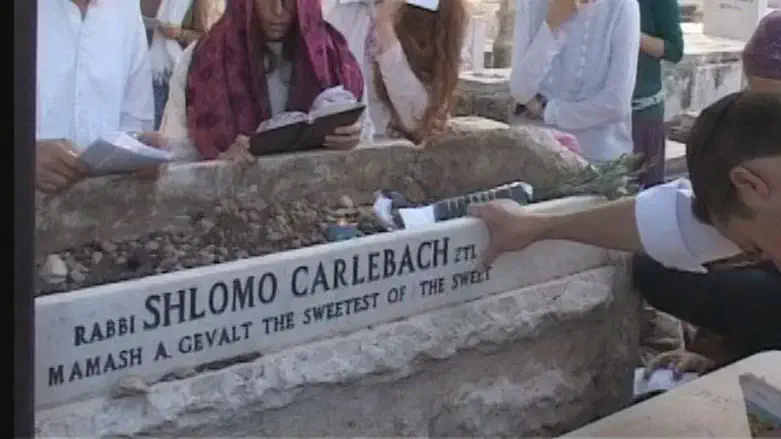
The Darkest Light, a documentary about the life and legacy of Rabbi Shlomo Carlebach, is set to be shown at the Jewish Film Festival in San Francisco.
The film examines Carlebach's enduring influence on Jewish prayer and music, while also addressing allegations of sexual abuse made by numerous women after he died in 1994.
Ahead of the premiere, Carlebach's daughter, Neshama Carlebach, published a personal essay in The Times of Israel announcing that she had decided not to attend the event. She wrote that the decision followed considerable reflection, despite her belief in the film's importance and her support for its continued screenings around the world.
Neshama wrote that her father "profoundly shaped Jewish life through his music, teachings, and ability to touch people’s souls. He also caused profound harm." She said the documentary presents both sides of his legacy "with care and precision," combining his contributions to Jewish life with the testimonies of women who said they were harmed by him.
She argued that the film's central challenge is not whether communities should continue singing her father's melodies, but how to build safer communities that believe survivors and establish meaningful accountability for spiritual leaders.
Carlebach's other daughter addressed the film and stated: There's been a lot of talk about the stance of my family in relation to this new documentary that just emerged. I want to say first of all that I was interviewed four years ago, before the direction of this film was made known to me. I would never be a part of a film like this, and if I could be removed, I would a thousand times. Unfortunately, I am bound by a release I signed. There is somehow a popular opinion that because my sister has clearly stated her opinion, that is the opinion of the entire family. That is hers and hers alone.
She noted that she prays that "all women who ever got hurt by any situation, by any person, are healed and protected and supported. But I cannot accept or condone anything the documentary says, because like my sister, I wasn't there, and the whole truth died with my father. We live in a world where almost everyone has the ability to broadcast their opinions through social media, films, podcasts, and countless other platforms. But opinions, no matter how passionately they are expressed, or how wildly they are shared, are still just opinions."
"Justice is meant to be something different. It depends on a careful process of gathering evidence, testing claims, cross-checking facts, and giving all sides the opportunity to be heard. The goal isn't simply to reach a conclusion quickly, but to arrive as closely as possible to the truth. That's why the principle of innocent until proven guilty is so important. It protects people from being judged solely by public opinion, emotion, or accusation. It reminds us that allegations are not the same as proof, that fairness requires patience, evidence, and due process. In a world where information spreads instantly and judgment can be made in seconds, this principle is more important than ever. It exists to ensure that justice is based on facts rather than the loudest voices."
Dari added, "I can only say what I know, and what I know is that all my life I witnessed the kindness, the humility, and the open-heartedness of my father. I saw him give his life repeatedly over and over and over again, saving people and doing chesed, being accessible 24-7, going to prisons and hospitals, traveling to wars, praying for soldiers, and singing for them. In anything in his capacity, he was always the first to run to do good."
She further stated: "His heart was wide open and he was humble to a fault and never sought out power or control. He was devoted to his mission to meet every person and bring love to the world. I saw him give away his money, his clothes off his back, and anything possible to give over and over again."
"Can I say that he ever didn't make mistakes or was perfect all the time? No, I can't, because no one is perfect. And more importantly, I'm not him, and no one can actually speak for anyone else. I can only say what I know, and what I know is I believe in my father, and I stand by his goodness, and I stand by the fact that anything that's coming out is clearly a misinterpretation or out-of-context story that we can't fully understand because he's not here to bring his voice or his truth.
"I believe that every person, when they pass, meets G-d and has their own personal reckoning, and that their souls know how to evolve and become the unconditional love that they were meant to be. I believe that my father is now unconditional love and lives in a very high place... I believe my dad always did his best and whatever he was capable of and had a deep, deep desire to bring good to the world, and that's what I stand by: his goodness, his heart, his divine inspiration, and his extreme bravery to do things that no one else has ever done before him.
"I continue to believe that his inspiration and his sparks ripple out into the world and bring so much good and greatly outweigh any misunderstandings or heaviness that exists."
Speaking ahead of the premiere in an interview with the YouTube channel moviereviewsnmore, director Simon Mendes said he had spent years working on the project in an effort to examine one of the most influential and complex figures in modern Jewish life. He said that while Carlebach transformed contemporary Jewish music and inspired countless communities, it was equally important to present the allegations against him rather than tell a one-dimensional story.
Mendes said he hopes the film's premiere at the San Francisco Jewish Film Festival will serve as the starting point for a broader dialogue within the Jewish community and beyond. "This is a film about recognizing the truth," he said. "If people leave ready to have an honest conversation about power, accountability, and harm, then it has achieved its purpose."