
Dr. Chaim C. Cohen, whose PhD. is from Hebrew U., is a social worker and teacher at the Hebrew Univ. School of Social Work, and Efrata College.
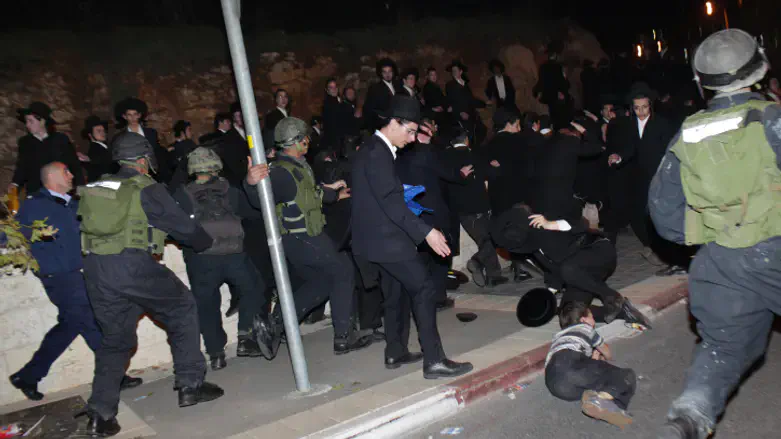
The current burning question of how to draft a significant number of haredi youth into the IDF is only the 'tip of the iceberg'.
The real underlying question is how the haredi population can develop responsibility for building a more 'mature' integration into mainstream Israeli society. And correspondingly, how will mainstream Israeli society develop a mature acceptance of haredi participation.
Both societal movements -haredi integration and Israeli acceptance- are crucial for an ongoing building of our, hopefully eternal, Jewish State.
Almost all sociologists addressing this question have been liberal-left secularists who have seen the growing haredi population as an existential threat to future of the Israeli Zionist state. I am addressing the question from an opposing perspective, one that sees the tremendous benefit that will come to general Israeli society from a mature integration and cooperation of the haredi population.
Over the last twenty years I have come to better understand the haredi world as now half my family is educated in the haredi school system, and those grandchildren are establishing families based on haredi social cultural values. On one hand, my wife and I are happy and proud of them. We are actively involved in their lives.
On the other hand, as an academic sociologist, my now, much deeper, acquaintance with haredi social culture has allowed me to understand better both the 'benefits' (strengths') and 'costs' (weaknesses)of haredi society (as understood from my avowed religious Zionist social perspective.)
This article thus aims to first explain the 'benefits' and 'costs' of haredi society, and then argues that building a true 'cooperation/integration 'with haredi society is a much more difficult and prolonged task than of our political leaders and publicists understand. The task is imperative for the state of Israel's society, but it will be difficult and prolonged.
Personal clarification: As a religious Zionist, I fully support using a full range of financial sanctions against haredi community in order to compel more haredi young men to enlist into the IDF. For me, serving in the IDF is one of G-d's most important, holy mitzvot. (As a social worker I was a mental health officer in the IDF) And it deeply pains me that our haredi grandchildren are not serving in the IDF (however, in order to remain loving grandparents, we strictly avoid discussing this subject with them).
Thus, the point of this article is that strict financial sanctions will not 'solve the problem'. Look at the haredi community in America. They receive no governmental allocations, and are thriving. This article will thus explain that our national dilemma is much more holy and complex than the issue of seriously reducing financial allocations to the haredi society.
The growth of Israeli (and American) Orthodox/haredi communities is a historical phenomenon/miracle.
At the end the Holocaust there were probably less than 300,000, Sabbath observant, Orthodox Jews in the world, out of 12 million Jews ( less than 3%) and they had very limited influence and input into the workings of the Jewish community. (In 1947 there was not yet a very clear, distinct, 'everyday social life' distinction' between haredi and non-haredi sabbath observant Jews).
Now the picture is 'miraculously' different. In Israel there are now over two and a half million Orthodox Jews, (haredi and National Religious) in Israel, roughly 27% of the population.
Similarly, in America there are roughly 550,000 Orthodox Jews, roughly 10% of America's Jewish population. Two thirds of America's Orthodox population is haredi. (The statistics here are based on GPT Chat).
These 'dry statistics' actually tell us of a 'historical miracle'. It is a miracle because in today’s dominant, secular-postmodern, social world the goal to live a very distinct, disciplined observant religious life (for example Sabbath observance) means to live in ongoing, direct conflict with all the major social cultural values of the surrounding society. To be Jewishly religiously observant means you are constantly 'swimming upstream in a turbulent, downstream river' of secular culture.
The haredi and National Religious communities have developed very different strategies for coping with a primarily hostile social cultural environment. This article analyzes the strategy of the haredi community.
A sociological analysis of the 'benefits' and ‘costs' of haredi (particularly Israeli) social culture:
The ‘benefits’ (strengths) of haredi social culture
First, haredi society is a ‘healthy’ society. The study of sociology has defined determinants of what defines a healthy society, and haredi society receives a very high score. For example, haredi society has a longer life expectancy (lower mortality) than other sectors. It also reports a significantly higher degree of life satisfaction, lower level of depression and anxiety, and a higher level of family and communal support. The haredi community also has a higher level of family sizes, and lower level of divorce. And it has the lowest level of violent crime and theft in the Western world. (Chat GPT statistics)
Most significant, other sectors in other countries with the same level of low income, crowded housing, and relative poverty score much, much lower on all of these social determinants.
Sociologists ascribe this surprising, positive haredi correlation of low income but high social wellbeing to the phenomenon of social integration. Strong family ties, shared religious meaning, frequent communal participation, and a clear sense of life purpose provide psychological benefits that offset the disadvantages of lower income and crowded housing.
Second, haredi society is ‘revolutionary movement’, despite ‘selling itself’ as a ‘return’ the Torah based life of the pre-twentieth century Eastern European town (the shtetel).
In order to gain historical legitimacy, and make its ongoing ‘confrontation’ with the surrounding postmodern secular society seem less threatening, haredi leaders have created the public relations message that the current social dynamics of their society are actually ‘conservative, traditional’, and are simply a return to ‘the good, old holy days’ of pre-modern-secular revolution of Eastern Europe.
This ‘public relation’ pitch is an illusion. It is true, that as in the 19th century village is Eastern Europe, they have succeeded, in creating a society where Torah learning, and Shulchan Aruch religious observance, are the main values and building blocks of their society. But otherwise almost all other current social cultural attributes pertaining to current haredi society are radically different than those of the shtetel.
This is not the place to elaborate. I will just illustrate my argument with two examples. One, in Eastern Europe rampant poverty allowed only a very small number of men to learn in yeshivot. Today overall affluence, and governmental support, has created an historically unprecedented, 'mass, revolutionary number' of Torah learners and yeshivot. Second, in Eastern Europe almost no women worked outside the home, and in secular society. Now eighty percent of haredi women work ( and only 50 percent of haredi men) outside the home, and at least 50 per cent in jobs in secular society.
In brief, haredi society is attempting in a 'revolutionary manner' to preserve the primacy of Torah study and Torah social cultural values, in the midst of an ongoing social value conflict with post modern secular society, .
Theology is the ideology of current haredi society
Almost all modern and postmodern 'political movements' are based on a primarily secular ideology whose political lifetime is three to four generations.
In contrast, the ideology of the haredi community is based on a theology of Torah-Rabbinic laws and wisdom whose timespan is over two thousand years old. We believe that this 'ideology-theology' has a divine origin. And over two thousand years this Rabbinic 'ideology-theology' has proved itself to be the 'insurance policy' that has allowed the Jewish People to sociologically survive and flourish despite being constantly surrounded by a hostile, persecuting non-Jewish society.
This Torah based 'ideology-theology' is probably the 'not so secret' formula why the haredi society has been so phenomenally able to grow in the context of its current,'on going' battle with modern secular social values.
Haredi society has ideologically decided to self-segregate itself both geographically, educationally and culturally.
In order to promote and protect this Torah based 'ideology-theology' haredi society has energetically created an autonomous 'social-cultural-political entity in the midst of the Israeli-Jewish state. It has chosen the strategy of autonomy over even partial integration and participation into overall Israeli-Jewish society. It sees modern Jewish-Israeli society as being primarily opposed to-and in conflict with- Torah social values and truths. To my sorrow, this social strategy, in the short run' is 'working well' for them.
Communal self help
The combination of a legal tradition of Rabbinic laws prescribing communal self-help, and the haredi's instinctive lack of trust in, and self-segregating distancing itself from, governmental social services, has brought the haredi community to develop a 'parallel' set of self-help-social institutions. These haredi communal institutions are less professional in their social services delivery. But they are much more trusted by the haredi population because services are provided in accord with haredi social norms. haredi communal self-help services have proven to be effective in meeting the basic social needs of the community.
Current haredi society is quite hierarchal
Yes, haredi society is not hermetic. It does slowly change and absorb outside social influences. For example, in comparison to even twenty years ago, many more women are working outside the house. Also, social media, computers, cell phones, cars, woman driving cars, and foreign travel are now quite common place in society (all with a haredi 'twist'), unlike twenty years ago.
However, rabbinic and Chasidic leadership very much influences (try to 'control') the pace and nature of this social change. For example, in National Religious society social change occurs from 'the bottom up' with leading rabbis then trying to moderate, influence and educate social change to make it more in accordance with Torah values (for example the growing number of religious women serving in the army).
In the haredi world, from the outset, the rabbinic leadership attempts to determine the nature and pace of social change. They try to regulate ('employing social sanctions') inevitable social change so that it will be better coordinated with Torah law.
The 'hidden sanctions' in haredi life that enforce a very high level of social conformity
Surrounded by a threatening secular world, haredi society demands a high degree of conformity from its members in order to maintain internal coherence and stability. This is not the place to elaborate. I will just mention two types of 'sanctions'. One, the 'danger' of not conforming to a very strict social code. My favorite example is the 'blue shirt'. A man works all week at the office wearing a white shirt and black kipa, but on Friday, 'wanting a sense of escape' he comes to minyan in a blue shirt. Immediately all alarms go off and his self-identity is on the defensive.
The haredi world has strict social code for almost all aspects of daily, family communal social life. One will only disregard the code either out of a sense of despair, or out of a need to express personal independence.
The second type of 'sanctions' is the society does not grant the minimal educational resources that would allow an individual to make a realistic choice whether wants to continue to live within the confines of haredi society. Lack of minimal secular education forcibly 'locks' probably at least twenty percent of haredi men within the community.
The social 'costs' (weaknesses) of haredi social culture- A personal postscript.
There are no 'free lunches'. haredi society 'pays a serious price' for building a successful autonomous society built on strict social conformity
This criticism is based on the fact that I became an Orthodox Jew, and an academic, through a highly individualistic, fairly lonely process. I strongly identify with the Torah of Rav Soloveitchik and Rav Kook.
My wife and I are very proud and happy with the haredi Torah learning and Torah life of our grandchildren (Their parents, our children, had a national religious education). But I am very pained and disappointed by four aspects of their education, aspects which I believe reveal the somewhat hidden 'costs' of haredi social culture.
These costs are:
1. Haredi education does not discuss or encourage the concept of self-knowledge, self-exploration or self-actualization and creativity. Conformity is a ruling social value.
2. Haredi education does not give priority to professionally understanding and professionally working with the special needs of the weaker, lower thirty per cent of their students. Their needs are basically ignored.
3. Yes, much of secular culture is dangerous to a Torah way of living. But haredi education makes no effort to encourage 'haskala', teaching in a 'kosher, supervised manner, the areas of history, art, literature, and sciences in a way that inspires, reveals and respects all aspects of G-d's creation. Haredi life is much shallower because of ignorance in these areas.
Finally, haredi society does not encourage higher professional training in the areas of human social services. There is no reason a graduate of a yeshiva education cannot become a social worker, educational counselor, psychologist, or a nurse. Today we have the knowledge and literature to teach all these professions based on Torah literature in gender segregated frameworks.
Why does the haredi community have to be dependent on the National Religious community to provide professional services in these fields? Training yeshiva graduates in these areas would only positively empower haredi society in its ongoing combat with the secular world.
Believe me, if the haredi community would 'only open the windows' in these four areas, it would only be strengthening its inner resilience and cohesion and ability to combat and defeat the dangers of secular cultural values in the long run.
Summary: The national, strategic policy implications of the 'strengths' of the haredi society
I have gone into such detail to 'prove' that haredi society has been basically very successful in its effort to establish an alternative social culture to that of post-modern secularism. haredi society is unique. No other minority social culture in the world has been able to accomplish what Hared society has accomplished in its 'ongoing war' opposing modern secular culture.
Recognizing these the strengths and successes of haredi society must be the starting point of designing a way to get haredi men to serve in the IDF.
This is the main point of this article. As I said above, I support financial sanctions and limiting/eliminating governmental allotments encourage haredi enlistment. But the point of the article is that confrontation, 'storming the walls of the autonomous, walled city that the haredi society has constructed ,is an incorrect strategy.
Boisterous, combative slogans, shouting and protests will not bring one additional haredi man to the IDF. The haredi society is too successful, too coherent, too ideological, and too inwardly oriented to be so easily defeated.
More important the national goal of our Israeli- Jewish state must be to more significantly integrate haredi society into general Israeli society, particularly the economic sector. Having more soldiers of haredi background is an important goal, but not the most important one. For example, greater economic integration of haredi men is a more important goal.
Our national goal in resolving the conflict with the haredi community over IDF service must be one of integration and not confrontation.