

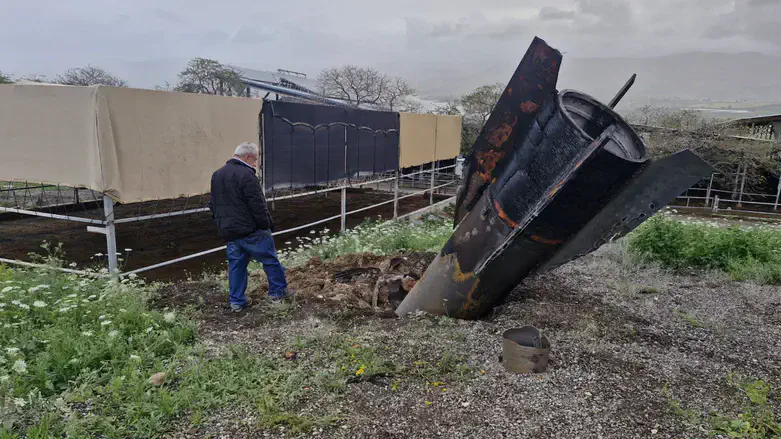
Tangible risks of an Israel-Iran nuclear confrontation remain real. At some point, even if Iran stays non-nuclear, that country’s drone and ballistic missile capabilities could prod Israel to issue measured nuclear threats. If such threats were subsequently carried out, Israel and Iran would find themselves locked in an “asymmetrical nuclear war."
To clarify, even while it holds a regional nuclear monopoly, Israel will face intermittent Iranian attempts at “escalation dominance." To manage such challenges, Jerusalem will need to adjust its “ambiguous" nuclear posture. Among other things, this means trading a traditional “bomb in the basement" strategy for a stance that favors “selective nuclear disclosure."
In core matters of relevant military strategy, the most salient issue is not just a binary division between nuclear and non-nuclear capacities. Tehran already has operational access to radiation dispersal weapons (i.e., enriched uranium ordnance - Trump’s “nuclear dust") and to other weapons (missiles and drones) that could launch conventional attacks on Israel’s Dimona nuclear reactor. Iran’s related capabilities could be unprecedented and synergistic. This second term references interactions in which Iran’s cumulative military capability would exceed the sum of its constituent parts.
When judging such capabilities, science will matter to Israel. As there has never been a nuclear war (Hiroshima and Nagasaki don’t count), nothing about nuclear conflict likelihood could be reliably estimated. It follows that any illuminating details of an Israel-Iran nuclear confrontation (whether asymmetrical or symmetrical) will remain speculative.
Even if Iran were to remain non-nuclear, Israel could sometime calculate that explicit nuclear threats would be rational and cost-effective. This prospect could obtain in circumstances wherein the non-introduction of Israeli nuclear threats would grant Iran a decisive upper hand. Here, Jerusalem’s only sensible objective would be to manage Iranian threats via credible deterrence.
These are all weighty intellectual questions, not “common-sense" matters amenable to easy resolution. In such potentially existential matters, nothing could be more injurious to Israel than relying on ad hoc calculations or visceral military reprisals.
For a country smaller than America’s Lake Michigan, nuclear weapons and deterrence remain essential to Israel’s national survival. Jerusalem’s traditional policy of “deliberate nuclear ambiguity" (the “bomb in the basement") goes back to early days of the state. During the 1950s, David Ben-Gurion, Israel's first prime minister, understood early on the need for a dramatic "equalizer." Significantly, however, for Ben-Gurion, most of original enemies were Sunni Arab states.
Now, facing a recalcitrant Shiite Iran and aspiring Sunni adversaries in Turkey, Egypt, Qatar and Pakistan, Israel will need to update its nuclear doctrine and strategy. The core objective of all such refinements ought to be credible nuclear deterrence, a goal that will require carefully-calculated shifts to selective nuclear disclosure. Though ironic and counter-intuitive, a non-nuclear Iran would need to be convinced that Israel’s nuclear arms were appropriate for operational military use. In all matters of military deterrence, nuclear and non-nuclear, what will matter more than destructive capability is enemy perceptions of this capability.
There will be perplexing and intersecting nuances. In Jerusalem, where strategic planners need to fashion reason-based nuclear postures, all prospective enemy decision-makers (Sunni and Shiite) should be considered rational. It is conceivable, of course, that perilous adversaries could sometime act irrationally, either by themselves or in alliance with other presumptively rational states. Anticipating this fearful prospect, Israeli planners should always plan for a variety of plausible preemption options.
And, although the only gainful purpose of Israel’s nuclear weapons should be deterrence at varying levels of military destructiveness, there are foreseeable circumstances in which that country’s nuclear deterrence could fail. How might such worrisome circumstances arise? To provide a useful answer, the following scenarios should be identified and evaluated. In part, at least, all four scenarios could represent the “by-products" of Israel’s protracted fight against both enemy states and sub-state jihadi adversaries.
(1) Nuclear Retaliation
If a still non-nuclear Iran were to launch a massive conventional attack on Israel, Jerusalem could respond (suddenly or incrementally) with a limited nuclear retaliation. If Iranian first-strikes were to involve chemical or biological weapons, electromagnetic pulse weapons (EMP) or radiation dispersal ordnance, Israel could also choose to launch a measured nuclear reprisal. In large part, this unique decision would depend on Jerusalem's expectations concerning follow-on Iranian aggression and comparative damage-limitation.
A nuclear retaliation by Israel could be ruled out (but not conclusively) in circumstances wherein the enemy aggressions were verifiably conventional and “hard-target" oriented; that is, oriented toward Israeli weapons and military infrastructures, not toward Israel’s civilian populations.
(2) Nuclear Counter-retaliation
If Israel should again feel compelled to preempt Iranian nuclear options with its non-nuclear weapons, Tehran’s response would determine Israel’s next moves. If this response were to include “only" radiological weapons, Israel could turn to variously-proportionate forms of nuclear counter- retaliation. If Iran’s retaliation were to involve other non-nuclear weapons of mass destruction, Israel could still feel pressed to take the escalatory initiative. This decision would depend on Jerusalem's considered estimations of enemy intent and also its corollary calculations of effective damage-limitation.
If the Iranian response to Israel's preemption were limited to hard-target conventional strikes, it is unlikely that Israel’s decision-makers would move to any level of nuclear counter retaliation. If, however, the Iranian conventional retaliation was "all-out" and directed in whole or in part to Israeli civilian populations, an Israeli nuclear counter-retaliation could not be excluded. A nuclear counter-retaliation could be ruled out only if Iran’s conventional retaliation were presumptively proportionate to Israel's preemption, confined to Israeli military targets, circumscribed by legal limits of military necessity and accompanied by compelling evidence of non-escalatory intent.
(3) Nuclear Preemption
It is highly unlikely (perhaps even inconceivable) that Israel would ever decide to launch a preemptive nuclear strike against Iran. Though circumstances could arise wherein such a strike would be technically rational and permissible under international law, it is improbable that Israel would ever allow itself to reach such end-of-the-line circumstances.
In principle, however, an Israeli nuclear preemption could be plausible only where (a) Iran had acquired authentic (chain-reaction) nuclear weapons or other weapons of mass destruction; (b) Iran had clarified that its military intentions paralleled its capabilities; (c) Iran was believed ready to begin a "countdown to launch;" and (d) Jerusalem believed that exclusively conventional preemptions could no longer be consistent with basic preservation of the Jewish State.
(4) Nuclear War fighting
If nuclear weapons should ever be introduced into a conflict between Israel and Iran, some form of nuclear war fighting would ensue. This would hold true as long as: (a) Iranian first-strikes would not destroy Israel's second-strike nuclear capability; (b) Iranian retaliations for an Israeli conventional preemption would not destroy Israel’s nuclear counter-retaliatory capability; (c) Israeli preemptive strikes involving nuclear weapons would not destroy Iran’s second-strike nuclear capabilities; and (d) Israeli retaliation for conventional first-strikes would not destroy Iran’s nuclear counter-retaliatory capability.
In sum: For the moment, an operational Iranian nuclear capacity remains limited to radiation dispersal weaponry, but even that inferior capacity could be sufficient to trigger massive conventional exchanges with Israel and/or an asymmetrical nuclear war. Though the second prospect would favor Israel, it could still produce grave harms to the Jewish State, either directly from Iran or by Iranian allies that are already nuclear.
Prof. Louis René Beres was educated at Princeton (Ph.D., 1971). Born in Zürich at the end of World War II, he is the author of many books, monographs, and articles dealing with Israeli nuclear strategy. Emeritus Professor of International Law at Purdue, he has lectured on this topic for over fifty years and his twelfth book, Israel's Nuclear Strategy: Surviving amid Chaos, was published in 2016 (2nd ed., 2018). In December 2016, Professor Beres authored a monograph at Tel-Aviv University (with special postscript by retired USA General Barry McCaffrey): Israel's Nuclear Strategy and American National Security. In 2003-2004, Beres served as Chair of Israel’s “Project Daniel" (Iranian nuclear weapons) for Prime Minister Ariel Sharon.