

Stephen M. Flatow is an attorney and the father of Alisa Flatow, who was murdered in an Iranian-sponsored Palestinian Arab terrorist attack in 1995. He is author of A Father’s Story: My Fight for Justice Against Iranian Terror (now available in an expanded paperback edition on Amazon.com) and is the president of the Religious Zionists of America-Mizrachi. An oleh chadash, he divides his time between Jerusalem and New Jersey.
A congressional amendment can lose by 210 votes and still send an unmistakable warning.
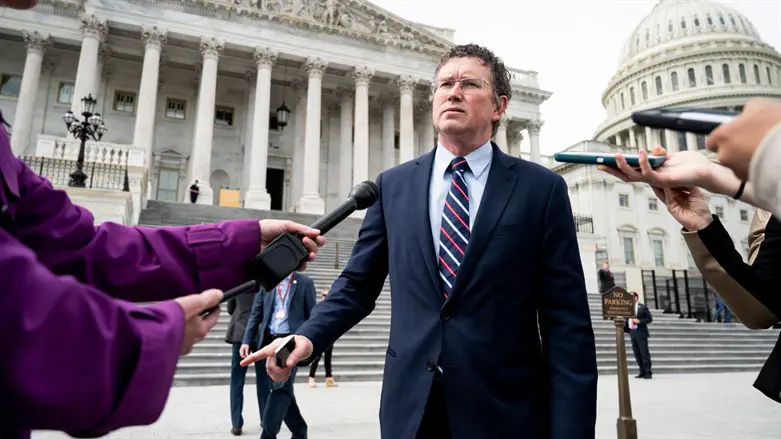
On July 15, the House of Representatives rejected an amendment offered by Republican Thomas Massie that would have prohibited funding for Israel and reduced the Foreign Military Financing account by $3.3 billion. The final vote was 314-104.
But the party breakdown tells the real story. Massie was the only Republican to support his amendment. He was joined by 103 Democrats. Only 98 Democrats voted against it, while another 10 voted “present." Among Democrats willing to vote yes or no, a majority supported eliminating the assistance.
As a registered Democrat, I take no satisfaction in writing that. But friends of Israel cannot explain away what happened as another meaningless symbolic vote.
The Wall Street Journal called the result a shocking abandonment of an ally and evidence of the growing power of the Democratic Party’s anti-Israel wing. It noted that the supporters included former House Speaker Nancy Pelosi and Katherine Clark, the second-ranking House Democrat.
The deeper lesson is even more troubling: The traditional American-aid model may be approaching the end of its political life.
Pelosi acknowledged that the Massie amendment was “ill-conceived." She voted for it anyway because of “the message that it sends."
That is a significant development. Senior Democrats were willing to support a measure they considered poorly designed because casting a vote against assistance to Israel has itself become politically valuable.
Representative Adam Smith of Washington provides the most disturbing example.
Smith’s statement recognizes that Israel faces profound existential threats from Hamas, Hezbollah and Iran. He also acknowledges that many people demanding America abandon Israel do not support Israel’s right to exist.
Smith then describes what has happened to him and his family:
His home was vandalized, a fire was set in his driveway, his neighbors were subjected to middle-of-the-night demonstrations and a member of his staff was physically assaulted.
Smith rightly condemned those tactics. He explained that his vote arose from his frustration with Prime Minister Benjamin Netanyahu’s government and his belief that Israel’s policies had not changed despite his repeated objections.
Nevertheless, after the vandalism, intimidation, fire and assault, Smith voted to stop $3.3 billion in assistance in order, in his words, to “get the attention" of the Israeli government and “force them to change their actions."
Smith may sincerely believe that intimidation played no part in his decision. But politics is also about the lessons that conduct teaches.
The people who targeted him can now conclude that their methods worked. A member of Congress who supported Israel was subjected to escalating pressure, and they ultimately received the roll-call vote they demanded.
That should alarm every American, regardless of his or her position on Israel. It is not democratic persuasion. It is coercion.
Nor should Israelis comfort themselves with the belief that the problem begins and ends with Netanyahu.
Polling this spring found that 80% of Democrats and Democratic-leaning independents held an unfavorable view of Israel-not merely Netanyahu or his coalition-up sharply from 2022. Among Americans under 30, only 32% viewed the Israeli people favorably, compared with 58% who viewed the Palestinian Arabs favorably.
A new Israeli government might receive a temporary political honeymoon. It would not end the arguments over Gaza, Judea and Samaria, Lebanon, settlements, Palestinian Arab statehood or Israel’s response to Iran.
The political momentum is unlikely to disappear even if Israelis replace Netanyahu in the coming election.
What, then, should Israel do?
Israel should not recklessly reject American assistance tomorrow. The military relationship cannot be dismantled overnight without affecting Israel’s procurement planning, weapons inventories and ability to prepare for a multifront war. But -
Israel must begin treating dependence on annual congressional appropriations as a strategic vulnerability.
The current security memorandum expires in 2028. Encouragingly, Israel and the United States have already opened formal talks on a replacement. Israel’s Defense Ministry says the emerging framework is intended to expand joint investment in research, development and co-production while gradually moving from aid to a completely reciprocal partnership.
That is the proper direction.
The objective should not be a weaker American-Israeli alliance. It should be a stronger alliance in which Israel is less dependent upon direct grants that future members of Congress can threaten to suspend whenever they disapprove of an Israeli election result or military decision.
Israel must manufacture more of its essential munitions, enlarge its domestic production capacity, diversify its strategic relationships and expand defense exports. Its record defense exports demonstrate that Israel possesses both the technology and the international market needed to begin that transition.
American Jews also need a new strategy.
They must remain active in Democratic primaries rather than waiting until anti-Israel candidates have already secured their nominations. Candidates should be pressed to say precisely what they support: Do they oppose all assistance, particular weapons, a particular Israeli government or Israel’s ability to defend itself? Would they fund missile defense and emergency resupply during a regional war?
Jewish organizations must make the case that the alliance serves American interests through intelligence cooperation, joint technological development, missile-defense research and the containment of Iran and its proxies. Support for Israel cannot be presented merely as charity to a foreign country.
At the same time, American Jews should support Israel’s movement toward greater self-sufficiency. There is no contradiction between fighting attempts to disarm Israel today and helping Israel become less vulnerable to congressional pressure tomorrow.
Nor should Republicans be given a free pass. The amendment came from Thomas Massie, a Republican. Isolationism is growing on parts of the American right as hostility to Israel grows on the left. A genuinely bipartisan Jewish strategy must confront both.
For decades, American assistance helped Israel become strong. The next stage of the relationship should help Israel become less dependent.
Aid can be a shield. Increasingly, Washington politicians want to turn it into a leash.
Israel has now been warned. It should act before the leash is pulled.