

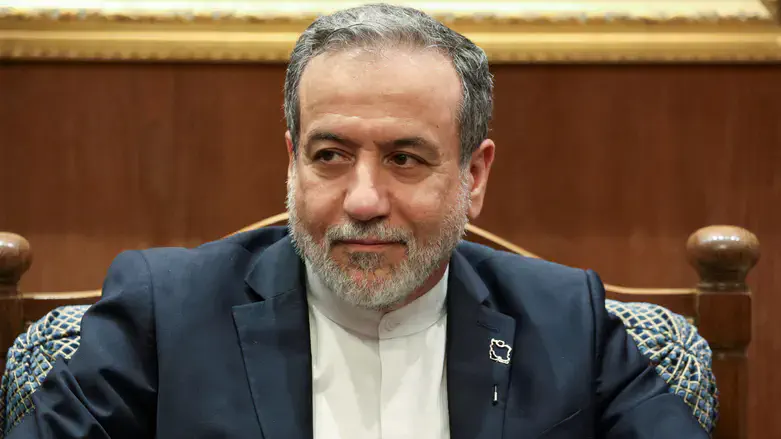
An extraordinary admission by Iran's foreign minister has shed new light not only on the depth of Israel's intelligence penetration, but also on the lingering shock that continues to grip the leadership of the Islamic Republic. More than a year after Tehran suffered a devastating blow at the opening of the conflict, Iran's greatest fear no longer appears to be another Israeli strike-it is the possibility that someone deep within the regime is still passing highly sensitive information to Israel.
Iranian Foreign Minister Abbas Araghchi acknowledged in a Persian-language interview that the intelligence breach that enabled Israel to reach the highest levels of the Iranian leadership "likely still exists." The remarkable statement suggests that, even today, Tehran has little confidence that its internal security apparatus has succeeded in sealing the leak that exposed its most closely guarded secrets.
According to Araghchi, on the morning of February 28 he told President Masoud Pezeshkian that "the atmosphere was one of war." At 9:00 a.m., he met with Ali Asghar Mir Hejazi, a senior aide to then-Supreme Leader Ali Khamenei. Shortly afterward, Israel launched a devastating strike that hit the very heart of Iran's decision-making establishment.
The opening barrage killed Supreme Leader Ali Khamenei and eliminated 40 additional senior commanders. By Iran's own account, the attack struck the country's political and military leadership while several of its top decision-making bodies were meeting simultaneously.
Araghchi said Khamenei was in his office at the time, while the Strategic Council on Foreign Relations was holding its weekly session and the Supreme Defense Council was also convening. "Holding parallel meetings was not unusual in those days," he said, before making what may have been his most revealing admission: "The enemy's knowledge of these meetings was the result of an information breach that likely still exists."
The statement underscores what has been widely viewed as one of Israel's most significant intelligence achievements in its confrontation with Iran. Beyond the elimination of senior officials, Araghchi's remarks indicate that Israel had access to exceptionally sensitive information regarding the regime's schedule, the whereabouts of its top leadership, and the timing of critical meetings. For Tehran, the implications extend far beyond the damage already inflicted-they point to an enduring inability to determine whether its security institutions have truly regained control.
More than a year after the events, the Iranian regime still appears to be struggling to repair the fractures exposed that day. Persistent concerns over an unresolved intelligence breach, combined with extraordinary security measures surrounding the country's leadership, paint the picture of a regime operating under a cloud of deep mistrust and uncertainty.
The extent of that anxiety was further illustrated by Araghchi's revelation that he has yet to meet Iran's new Supreme Leader, Mojtaba Khamenei, in person. "Only a handful of people have met with him," he said, highlighting the extraordinary secrecy surrounding the new leadership and its continuing fear of another intelligence penetration.
Taken together, the foreign minister's comments amount to far more than a retrospective account of a past operation. They portray an Iranian regime still grappling with the consequences of one of the most devastating security failures in its history, while the shadow of Israeli intelligence continues to loom over the highest levels of power in Tehran, raising questions about the regime's ability to protect even its most senior officials.