

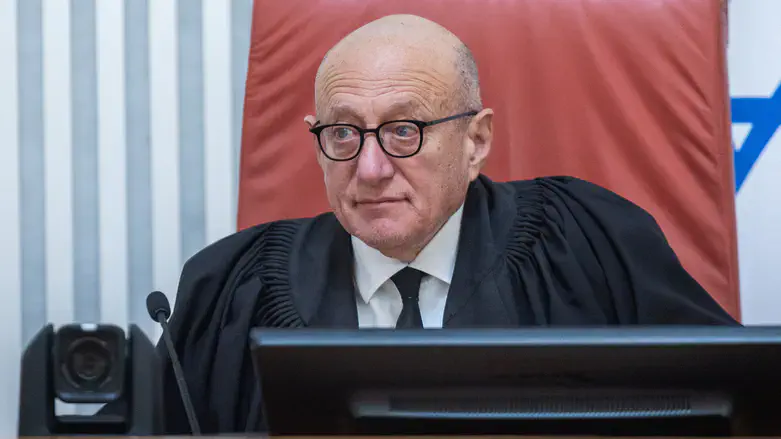
Israel's High Court of Justice heard a petition today filed by the organization Physicians for Human Rights-Israel, seeking to require the state to allow patients from the Gaza Strip to enter Israel for medical treatment. National Security Minister Itamar Ben Gvir also attended the hearing.
During the proceedings, the justices criticized one of the documents submitted by the petitioners. Justice Alex Stein said, "Withdraw the appendix, because it contains accusations and statements against the IDF and the State of Israel. If you do not remove it from the case file, there will be costs."
Justice Yael Vilner added, "There is an accusation here against IDF soldiers that is without precedent," and later said, "There is absolutely no justification for submitting a document that accuses IDF forces." Following the court's remarks, the petitioners agreed to remove the appendix.
State representatives argued that policy has changed since October 7 and that the Minister of Defense now authorizes the transfer of patients from the Gaza Strip only to third countries.
According to the state, 800 patients and their escorts left Gaza through the Rafah Crossing in February, 1,462 in the following month, and 1,820 in May. The government said the policy is based on security considerations.
The state also requested that the court review classified material in an ex parte proceeding. During the hearing, Justice Yechiel Kasher noted that the current number of patients leaving Gaza is only about 10 percent of the number who left before October 7.
Before the hearing began, Minister Ben Gvir criticized both the petition and the Supreme Court.
Speaking to Arutz Sheva, he said, "It is simply outrageous that these people repeatedly exploit what is essentially their home field in the High Court. They know it's home-field advantage-it's like playing in the World Cup with the referee on only one side."
Ben Gvir added that, in his view, Israel should pursue comprehensive judicial reform.
"We've accomplished a great deal, but in the next elections I will demand full judicial reform," he said.
Attorney Yehuda Puah, chairman of the B'Tsalmo organization, also sharply criticized the proceedings. He said the petition had been filed by organizations that, in his view, support a terrorist organization and are seeking to compel the state to provide medical treatment in Israel.
Puah argued that the state's position was that there is no objection to patients and wounded individuals receiving medical treatment in other countries, and that they could be allowed to leave through border crossings provided a third country agrees to receive them. According to him, the petitioners specifically demanded that the treatment be provided in Israel.
He said that during the hearing, the justices remarked that a mechanism should be considered to address exceptional humanitarian cases. Puah quoted the court as saying, "There cannot be no mechanism; there cannot be no opening," and argued that this effectively amounted to a demand to create a pathway for Gaza residents to enter Israel.
Puah also said he attended the hearing as the representative of 39 bereaved parents, but that Justice Vilner informed him he would not be permitted to present oral arguments because the court had already reviewed his written submission. He criticized the decision, arguing that while the petitioners were allowed to present their case in person, the bereaved families were denied the same opportunity.
According to Puah, his submission included publications that, he claimed, show the petitioners support a terrorist organization, as well as arguments that no effort had been made to seek other countries willing to receive the patients. He further asserted that in the past there had been cases in which individuals who entered Israel for medical treatment later assisted Hamas by transferring information and materials. For that reason, he argued, Israel should not establish a permanent mechanism allowing patients and their escorts to enter the country.
Puah concluded by saying that the State of Israel continues to maintain its position that patients may transit through Israeli territory to a third country willing to receive them, but should not be permitted to enter Israel itself for medical treatment.