

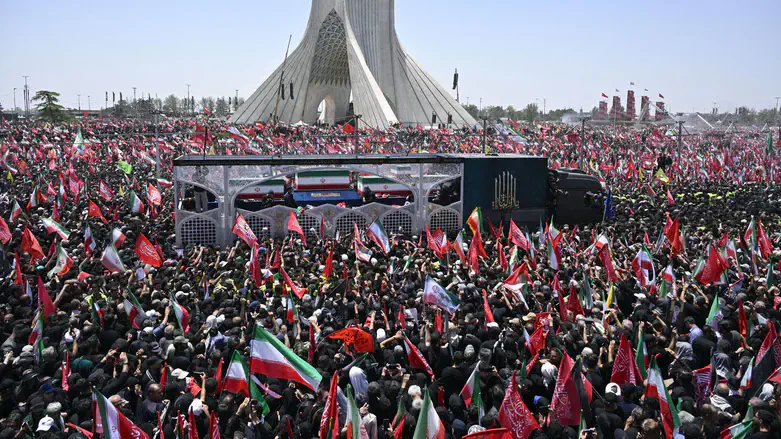
A CNN report on Saturday highlighted growing internal discord in Iran, as senior Iranian officials have come under increasing criticism from hardline factions following the funeral of Supreme Leader Ali Khamenei, with some accusing the country's leadership of abandoning the Islamic Republic's revolutionary principles after reaching an agreement with the US.
Mourners confronted Iranian President Masoud Pezeshkian during the funeral procession in Tehran, where some chanted "death to the compromiser" as he walked beside Khamenei's coffin. Iranian Foreign Minister Abbas Araghchi also reportedly left the funeral after demonstrators threw rocks and accused him of being a "traitorous sellout."
The criticism centers on officials involved in negotiations with the Trump administration that resulted in a ceasefire and the easing of some sanctions. Hardline groups claim the agreement contradicts the wishes of the country's new supreme leader, Mojtaba Khamenei, who has remained out of public view since succeeding his father.
Several prominent conservatives have alleged that leading officials, including Pezeshkian, parliament speaker Mohammad Bagher Ghalibaf, and Araghchi, are attempting to shift power away from the supreme leader and parliament.
Mahmoud Nabavian, a hardline lawmaker, publicly questioned whether a coup was underway and later declared that supporters of the late leader would oppose any such effort. Iran analyst Arash Azizi told CNN that the absence of Mojtaba Khamenei from public life has fueled accusations that Ghalibaf and his allies are effectively running the country.
The funeral also became a platform for hardline supporters calling for retaliation against the US rather than continued diplomacy. Before the recent escalation, security-linked religious singer Mohammad Ali Bakhshi publicly warned President Pezeshkian that failure to uphold the supreme leader's conditions would bring severe consequences.
Kamran Ghazanfari, another hardline parliamentarian, claimed that officials were expanding the authority of the Supreme Council for National Security while reducing the influence of both the supreme leader and parliament, describing the process as a political coup.
This week, Nabavian and another parliamentarian opposed to the US agreement were removed from the parliament's National Security Commission. Nabavian had previously criticized the negotiations and claimed the negotiating team had crossed the supreme leader's red lines.
Observers cited by CNN said Ghalibaf has sought to reduce the influence of the most hardline factions, arguing that their actions have become increasingly damaging as Iran faces continued instability.
Although hardliners retain influence in institutions including parliament and the state broadcaster, analysts quoted by CNN said Iran's leadership remains united on pursuing an end to the conflict while seeking sanctions relief and maintaining control over the Strait of Hormuz.
Despite that assessment, divisions within the political establishment remain visible, with hardline figures continuing to press for a more confrontational approach toward the US and Israel.