
On Sunday morning in Jerusalem, I opened Twitter and froze. Senator Lindsey Graham, dead at 71, hours after stepping off a plane from Ukraine. The shock landed on a bruise: only last week our neighborhood buried a friend who died just as suddenly, a man we raised our children alongside. Sudden death, of someone close in friendship or in conviction, shakes something at the foundation.
What is man, and how fragile. Those words were still echoing in me when another thought rose, and it would not sit down.
Prime Minister Netanyahu said Israel had lost one of its greatest friends. True. But underneath the eulogies, in Washington and in Jerusalem, a question is stirring that few will say out loud this week: who stands with Israel now?
Graham spent his final years arguing not with Israel’s enemies but with his own political family. A new instinct has taken root on parts of the American right, and not only on the left, that asks why Israel is America’s business at all. The friendship Graham embodied stood on two pillars, strategic interest and moral memory, and both are weakening: interests are being recalculated in real time, and the generation that carried the memory is leaving the stage.
I do not know how the argument inside the American right will end, and I will not pretend to. What I do know is what has been arriving in my inbox.
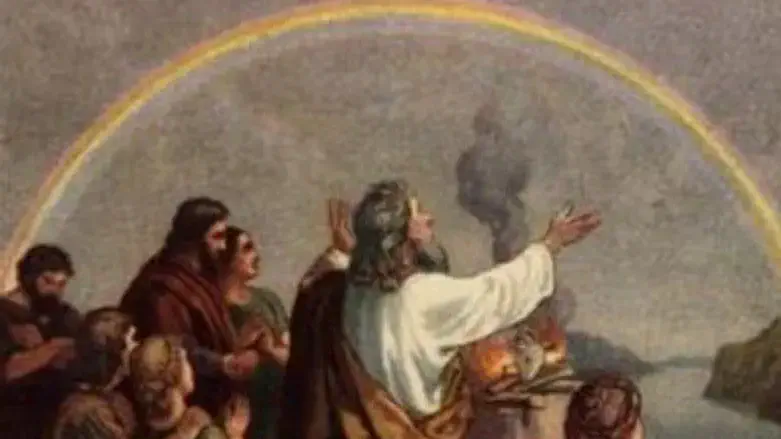
I wrote last week, in a separate essay, about the old argument between Francis Fukuyama and Samuel Huntington: the prophecy of history’s happy ending against the prophecy of civilizations forever colliding, and why, three decades on, it is Huntington’s world we keep waking up to. My claim was that the Torah offers a third option neither man considered: the covenant of the Children of Noah, in which every nation keeps its own language, memory, and path while all of humanity shares one moral foundation. Unity without uniformity.
I will not repeat the argument. I want to show you what it looks like when it gets up and walks.
This week the coordinator of our English department forwarded me an email, and added one line of his own: “What do I answer her?" It was not the first time he has sent me that question. The email was from a woman named Lara, in Texas. “Are there any other Noahides near me? I have felt alone for years, ever since I declared myself a daughter of Noah." I read it twice. There is a frustration in this work that never dulls: the world’s distances keep pushing the warm, human encounter behind a screen, and all we can send back is words.
Messages as Lara’s reach us every week, from the American South, from northern England, from the Philippines, from Kenya. They come from people who took upon themselves the Seven Laws of Noah, the Torah’s universal covenant, out of conviction alone, and who have paid for that conviction in solitude. Many held on to it through years when standing openly with Israel carried a social price in the West. No lobby recruited them. They read, studied, and decided alone.
This November the solitude ends, at least for five days. Nearly 100 Noahide leaders from 20 countries across six continents will gather in Jerusalem for the First International Congress of Noahides, the first of its kind. They will study together, sign a founding charter, establish the first international rabbinical court for Noahide affairs, and be received at the Residence of the President of Israel, with the blessings of Israel’s Chief Rabbis. They are not Jews, and they are not converting. Nobody is paying their airfare. Nothing binds them to Israel except a covenant they chose, which is why they cannot be unbound.
Here is what Graham’s passing forces into focus. A senator’s friendship, even the best of senators, is built of interest and memory. It is precious and mortal: it hangs on a primary electorate, a news cycle, a heartbeat. And I write the next sentence with gratitude, because Israel has had no warmer friends in America than its Evangelical Christians: even friendship of faith passes through generational weather.
The surveys have been saying for years what the podcasts now say aloud, that the children of Israel’s warmest friends do not automatically inherit the warmth. Support, however loving, stands beside Israel’s story. A covenant stands inside it. The Noahide believes in Israel’s prophets and in Israel’s God; his faith has one center, and its address is Jerusalem; and nothing in his own culture must be erased for the bond to hold. A covenant does not run for reelection, and no podcast talks a grandchild out of it.
Israel will always need friends in the world’s capitals, and it should honor them; this week it mourns one of the greatest. But a nation cannot rest its future on the lifespans of its admirers. The deeper answer to “who stands with Israel now?" is being written far from Washington, in a study group in Texas, in a living room in Manchester, in a congregation in Nairobi, by people whose grandchildren will know that their family’s story is bound to Israel’s.
Lindsey Graham earned his title, and may his memory be blessed. A man is fragile. I have been reminded of that twice this month. A covenant is not. And perhaps that can be part of his comfort: he was not the last of Israel’s friends. The next ones have already bought their tickets to Jerusalem.
Chaim Goldberg is the CEO of Brit Olam - World Noahide Center in Jerusalem, convening the First International Congress of Noahides on November 2-6, 2026 (brit-olam.org/congress).