

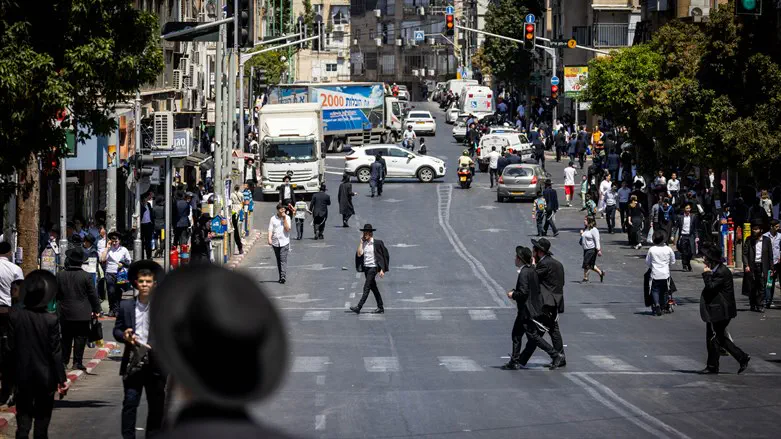
The battle over the character of Israel’s public sphere has entered another chapter, this time on the busy streets of Bnei Brak.
An urgent petition was filed with the High Court of Justice against the Bnei Brak Municipality, demanding an immediate halt to infrastructure work and the installation of signs intended to create complete gender separation between men and women on the city’s sidewalks.
The petition, first reported by Dafna Liel, was filed by social activist Yaya Fink and former Knesset member Michal Rozin (Meretz). The two argue that the measures constitute a serious violation of basic rights and the principle of equality. “We will not allow the exclusion of women from the public sphere," the petitioners said. “Bnei Brak will not become Tehran."
The current controversy began following a report by Yoeli Brim on Channel 13, according to which the Bnei Brak Municipality had begun implementing in practice a ruling issued by the city’s rabbis calling for complete separation between men and women on Ezra and King Solomon streets. The streets are major thoroughfares lined with numerous wedding halls that attract thousands of celebrants every evening.
To prevent crowding and “mixing" between men and women on the way to events, the municipality began making physical changes to the public space. These include widening sidewalks, dividing them, and placing directional signs intended to ensure that men walk on one sidewalk and women on the opposite side.
Supporters of the move describe it as a legitimate “community arrangement" designed to help local residents maintain their way of life and prevent overcrowding, while opponents argue that it represents a clear overreach of a local authority’s legal powers.
Municipal sources also noted that the current plan was formulated several years ago and that there are plans to expand the separation model to additional crowded streets in the city, similar to practices in more extreme haredi communities.
While in the initial stages the municipality presented the move as directly complying with religious directives, its updated official response adopted a different tone, apparently due to an understanding that the measure conflicts with previous High Court rulings - such as one that prohibited gender-segregation signs in Beit Shemesh.
The Bnei Brak Municipality stated: “The call for separation in the area of the wedding halls is a private initiative of the city’s rabbis, directed directly at the public. The municipality assisted only with the development and expansion of physical infrastructure in the area due to the severe overcrowding near the halls. This is not a municipal directive, enforcement measure, or official policy."