
To:
The Most Reverend and Right Honourable Dame Sarah Mullally, DBE
The Archbishop of Canterbury
Lambeth Palace, London, SE1 7JU
Your Grace,
I am writing to you today not just with a sense of deep sadness, but with a profound moral objection to the Church of England General Synod’s recent decision to formally "hear" the Kairos II document.
I know that some within the Synod have defended this choice as a mere pastoral gesture of "listening." But we must be honest: "hearing" is never a neutral act. When a prestigious body like the Synod places a document on its formal agenda, it is investing its own institutional prestige into those words. It shifts the boundaries of what is acceptable. By agreeing to formally "hear" a text that demands a boycott of "Zionist voices"-which, in reality, means shutting out the overwhelming majority of the global Jewish community-the Church is no longer just listening. It is legitimizing prejudice and hosting a conversation about our own exclusion.
As your predecessor, Archbishop Rowan Williams, so incisively warned, Jewish identity is not an optional lifestyle choice that can be carved up to suit progressive political tastes. By demanding that Jews strip away their Zionism-their deep, scriptural connection to the Land of Israel-just to be considered acceptable partners for Christian-Jewish dialogue, the Synod is attempting to define for Jewish people who they are allowed to be.
This betrayal of trust is made all the more painful by the way the Church chose to bypass its own established, honorable channels of dialogue.
On September 6, 2006, at Lambeth Palace, the Office of the Archbishop of Canterbury and the Chief Rabbinate of Israel signed a historic Joint Declaration. That document established our bilateral Anglican-Jewish Commission, recognizing a relationship "rooted in the one overarching covenant of God with Abraham." It was created precisely so that we could face sensitive, difficult issues together, through mutual respect and consultation.
Yet, this vital commission was completely ignored. Instead of consulting, the Synod chose a path of unilateral action.
This disconnect was painfully visible during your recent visit to Israel. Rather than engaging in genuine, two-way dialogue, you did not meet with your Israeli Jewish counterparts or the Chief Rabbinate. By choosing to meet exclusively with one side [of the conflict], you allowed yourself to be presented with a heavily curated, one-sided narrative. You shut out the lived reality, the trauma, and the perspective of the Israeli people. When the leadership of the Church of England echoes these biased narratives, it lends the moral weight of the Church to a highly distorted, partisan agenda.
There must be boundaries to what a moral institution is willing to tolerate. A manifesto that delegitimizes the world’s only Jewish state, seeks to rationalize the atrocities of October 7th, and demands the silencing of mainstream Jewish voices should have no place in the halls of the Church of England.
We must recall the haunting words of Dietrich Bonhoeffer, who warned the church of his own day against the comforting illusion of beautiful liturgy paired with moral silence: "Only he who cries out for the Jews may sing Gregorian chants."
If the Church continues to sing its prayers while "hearing" a document that actively seeks the exclusion of the Jewish community, its liturgy becomes hollow, and its moral authority is compromised.
By the Church’s own standard-having formally adopted the IHRA Working Definition of Antisemitism-the Kairos II document's denial of Jewish self-determination is antisemitic. To vote to engage with a text that violates your own adopted definition of prejudice is a staggering contradiction.
True dialogue cannot be built on the exclusion of one party. I urge you, Your Grace, as you begin your historic primacy, to show the moral courage this moment demands. Stand firmly by the IHRA definition your Church adopted, and restore the integrity of our relationship by honoring the established channels of the Anglican-Jewish Commission.
Respectfully yours,
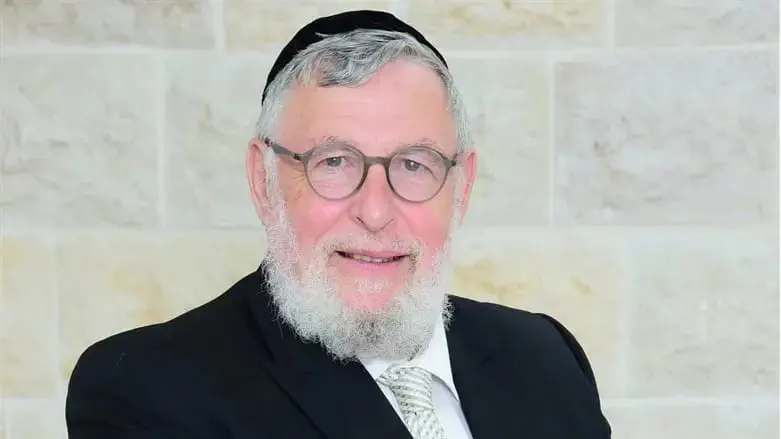
Eliezer Simcha Weisz, Member of the Chief Rabbinate Council of the State of Israel
CC:
The Chief Rabbinate of Israel
The Office of the Chief Rabbi of the United Hebrew Congregations of the Commonwealth (Sir Ephraim Mirvis)
The Board of Deputies of British Jews
The Council of Christians and Jews (CCJ)
Rabbi Weisz immigrated to Israel from Manchester.