

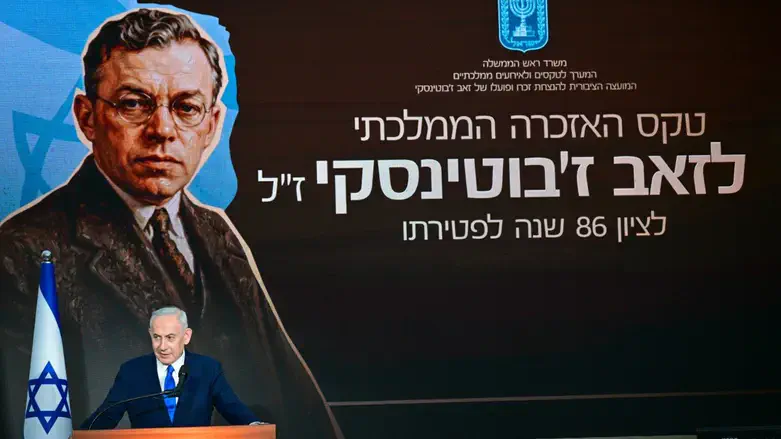
Prime Minister Benjamin Netanyahu spoke today at the state memorial ceremony for the late Ze'ev Jabotinsky, “To all my friends and colleagues who guard and preserve the legacy of Ze'ev Jabotinsky: I thank you, and I believe I do so also on behalf of the members of the Jabotinsky family who are present here today.
Dear friends, a cross-generational, historical debate has long centered on the question: Which is greater - the sword or the pen? Does military power and the achievements of war shape the world, or is the power of words and ideas stronger, more influential, and eternal?
For Jabotinsky, this was not a dichotomous question, a view that only recognizes opposing extremes. It is not black or white; it is the combination of both. Jabotinsky naturally exchanged the pen for the sword, and the sword for the pen. The sword protects the nation and its values, while the pen grants meaning and heritage to our national existence. I open with this because these days mark 100 years since the completion of Jabotinsky's seminal book, ‘Samson’.
I do not know if you are aware of this, but a Hollywood film was actually based on this book by Jabotinsky. The biblical Samson, one of the greatest judges of the Biblical era, fought Israel’s enemies, including in Gaza. Samson tore apart a young lion with his bare hands; he was as strong as a lion himself. We have done the same this past year, through Operations Rising Lion and Roaring Lion, in which we struck severe blows against the terrorist regime in Iran and its proxies.
Jabotinsky’s Samson bequeaths a command to his successors: ‘Gather iron.’ We, too, are determined to gather iron, to amass the vital weaponry required to defend our state, and we are turning toward a path of domestic manufacturing independence. Alongside our gratitude to our American allies who assist us in arming ourselves, Israel must establish an independent weapons-production infrastructure.
I want to clarify another point: There is no perfect match between the Biblical Samson and Jabotinsky’s Samson. He exercised writer's license, but despite the differences between the characters, heroism remains the unifying message.
Jabotinsky pinned great hopes on Hebrew youth, believing they would establish a Hebrew army and self-sacrificingly defend the Land of Israel. I think we can say now, three years into the War of Redemption, that these hopes are being realized beyond all expectations. Following in the footsteps of Israel’s past wars, the War of Redemption has revealed the wondrous strengths of our younger generation. In the Government, we made wise and courageous decisions to act step-by-step against those who seek our lives. Concurrently, our heroic fighters - soldiers and commanders, men and women alike - acted step-by-step with immense daring on land, in the air, and at sea to crush the Iranian axis of evil, which sought to encircle us in a ring of terror.
And here is a deeply moving closure of a circle from recent days, stretching from the Bible to Jabotinsky, and from Jabotinsky to the heroes of the present: Author Tzur Ehrlich dedicated his new song, ‘Samsons’ , to the late Avraham Azoulay of the Engineering Corps and his fellow heavy excavator operators.
Avraham, one of the trailblazers who cleared the paths in the Gaza Strip, fell in battle a year ago. The song speaks of these new Samsons: ‘And what a hand they have, and what an arm, to tear apart evil. Great as a raging mountain, their muscles are the first to engage the fire.’
Distinguished guests, Jabotinsky resented the tendency in certain circles of our people to cling to fashionable, temporary worldviews: Territorialism, cosmopolitanism, Marxism, communism, anarchism. He believed that if one does adopt an ideology ending in ‘-ism,’ it must serve the national cause. Thus, Jabotinsky is identified with Revisionism: Revising and changing the political course of the Zionist movement in the face of the anti-Zionist policy of the British Mandate government.
My late father was a student at the Hebrew University. He told me that the first time he saw Jabotinsky, it was on the ridge overlooking Jerusalem at the High Commissioner's Palace, there was a Commissioner residing there, and Jabotinsky stood outside, directly facing the British soldiers. He defied the Commissioner and said: ‘I speak freely. You will leave here, you will all leave here, because this is our land.’ My father was completely captivated. He witnessed that courage, that immense daring, and that sense of sacrifice, because such actions carried a heavy personal cost, as you well know.
That was his first encounter, which was followed a few years later by another meeting, when my father traveled to London and explained to Jabotinsky that if he wanted to realize his vision, he had to change his location: International support for Zionism would not be decided in England, but in America. ‘You will not convince the English. Convince the Americans, and they will force the English’, that is what my father told him. Jabotinsky called the entire delegation that was with him and said: ‘The lad’, well, not quite a lad, my father was 29 at the time, ‘is right.’ They packed up their belongings, traveled to the United States, and there, as you know, a short time later, Jabotinsky passed away. My father was one of his pallbearers.
But Jabotinsky possessed a vision that infected everyone who walked in his path. Instead of appeasement and restraint, he championed firmness, a policy of pressure, and standing strong on vital interests.
We, too, have made a fundamental revision to our security doctrine. Two days after the horrific October 7 attack and massacre, I promised that we would change the face of the Middle East. And indeed, we have changed the rules of the game: there is no more containment of threats. There are no more terrorist armies on our borders. There are buffer zones that we created deep within our neighbors' territories. The Gaza envelope is now inside Gaza. The Lebanon envelope is inside Lebanon. The Golan envelope is inside Syria.
We changed the region, but first and foremost, we changed ourselves. We broke the barrier of fear that gripped the entire world for 47 years, ever since Iran was hijacked by that group of theological thugs. No one dared to attack Iran on its own soil, except Saddam Hussein for a brief period. But we dared, and how we dared. We proved that we would not hesitate to strike back with immense power, anywhere, against anyone who raises a hand against us.
This revision, changing the old order, is also reflected in our efforts to forge alliances. Thanks to the consistent cultivation of our power, various nations are seeking to become closer to us. This is a cooperation that is growing stronger behind the scenes; it is happening, and not just in one or two countries. This also opens the future door to normalization and peace.
A complementary aspect of contemporary Revisionism is, and I will use a word that might surprise some of you, contemporary activism. ‘Activism’ is another core principle championed by Jabotinsky. He meant a policy of taking the initiative, taking our fate into our own hands, waging an uncompromising struggle against hostile forces, and initiating moves that serve national goals.
Israeli initiative made a massive leap forward in this current war. We settled accounts with those who wish us harm, from Gaza to Yemen, from Lebanon to Iran. We acted with power, took the offensive and used stratagems against the Iranian axis, which for years had invested hundreds of billions of dollars to bleed us. We brought back our hostages, down to the very last one. We crushed much of the military capabilities of Iran and its proxies. We removed the immediate danger of a nuclear-armed Iran.
I pledge once again: As long as I am the Prime Minister of Israel, Iran will not obtain nuclear weapons.
One of the pillars of Jabotinsky’s activist approach is the ‘Iron Wall’ principle. However, today’s iron wall is not a static wall, a defense system rooted in a single location. The wall is dynamic. It moves from theater to theater with our pilots, with our missile boat and submarine crews, and with our infantry forces maneuvering on the ground. Yet, it also has components rooted in the soil. I refer, of course, to those security buffer zones that we maintain and will continue to maintain as long as we face danger from neighboring countries. The iron wall is also a wall of alertness and determination. We continue to maintain high alertness in the face of every danger. Anyone who seeks friction will get friction. Anyone who wants a battle will get a battle. Anyone who misjudges our determination will pay a very heavy price.
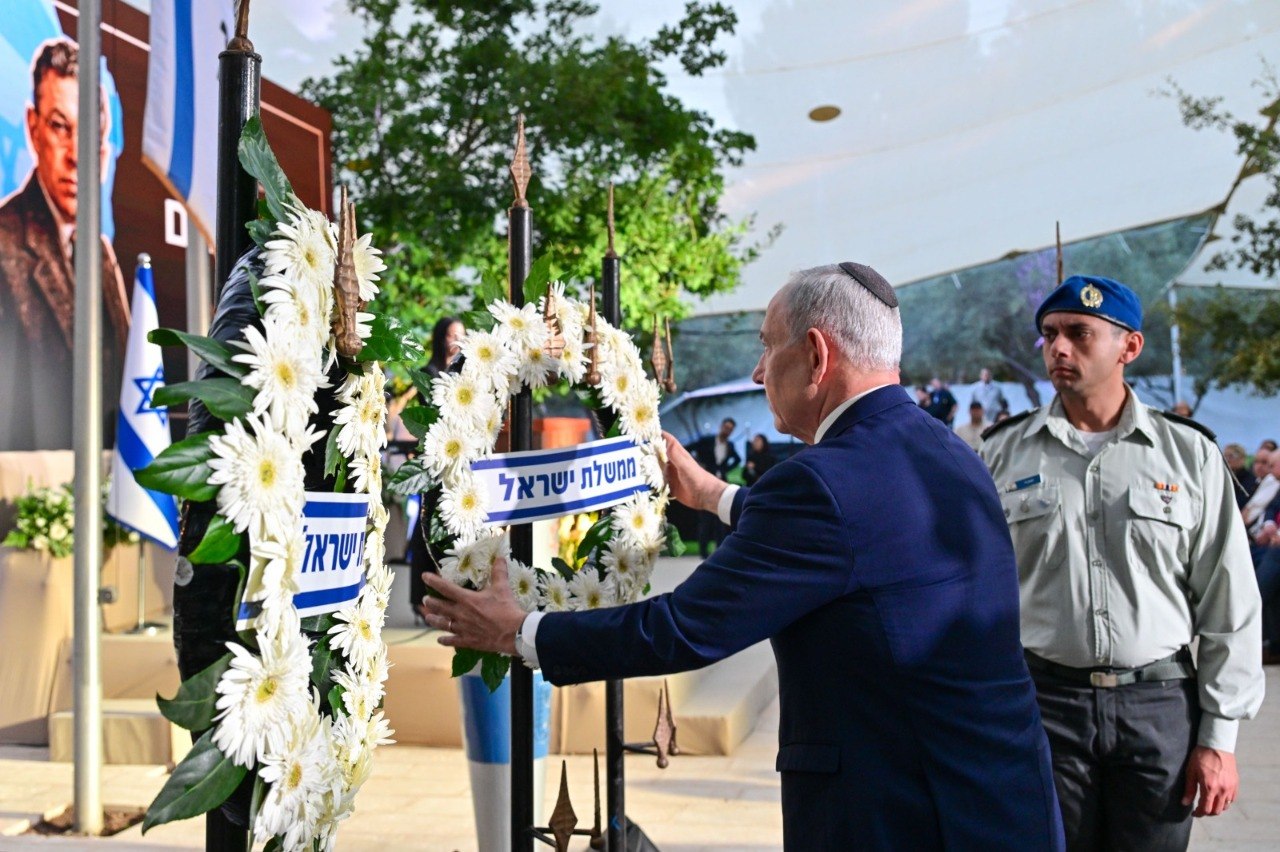
I say this to the tyrants in Iran: Do not mistake us. If we are attacked, we will respond with power. But it will not be a replay. It will be a different event altogether, and even more powerful.
Jabotinsky, the father of military Zionism, was not a bloodthirsty militarist. He emphasized the necessity of Jewish power in the face of the packs of wolves surrounding us, but at the same time, he emphasized the moral dimension of our struggle. Today, we are fighting against the barbaric fanaticism that threatens us and the entire free world. The campaign is for life itself, and concurrently, for freedom, culture, and progress. This approach aligns with Jabotinsky’s stance on the warmongers of both World Wars. He saw the Ottoman Empire, which was among those responsible for World War I, as a predatory regime destined to pass from this world.
Upon the outbreak of World War II, Jabotinsky continued his moral line: He advocated for the establishment of a Hebrew army to fight alongside the Allies against Nazi Germany to save our people, and at the same time, to save civilization and democracy. My father had the privilege of being alongside Jabotinsky during his final days in the United States. He later wrote: ‘From the resistance to tyranny and the standing on independence stemmed that activist concept, which constituted the essence of Jabotinsky’s doctrine and from which his main contributions to Zionism flowed.’
Distinguished guests and friends, Jabotinsky, the lighthouse of Zionism, continues to project his leadership and spirit onto the builders and defenders of the State. Israel is stronger than ever, and we are acting to ensure that it will be far stronger in the future. Many great challenges still lie ahead of us.
I grew up with Jabotinsky. I remember Eri Jabotinsky [Ze'ev's son] from his many visits to our home. I remember the dear Jabotinsky family. I read his writings and his words as a youth, and later as an adult. I cherish him as one of the founding fathers of Zionism, a man without whose teachings it is doubtful we would be standing here today.
May the memory of Ze'ev Jabotinsky be blessed for generations to come."