
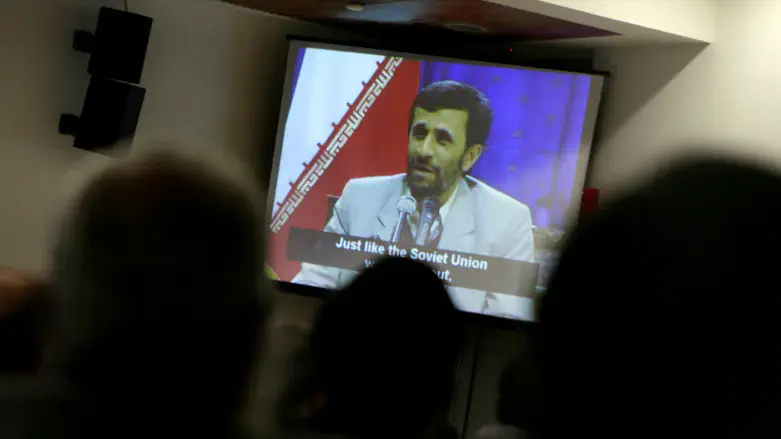
Reports that Ahmadinejad was recruited to serve the Mossad remain an unverified journalistic rumor, and it is unclear who is behind them or what the basis for the claims is. However, the idea of recruiting the leader of an enemy state to assist Israeli intelligence brings to mind a much older affair from the 1940s: the case of Husni al-Za'im, the Syrian president who held power for only 137 days. The affair was discussed with intelligence and heritage researcher Lt. Col. (res.) Gideon Mitchenik.
Mitchenik also casts doubt at the outset on the story of the Syrian president and the possibility that he was recruited by Israeli intelligence, but nevertheless presents the little-known account.
The year is 1949. The War of Independence comes to an end following major battles with Egypt during Operation Uvda in March. Armistice agreements are signed with four Arab states, with negotiations with Syria being the longest - lasting more than 100 days - and the most difficult. The meetings between Syria and Israel take place at locations along the border between the two countries.
That same year, Syria undergoes three coups, the first of which is led by al-Za'im. “Alongside the official negotiations over the armistice agreement, negotiations in which both Israeli and Syrian demands are raised - including Syria’s demand that Israel withdraw from the Galilee - direct contact is maintained with Husni al-Za'im, who at the time also serves as foreign minister and had previously been Syria’s chief of staff," Mitchenik explains.
He notes that the contact had actually begun even before the establishment of the State of Israel, and that it was conducted by members of the Jewish Agency’s Political Department.
Moshe Sharett was then head of the Political Department, and in that role he developed the intelligence component through numerous emissaries, diplomats who established ties in Arab countries. This was also how contact was established with King Abdullah, the grandfather of King Hussein. “A number of people met with many Arab leaders behind the scenes. The main motivation was an attempt to reach understandings, even if they did not amount to peace agreements."
Regarding Syria, a process begins that David Ben-Gurion, then head of the Jewish Agency, was aware of in detail. During this period, information reaches Israel about a British-Iraqi plan to take control of Syrian territory. Ben-Gurion decides to thwart the move and, through the Political Department, sends an intermediary to inform the Syrians of the plot. Later, the war with Syria breaks out.
Husni al-Za'im, then serving as chief of staff, leads the military coup at the beginning of 1949. Afterwards, he adopts an aggressive policy toward Israel, but behind the scenes he maintains secret contacts with various Israeli figures, including Tuvia Arazi, a member of the Political Department who would later be sent to establish an espionage network in Syria to gather intelligence on developments in Arab countries.
Arazi holds secret discussions with al-Za'im, and surprisingly, al-Za'im is willing to open a dialogue with Israel and even consider a peace agreement. He also expresses a basic willingness to absorb 300,000 Palestinian refugees into Syria. At the same time, however, Israel knows that al-Za'im has ties with American officials, possibly even the CIA, although there is no evidence to claim that he was spying for the organization.
Ben-Gurion, who must decide how to proceed regarding Syria, is unwilling to take a gamble on al-Za'im for several reasons, chief among them the concern that if he is cooperating with the Americans, he cannot necessarily be trusted.
Mitchenik notes that the person who exposed these contacts and Ben-Gurion’s considerations was Prof. Itamar Rabinovich, who wrote about the matter in a book after reviewing American and other archival materials.
“This was not an espionage affair, but just as with the dialogue with King Abdullah and later with King Hussein, during this period there was a secret diplomatic - and perhaps even intelligence-related - dialogue with a Syrian president."