
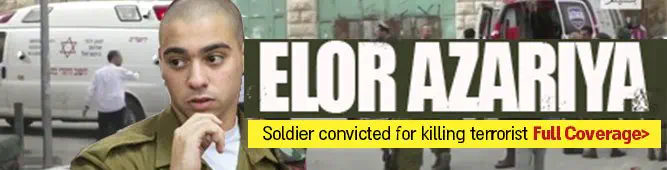

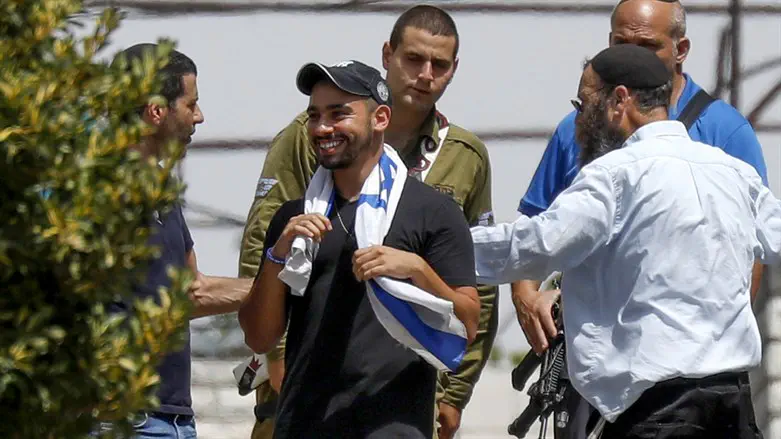
Former IDF soldier Elor Azaria, who was convicted and jailed for killing a terrorist he perceived to be a threat, on Tuesday requested that Israeli President Isaac Herzog shorten the wait time necessary to erase his criminal record.
In a statement confirming the request, the President's Residence said that it has not yet made a decision on Azaria's case following Defense Minister Israel Katz's letter requesting that he issue the pardon.
The statement added that Azaria's request will be examined according to the accepted protocols and, as per protocol, it has been passed to the relevant individuals in defense echelon for their opinion. The statement added that Katz's letter was received, and upon receipt of all relevant opinions, Herzog will weigh the request "responsibly and seriously."
According to sources involved in the process, the opinions not yet received are that of the IDF Chief of Staff, Military Prosecutor's Office, and head of the IDF Personnel Directorate.
Meanwhile, reports said that the IDF opposes the request for pardon: In a document submitted to the President's Residence, IDF Chief of Staff Lt. Gen. Eyal Zamir and Head of the IDF Personnel Directorate Maj. Gen. Dado Bar Kalifa stated that Azaria's request to shorten the period before the expungement of his record should be denied.
The document, signed by the Chief of Staff's aide, Col. Alon Laniado, states that Zamir and Bar Kalifa's position is based on the legal opinion of the deputy military advocate general responsible for handling requests of this kind.
Earlier on Tuesday, Katz sent a letter to Herzog, requesting that he grant pardon to Azaria and allow the erasure of his criminal record.
In his letter, Katz noted that over ten years have passed since the incident, and Azaria completed his full sentence in 2018.
According to him, the request is not to erase the conviction itself, but rather to shorten the wait time for erasing a criminal record, after the statute of limitations has concluded.
Katz stressed in his letter that Azaria's service as an excellent combat soldier and combat paramedic should be taken into account, as well as the circumstances of the incident in question: it occurred during active operations, and cost him a personal, family, and public price which he has paid throughout the years. Katz also noted Azaria's efforts to rebuild his life, build a family, and re-enter the job market following his release from prison.
In addition, Katz noted that the October 7 massacre and its ensuing consequences made clear the necessary mode of fighting terror organizations and the reality in which IDF soldiers must operate.
He also pointed out that recent years have also seen hundreds of convicted terrorists released from prison in various prisoner swap deals, and under such circumstances, especially after Azaria completed his sentence, it is hard to justify the continued damage to Azaria's ability to fully rejoin society.