
HaRav Shlomo Aviner is Head of Yeshivat Ateret Yerushalayim and author of some 300 books on a wide range of Torah subjects.
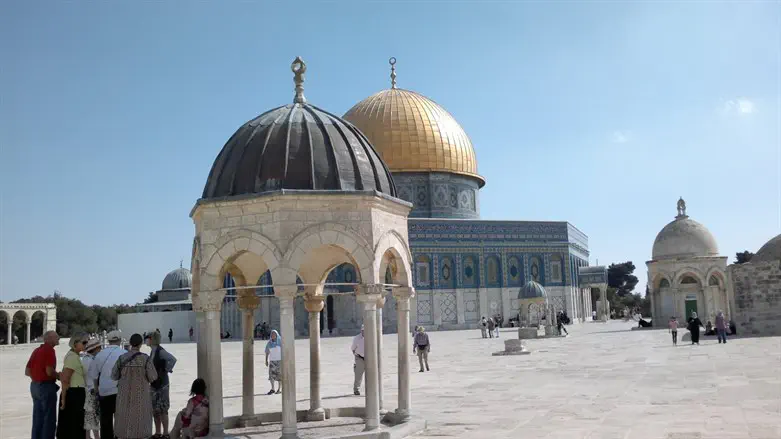
Ascent to the Temple Mount is an ongoing halakhic argument. By far, the dominant ruling of the vast majority of Torah authorities is that it is forbidden to enter the site of the Temple, and anyone who enters it is liable to karet (spiritual excision or premature death) even today when the Temple lies in ruins.
We do not know the exact location of the Temple on the Temple Mount. Many studies, diagrams, and measurements have been produced, yet every so often a new researcher arises and overturns all the previous calculations. That itself is one source of the problem - if everything were truly certain, one accurate measurement would have been sufficient. Even in the days when the Second Temple was rebuilt, a prophet was needed to determine the location of the altar. The situation has not changed from then until today.
Everything remains shrouded in uncertainty, and therefore the leading Torah authorities and the great rabbis of Jerusalem instructed that one should not pass beyond the surrounding Temple Mount wall for fear that a person trespass in a forbidden area.
Israel’s leading Torah sages, including the Israel Chief Rabbinate, have emphasized that even if there were locations where it was permitted to walk after ritual immersion, as practiced unwisely today in carefully-guided groups, other less-knowledgeable Jews could be led astray by this and wander into prohibited areas incurring the sever spiritual punishment of Karet.
All of the various measurements were scorned by Rabbi Tzvi Yehuda Kook, Head of the Mercaz HaRav Yeshiva in Jerusalem. When someone brought him a booklet containing such calculations, he pushed it aside, buried it beneath a pile of books, and declared that all these geographical surveys were comparable to spitting upon the Temple Mount (Sichot Rabbeinu 21:9). He also emphasized that the commandment to revere the Sanctuary does not apply only to the site of the Temple itself, but to the entire Temple Mount (ibid.).
Throughout the generations, leading Torah authorities forbade Jews from ascending the Temple Mount. Among them are Rabbi Abraham Isaac Kook and his son, Rabbi Tzvi Yehuda Kook, and Chief Rabbis of Israel including Rabbi Mordechai Eliyahu, Rabbi Avraham Shapira, and Rabbi Ovadia Yosef (Responsa Yabeah Omer, 14:26; Responsa Yechave Da’at, 1:25). We are neither wiser than they, nor more righteous than they, nor greater lovers of the nation.
The Temple Mount is not the private mountain of a particular person or group. It belongs to the entire Jewish People. The authority responsible for deciding such matters is the Chief Rabbinate.
Therefore, not only is there no mitzvah to ascend the Temple Mount, but doing so is prohibited. A prohibition does not become a mitzvah. As for the Arabs who enter the area, that is not our responsibility. If they wish to bring upon themselves the verse, "The unauthorized person who approaches shall be put to death," that is their own concern.
Furthermore, since halakhically we are forbidden to enter, we understand that this is God's Will. We have no prophets today to tell us God's Will explicitly, but delay itself also reveals His will, whether it is a practical delay or a halakhic one. This is what is meant by "compulsion that reflects an inner Divine will."
The road to the Temple Mount is still long. We need a much greater national connection to Torah - many more mitzvot, much more kindness, much more Torah learning, much more rebuilding of the Land of Israel, much greater honor for Torah scholars, much greater love for fellow Jews, much more Jewish education, and many more solutions for those without work, for the poor, and for the hungry.
We Will Conquer the Temple Mount Only Through the Resting of the Divine Presence.
Perhaps someone will argue: "We ascend the Temple Mount as an act of conquest so that the world will know that the Temple Mount is ours." To this we answer: "There is conquest, and there is conquest." This is not the way to conquer the Temple Mount. The pioneer conquers the Land of Israel through self-sacrifice, the soldier through his weapons, and the settler through his faith. But the Temple Mount is conquered in a different way - through the appearance and resting of the Divine Presence.
Not every place is the same; there are distinctions. See the words of our great teacher Maimonides in Hilkhot Beit HaBechirah (6:16), who explains that the sanctity of the Land of Israel is established through conquest, whereas the sanctity of the place of the Temple is established through the Divine Presence (the Shechinah).
How do we bring about the resting of the Divine Presence? Through Torah and mitzvot, through kindness and love. Three times each day we pray, "Who builds Jerusalem," referring to the Temple. But why do we say "builds" in the present tense? We do not see anything being built. Shouldn't the prayer say, "Who will build Jerusalem"? The answer is that we do not see because we possess only physical eyes. In truth, every mitzvah performed by every Jew throughout the world and throughout all generations builds Jerusalem, especially through baseless love, as Rabbi Abraham Isaac Kook famously taught - that the Third Temple will be built through baseless love (Orot HaKodesh III, p. 324). When the increase in Torah, kindness, justice, and love has accumulated, the Temple will ultimately be built in actuality.
Even when King David wished to build the Temple, the Master of the Universe told him: "The time has not yet come. Now is the time for wars. Now is the time for establishing the kingdom. Later the time will come - through your son Solomon." The present halakhic delay tells us the same thing: "The time has not yet arrived." We still have much work to do.
After the Six-Day War, our teacher Rabbi Tzvi Yehuda renewed his advanced Torah class for his leading students. In his humility he asked, "What shall we study now?" One student suggested, "Perhaps the laws of the Temple?" Rabbi Tzvi Yehuda warmly grasped his hand and replied, "We still have much to learn about the laws of kings and their wars."
In conclusion, longing for the Temple and the Temple Mount has accompanied the Jewish people throughout history, and every prayer concludes with the words: "May it be Your will that the Temple be rebuilt speedily in our days." From this burning longing we draw strength and courage, through which we add yet another mitzvah, more Torah, more kindness, and more holiness. From these, the Temple will be rebuilt speedily in our days.
Questions and Answers:
Question: In the past decade there have been many individuals and organizations working to promote Jewish ascent to the Temple Mount? Is such an initiative permissible according to halakhah?
Answer: The Rambam (Maimonides) writes in Hilchot Melachim (1:1-2) that the proper order is first to establish the Kingdom of Israel, then to eradicate Amalek, and only afterward to build the Holy Temple.
Question: There are Rabbis who permit entering certain areas of the Temple Mount. What about their opinion?
Answer: They are a small minority. They do not constitute either the majority in number or the majority in Torah scholarship of this and past generations. Beyond the fundamental prohibition, ascending the Temple Mount Is an affront to the Chief Rabbinate of Israel and to the Leading Torah Authorities. This leads to the blurring of essential distinctions. Our teacher, Rabbi Tzvi Yehuda Kook, taught that we must preserve the complete structure of God's creation of the Jewish People and the Land of Israel, each according to its proper level of holiness. There is grave spiritual danger in blurring boundaries and distinctions between different levels of sanctity.
When Miriam compared the level of Moses our teacher to that of the other prophets, she blurred these distinctions. This was the sin of equating the lesser with the greater. One of the fundamental principles of our faith is that there is an absolute distinction between Moses and all other prophets - to the extent that, in the truest sense, even the title "prophet" does not adequately describe Moses.
Likewise, when Korach declared, "The entire congregation is holy, and the Lord is among them. Why then do you exalt yourselves above the assembly of the Lord?" (Numbers 16:3), he blurred the distinctions among the different levels within the nation. Such thinking can ultimately lead to blurring the distinction between the holiness of Israel and the nations of the world.
Korach and his followers began by blurring distinctions within the Jewish People, and then continued by blurring the distinction between the Land of Israel and foreign lands, saying: "Was it not enough that you brought us up from a land flowing with milk and honey to let us die in the wilderness?" (ibid. 16:13). They actually referred to Egypt as "a land flowing with milk and honey"! Thus, the blurring of distinctions poses an enormous danger that can spread into every area of life (see Sichot HaRav Tzvi Yehuda, BaMidbar).
Ascending the Temple Mount is an injury to the Holy of Holies of the Jewish People, to the innermost point and heart of the entire nation. In comparison with the Temple Mount, all the rest of the Land of Israel is considered to possess an ordinary holiness.
There is a well-known incident involving Baron Rothschild, who ascended the Temple Mount while being carried in a sedan chair by non-Jews because he believed this was permissible. The leading Torah authorities of his generation strongly criticized him, although they later accepted his apology because he had acted unintentionally.
In his response to that incident, Rabbi Abraham Isaac Kook wrote:
"A single blemish to the sanctity of the site of the House of our Life is more serious to us than millions of practical settlements" (Igrot HaRe'iyah, Letter 677).
Ascending the Temple Mount blurs the proper distinctions of holiness. Just as it is forbidden to diminish the honor of the Torah, so too it is forbidden to diminish the sanctity of the Temple Mount.
Question: But there are Jews who do ascend the Temple Mount.
Answer: They are a very small minority. Halakhic rulings are not determined by what Jews do, but by the rulings of the leading Torah authorities of the generation.
Question: Can't one rely on Rabbi Shlomo Goren's opinion regarding those areas of the Temple Mount that he held were permissible to enter?
Answer: Rabbi Shlomo Goren was a great Torah scholar. However, in this matter many authorities disagreed with him. There are numerous differing opinions, and nothing is certain. Therefore, the Chief Rabbinate of Israel issued a complete prohibition against ascending the Temple Mount, and it is the Chief Rabbinate that has the authority to determine the halakhah in this matter.
Question: But there are prominent rabbis from the Religious Zionist community who ascend the Temple Mount.
Answer: Are you asking me what is happening, or what ought to be? If you are asking what is happening, you can buy a newspaper and read about it. But the authority that determines the halakhah regarding the Temple Mount is the Chief Rabbinate of Israel and the leading Torah authorities who prohibit ascending it.
Question: But the fact remains that there are rabbis who do ascend it.
Answer: That may be so. But theirs is a minority opinion, and halakhah is not decided on the basis of an individual opinion.
Question: Some argue that Rabbi Abraham Isaac Kook, along with Rabbi Tzvi Yehuda Kook and other Gedolim (Torah Giants) of the past opposed ascending the Temple Mount in their own day, but that if they were alive today they would change their position because of the terrible chillul Hashem (Desecration of Hashem) taking place there with the Arabs acting as if the Temple Mount is theirs.
Answer: As a rule, such an argument is simply a way of disagreeing with one's teacher while claiming not to do so. It is, so to speak, a way of arguing with clean hands. By this method, one could overturn virtually every ruling one's teacher ever issued.
It is true that on several occasions great Torah authorities have spoken this way. For example, in Eim HaBanim Semeichah (2:5), Rabbi Yissachar Shlomo Teichtal wrote this concerning his teacher, the Munkatcher Rebbe, who was among the strongest opponents of Zionism before the Holocaust (see Responsa Minchat Elazar, Yoreh De'ah 54):
"Had our teacher, the author of Minchat Elazar, been alive with us and seen all that has befallen us through the terrible decrees and massacres committed against us, God forbid, he too would have agreed that we should leave the lands of exile and go to the Land of Israel, which the kings of the earth have granted us (via the Balfour Proclamation and decision of the League of Nations), rather than wait for the Mashiach’s call."
Similarly, Rabbi Joseph B. Soloveitchik, who served as president of the Mizrachi movement in America, said in Chamish Derashot (in the essay Vayachalom Yosef Chalom):
"When I came to America, I came as an Agudah member, just like my grandfather, Rabbi Chaim of Brisk. Rabbi Chaim of Brisk was not merely my grandfather; he was the father of an entire approach and tradition of Torah. Rabbi Chaim belonged to Agudath Israel and opposed the return to Zion and the national revival in the Land of Israel. But I am in favor. This did not happen suddenly. Night after night I lay awake thinking, and in the end I became Mizrachi. Yet I am not disagreeing with my grandfather. There are 'two different laws': my grandfather lived before the Holocaust, while I live after the Holocaust. Had he lived after the Holocaust, he too would have become Mizrachi. Before the Holocaust I myself would have been Agudah, but the Holocaust proved that Mizrachi was correct in warning of the danger of remaining in exile" (See Nefesh HaRav, p. 88, note 28).
Our teacher, Rabbi Tzvi Yehuda Kook, taught that the Holocaust was such an overwhelming catastrophe that it is impossible to comprehend. It was clearly an act of Divine Providence, almost like a heavenly voice proclaiming that the Jewish People must detach themselves from exile. Thus the Divine “amputation" to bring European Jewry to the State of Israel which was created in the direct wake of the Holocaust.
Therefore, while ordinarily we cannot claim that our teacher would have changed his ruling, the Holocaust was an altogether unique event.
Accordingly, one cannot argue that Rabbi Abraham Isaac Kook or other Gedolim such as Rabbi Tzvi Yehuda would have changed their position regarding ascent to the Temple Mount. Moreover, the present situation is not fundamentally different from what has existed since the Six-Day War. The Arabs have always sought to dominate the site, while the State of Israel has always determined the practical arrangements there. We may not always agree with the government's decisions, but we do not possess all the information available to its leaders, and perhaps we would agree if we did.
The truth is that we are the sovereign authority there. The Temple Mount was in our hands after the Six-Day War, and, thank God, it remains in our hands today. When the spiritual level of our nation rises through t’shuva (repentance) and the widespread return to Torah as described above, our status on the Temple Mount will become clear to ourselves and to all of the world.
What therefore remains binding upon us are the clear rulings of Rabbi Abraham Isaac Kook and Rabbi Tzvi Yehuda Kook, who categorically forbade ascending the Temple Mount (see Rabbi Kook, Mishpat Kohen, no. 96). More importantly, the reasoning of Rabbi Kook and Rabbi Tzvi Yehuda was not based on issues of political sovereignty, but on the sanctity of the site.
Therefore, we repeat the words of our teachers and reaffirm their longstanding warning: every Jewish man and woman is forbidden to enter any part of the Temple Mount, regardless of which gate is used to enter. Beyond the obligation to avoid this severe prohibition of violating the purity and sanctity of the holy site, there is also the positive commandment to revere and safeguard the Sanctuary.
May the Holy One, blessed be He, through the merit of our ever-growing reverence for His Name, grant us His speedy salvation, hasten our complete redemption, and enable us to delight in the pleasantness of the Lord, to visit His Sanctuary, and to serve Him with a perfect heart, speedily in our days. Amen.
(Edited and translated by Tzvi Fishman)