
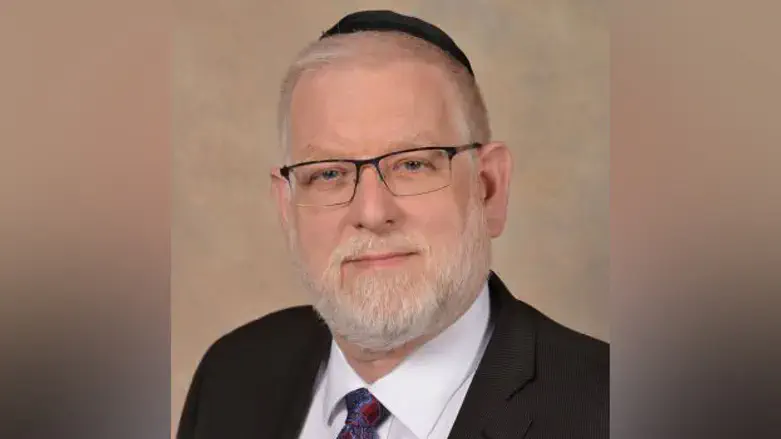
Rabbi Pesach Lerner is founder and chairman of Eretz HaKodesh, a slate representing Torah Jewry in the World Zionist Congress, and serves on the Board of Governors of the Jewish Agency for Israel.
I walked into the meeting room of the Jewish Agency's Unity of the Jewish People Committee - a committee on which I sit - and was handed an official statement, already written, already finalized, ready to be voted on. I had never seen it. I was never asked for input. There had been no discussion, no draft circulated, no deliberation of any kind. A committee whose very name invokes the unity of the Jewish people had prepared a statement on that unity while excluding a member of the committee who represents a different voice.
That statement committed the Jewish Agency for Israel to actively work in support of pluralism, to enhance the egalitarian platform at the Kotel, to oppose any change in the Law of Return, and to oppose anything "that undermines Jewish pluralism and weakens the Jewish People."
The Jewish Agency for Israel is the largest Jewish non-profit organization in the world, serving as the primary link between the State of Israel and Jewish communities globally. It is responsible for facilitating Aliyah, managing global shlichut programs, and strengthening Jewish identity. The organization is funded by global philanthropic efforts, including the Jewish Federations of North America, KKL/JNF, Keren HaYesod, and the Israeli government.
This took place at the Jewish Agency for Israel's Board of Governors meetings in Tel Aviv, June 28-30, 2026. I have attended many such gatherings as a representative of Eretz HaKodesh, the slate in the World Zionist Congress that speaks for Torah Jewry. I have learned to expect disagreement.
What I do not accept - what no one should accept - is a process designed to manufacture the appearance of consensus.
A fait accompli is not deliberation
When the statement was distributed, I raised my hand. I deliberately did not argue content. I argued process. Who wrote this? When did the committee see it? What is the purpose of a committee if its members are handed conclusions? I asked that the item be tabled until the full committee could review it and provide input - the way responsible institutions conduct business.
To his credit, World Zionist Organization Chairman Yaakov Hagoel supported the request to table. The chair declined, offering instead to "coordinate further discussion" after the vote.
A discussion after the vote is not a discussion; it is a courtesy call.
The vote proceeded: seven in favor, two against. Even Natan Sharansky, the former Jewish Agency chairman and a longtime advocate for the egalitarian section at the Kotel, was overheard acknowledging that if the committee had never discussed the statement and had not seen it before the meeting, then the objection was correct, and it was wrong to vote on it.
Hours later, at the closing plenary of the entire Board of Governors, the same statement was brought to the full body. The attendees had not seen it. It was not on the board portal. No copies were distributed. It was not even loaded on the screen when the chair began reading it aloud. I rose again, repeated my concerns, and moved to table the statement until the next meeting so that the governing body of the Jewish Agency could actually govern.
The chair called the vote anyway. Perhaps 30-40 hands out of some 200 Board and committee members and invited guests went up in favor - the others likely had no idea what the vote was even about - and the chair was prepared to end the matter there, without even calling for opposing votes, until I insisted the voting process be completed. Votes against came from myself, from Gael Grunewald of the WZO, a member of the Mizrachi faction, who told me plainly that if the committee had only seen the text that afternoon he would vote against on process alone; and from Charles Kaufman of B'nai B'rith, for the same procedural reasons.
Afterward, numerous board and committee members approached me - including people who disagree with everything Eretz HaKodesh stands for. Their message was consistent: I disagree with you, but you were respectful, and the process failed. Thank you for being here. It is time someone challenged the system. Some had even been told I had received the statement weeks earlier; when they learned that was untrue, their response was immediate - then it was wrong to call for a vote.
Who speaks for Diaspora Jewry?
The episode is not an isolated procedural lapse. It reflects a deeper assumption that runs through the National Institutions: that all of "Diaspora Jewry" holds one set of views, and that the institutions may speak in its name accordingly.
Earlier in the same conference, at the Government Relations Committee, senior staff - who throughout the year review Knesset legislation - presented bills addressing conversion according to halakha and the status quo at the Kotel, and announced, as a matter of course, that the Jewish Agency would work to challenge them. (I later learned that the only Knesset bills that seem to interest them are those addressing halakhic conversion and the protection of the sanctity of the Western Wall, Kedushat HaKotel. No other Knesset bill, regardless of topic, draws their attention.)
I raised my hand there too, and placed on the record a simple fact: there are members of this Board of Governors, and hundreds of thousands of Jews across the Diaspora - if not far more - who want conversion according to halakha and who want the status quo at the Kotel preserved. The Jewish Agency does not speak for all of Diaspora Jewry when it speaks against them.
No one else in the room said it. Someone had to.
What engagement achieves
There will be those who ask: why sit in these rooms at all? First, there are many important things that the Jewish Agency does. Second, the voice of the Torah community must be heard.
And the same Board of Governors meeting provided another answer.
For the past year, I and others have pressed the National Institutions on a painful and neglected problem: Lone Soldiers who complete their IDF service and return to their countries of origin receive no assistance - none - from the State of Israel, the IDF, the Jewish Agency, the WZO, or KKL. After the recent war, which is still ongoing, nearly every soldier carries wounds, physical or emotional; many soldiers require medical or mental health attention. Gedolei Yisrael on both sides of the Atlantic have said clearly that a wounded Jewish soldier must be helped as if he were our own child.
Working with NEVUT, an American organization founded by Lone Soldiers and their parents, we brought this issue to the attention of the President of Israel, Israel's Ambassador to the United States, senior IDF officers, the Minister of Aliyah and Klita, and the chairmen of the Jewish Agency, WZO, and KKL.
At this Board of Governors meeting, the Jewish Agency announced the creation of a new department: Lone Soldiers of the Diaspora, with its own director, staff, and budget. That is what a seat at the table accomplishes.
It is the same reason my counsel to the Global Jewish Connection Committee - which is mapping every Jewish community of 2,000 or more worldwide for emergency preparedness - was welcomed. I told them: work with Chabad, who are present nearly everywhere and are too often the target of attacks; and do not overlook the Torah communities, who are also often targeted, and whose Hatzalah, Shomrim, gemachs, and crisis-response networks are frequently the best-prepared resources any community has.
On notice
Unity is not achieved by drafting statements behind closed doors and calling snap votes before the room has read the text. Unity is achieved the way Jews have always achieved it - by sitting together, arguing honestly, and respecting the process. A "Unity of the Jewish People Committee" that bypasses its own members is neither unity nor a committee.
Eretz HaKodesh will keep showing up. We will keep raising our hands. We were, at times, a lone voice - but the institutions are now on notice that Torah Jewry is present, can be helpful, and is part of the Jewish people. And they now realize that we are watching, and that we will not be spoken for by others. Judging by how many people sought me out afterward, we are not nearly as alone as the vote count suggests.