
Duvi Honig is Founder and CEO of the Orthodox Jewish Chamber of Commerce and Co-Founder and Secretary of the Multicultural Business Coalition. He is the publisher of JBizNews.com.
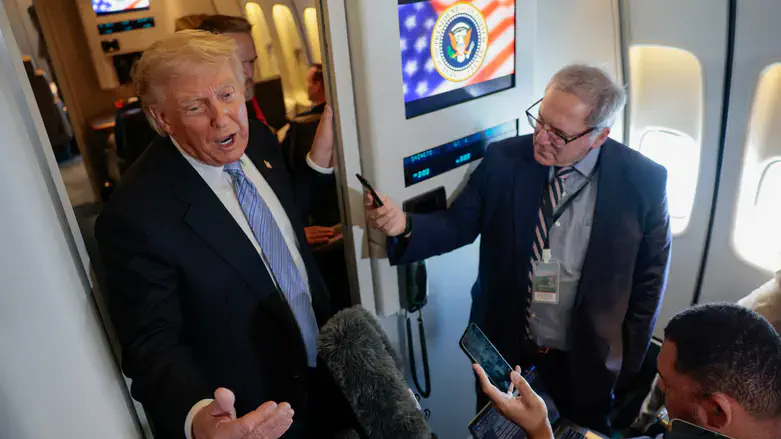
Start with the tell. Last week President Trump flew home from the NATO summit in Ankara on the old Air Force One - not the gleaming, Qatari-gifted jet he’d been showing off. Why? Because the older airplane carries the full set of defensive measures and the new one doesn’t. Multiple reports tied the switch directly to the Iran threat.
The President wasn’t coy about it. He told reporters he sits at the top of the regime’s list - “They want to take out the U.S. leader, me." Israel had handed Washington fresh intelligence, first reported by The Wall Street Journal, pointing to a new Iranian plan to assassinate him. At the Ayatollah’s funeral in Mashhad, mourners waved “We Will Kill Trump" banners, and Iran’s new Supreme Leader, Mojtaba Khamenei - the slain leader’s son - publicly vowed revenge.
So the commander in chief accepts, publicly, that a foreign regime is actively trying to murder him. He changes planes because of it. And on Friday night he posts that “1,000 Missiles are Locked and Loaded" and aimed at Iran should Tehran act on that threat, with orders already given for the military to stand ready, for a full year, to “decimate and destroy" the country.
Now look at what that same administration put right next to all of that this week. A Saturday deadline - delivered to Tehran and reported through Axios - demanding Iran publicly declare the Strait of Hormuz open and stop shooting at tankers. Open the shipping lane by the weekend, or else.
Saturday came. Iran’s answer was not a press release. The Revolutionary Guard fired a missile at the Cyprus-flagged container ship GFS Galaxy as it tried to transit, set it ablaze, drove the crew into a lifeboat, and declared the strait “closed until further notice." By Sunday, U.S. Central Command was launching its third round of strikes of the week, hitting some 140 Iranian targets.
Read those paragraphs back to back and tell me the math works. It doesn't. It doesn’t add up.
We are being asked to treat a plot to kill the President of the United States and a dispute over oil-tanker tolls as if they’re the same negotiation, on the same clock, with the same regime. They are not like adding apples to apples. They are not even in the same orchard. A shipping-lane deadline has exactly nothing to do with whether Iran gets to put a bullet in the president. Reopening the Strait does not lower the kill list. It does not recall the assassins. It does not make the man safer on the older airplane. So what, precisely, does it have to do with his security?
Here’s the part nobody in Washington seems willing to say out loud: you cannot run a routine maritime haggle with a government you simultaneously believe is trying to assassinate your head of state. Either the threat is real - in which case the strait is a sideshow and the entire posture should be built around the President’s life - or it isn’t, in which case somebody explain the old airplane and the thousand missiles.
It can’t be both. Pick one. Right now the government is behaving as if both are true at once, and this weekend that contradiction blew up in real time: a tanker on fire, a waterway slammed shut, and a president trading assassination threats with the very men he’s simultaneously asking to please reopen a shipping lane.
And let me say this as a businessman, because the Strait is my beat. I know exactly what that waterway is worth. It carries roughly one-fifth of the world’s oil. War-risk insurance that was a rounding error before the war now runs toward 3% of a ship’s value, with quotes as high as 5% - millions of dollars to move a single tanker - and traffic has collapsed to roughly a quarter of its pre-war level. Brent crude is back near $76 a barrel with the risk premium climbing again. Every dollar of it lands at the American pump and on the American shelf. I have built my career arguing that these everyday costs matter. They do.
But a shipping crisis is a commercial problem. A plot to kill the President is an existential one. Confusing the two - putting a tanker deadline in the same news cycle, the same breath, the same priority slot as an active assassination threat - is not strategy. It’s a scrambling of priorities.
Comparing apples to apples would mean this: the number-one item on every desk in that administration is keeping the President alive. Full stop. The strait, the tolls, the insurance premiums, the oil price - real as they are - come after that. Instead we got a weekend ultimatum about a waterway, a missile fired at a container ship, a fresh round of strikes, and a president slipping onto the safer plane - and we’re all supposed to nod along as if that adds up.
It doesn’t. One plus one still equals two. Secure the President first. Then, and only then, worry about who opens the Strait and when. Anyone treating those as sides of the same equation is either not doing the arithmetic - or asleep at the wheel.