
Fern Sidman, a former NY correspondent for Arutz Sheva, is the current editor-in-chief of The Jewish Voice, a New York based publication. Her writings can be accessed at tjvnews.com
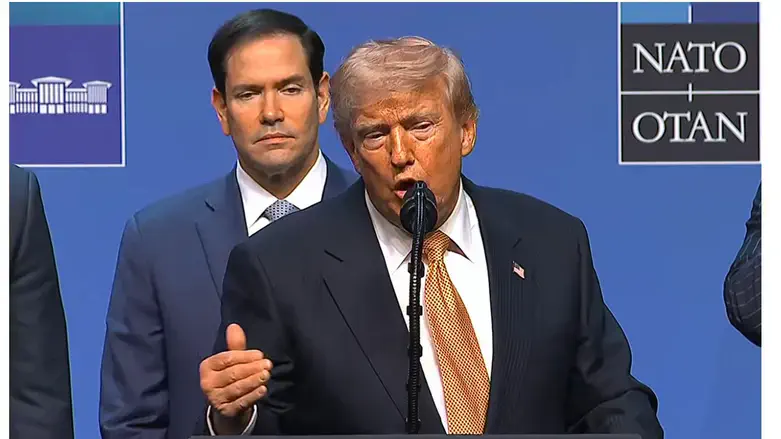
In a moment that demands clarity, sobriety, and strategic discipline, the remarks delivered by President Donald Trump at the NATO summit in Turkey instead reflected a deeply troubling seeming lapse in judgment-one that not only distorts geopolitical reality but risks undermining the very allies who have borne the brunt of confronting the most dangerous threats in the Middle East. His praise for Recep Tayyip Erdogan, coupled with his casual willingness to entertain the notion of providing F-35 fighter jets to Ankara, represents a strategic miscalculation of the highest order.
Trump’s own words deserve to be examined in full, because they are as revealing as they are alarming. “I like President Erdogan. He rolled out the red carpet for me. He is a great man," Trump declared. He then pivoted to criticize Benjamin Netanyahu, stating, “I love Bibi; he is a great Prime Minister. But Bibi said some harsh things yesterday about Turkey and about Erdogan." He went further, asserting, “He could have joined the war, because he doesn't really like Israel. And he doesn't really like Bibi either. But he didn't do it because of me."
This line of reasoning is not merely flawed; it is dangerously incoherent. To praise Erdogan precisely because he “doesn’t really like Israel" but refrained from joining a war against it is not a demonstration of strategic brilliance-it is an admission of how low the bar has been set. The implication that restraint from aggression is somehow worthy of reward, particularly in the form of advanced military technology, defies even the most basic tenets of international security policy.
Let us be unequivocal. Erdogan is not a misunderstood ally. He is a leader who has repeatedly and openly aligned himself with Hamas, an organization recognized internationally as a terrorist entity. His government has provided safe haven and operational space for Hamas operatives, allowing them to function from Turkish soil with a degree of impunity that should be intolerable to any nation claiming alignment with Western security interests. This is not conjecture; it is a matter of record.
Moreover, Erdogan’s rhetoric toward Israel has been consistently hostile, often crossing the line from criticism into outright incitement. Trump himself acknowledged this reality when he stated, “He doesn't really like Israel." That is an extraordinary understatement. Erdogan has not merely expressed dislike; he has positioned himself as one of the most vocal antagonists of the Jewish state on the global stage. To describe such a figure as “a great man" is not diplomacy-it is willful blindness.
Erdogan's rhetoric is even more reprehensible in light of a surprising revelation recently on Israel's Channel 14 by Avi Shushan, former spokesman for Tel Aviv Sourasky Medical Center-Ichilov Hospital. Shushan stated that about seven years ago, when Turkish President Recep Tayyip Erdoğan was gravely ill, the Mossad requested that an Ichilov Hospital specialist be dispatched to Ankara to treat him. The medical expert went from Tel Aviv to Turkey “on behalf of the State of Israel," the state Erdogan now villifies at every opportunity.
Equally indefensible is Trump’s suggestion that Turkey should be considered for acquisition of F-35 fighter jets. These aircraft represent the pinnacle of modern military technology, offering unparalleled stealth, precision, and battlefield integration. They are not diplomatic tokens to be distributed based on personal rapport or momentary restraint. They are strategic assets whose transfer must be governed by rigorous assessments of alignment, reliability, and long-term interests.
Trump’s rationale-that Erdogan “didn’t enter the war" and therefore merits consideration-collapses under even minimal scrutiny. The absence of hostile action is not a qualification for enhanced military capability. By that logic, any adversarial actor who temporarily refrains from aggression could claim entitlement to advanced weaponry. Such reasoning is not merely naïve; it is reckless.
What makes these statements particularly galling is their implicit contrast with Israel’s role in the ongoing confrontation with Iran. It is Israel-not Turkey-that has taken decisive, sustained action against the Iranian regime and its network of proxies. It is Israel that has absorbed the risks, conducted the operations, and demonstrated the resolve necessary to degrade a regime that poses an existential threat not only to itself but to regional and global stability. It is Israel whose population spent hours in shelters.
To put it plainly, if not for Israel’s participation in the war against Iran, the regime would not now be in a state of profound strategic vulnerability. Israel’s intelligence capabilities, precision strikes, and operational daring have fundamentally altered the balance of power. They have imposed costs on Tehran that no other actor has been willing or able to deliver. And yet, in this moment, Trump chooses to lavish praise on a leader who stood on the sidelines while simultaneously criticizing the one who carried the burden.
This inversion of reality is offensive; it is also strategically absurd.
Trump’s comments about Netanyahu are equally misplaced. “Bibi said some harsh things yesterday," he noted, as though frank assessments of Erdogan’s conduct were somehow inappropriate. In truth, Netanyahu’s warnings about Turkey are not expressions of personal animus; they are grounded in a clear-eyed understanding of regional dynamics. When Netanyahu cautions against empowering Erdogan, he is not engaging in rhetorical excess-he is articulating a sober analysis of risk.
To suggest that Netanyahu should temper such warnings in deference to Trump’s personal relationship with Erdogan is to misunderstand the nature of leadership. National security is not a matter of interpersonal courtesy. It is a domain in which clarity, candor, and vigilance are essential.
Trump’s defenders may argue that his approach reflects a pragmatic effort to maintain relationships and prevent escalation. But pragmatism does not require abandoning logic. It does not require ignoring the documented behavior of a foreign leader. And it certainly does not require rewarding that leader with advanced military technology that could, in time, be used to threaten allies.
Indeed, the history of Turkey’s engagement with Western defense systems offers ample cause for caution. Ankara’s prior acquisition of the Russian S-400 missile system led to its removal from the F-35 program precisely because of concerns that sensitive technology could be compromised. Those concerns have not vanished. If anything, they have intensified.
Against this backdrop, Trump’s willingness to revisit the question of F-35 sales appears irresponsible. It signals to allies and adversaries alike that strategic considerations can be subordinated to personal affinity-a message that erodes confidence and invites exploitation.
The broader implications of these remarks extend beyond the immediate issue of Turkey. They touch upon the fundamental question of how the United States defines and supports its alliances. Israel has long been described as America’s most reliable partner in the Middle East, a nation whose interests and values align closely with those of the United States. That alignment has been demonstrated not in words but in actions-through intelligence sharing, military cooperation, and a shared commitment to confronting common threats.
To diminish that partnership, even implicitly, by elevating a leader who has consistently undermined it is to engage in a form of strategic self-sabotage.
There is also a moral dimension that cannot be ignored. Israel’s struggle against Iran and its proxies is not merely a geopolitical contest; it is a defense against forces that openly call for its destruction. Hamas, which Erdogan has supported, does not hide its objectives. It proclaims them. It acts upon them. And it celebrates them. To overlook this reality in the name of diplomatic convenience is to abandon the clarity that such a struggle demands.
Trump’s remarks, taken as a whole, reveal a troubling pattern: a tendency to conflate personal relationships with national interests, to reward minimal restraint as though it were constructive engagement, and to criticize allies who speak uncomfortable truths. This is not a strategy. It is a series of impulses that, when translated into policy, carry significant risks.
The United States does not strengthen its position by flattering adversarial actors. It strengthens its position by standing firmly with those who share its commitments and who have demonstrated their willingness to act upon them.
Trump’s words were not merely ill-considered; they were, quite simply, wrong. They invert the logic of alliance, misread the character of a key regional actor, and diminish the contributions of a critical partner. In a moment that demands strategic clarity, they instead introduce confusion.
There are times in international affairs when ambiguity can serve a purpose. This is not one of them. The stakes are too high, the threats too real, and the lines too clearly drawn. Rewarding Erdogan for not attacking Israel is not diplomacy-it is folly. Considering the transfer of F-35 jets under such circumstances is not pragmatism-it is negligence.
And criticizing Netanyahu for stating the obvious is not leadership-it is a failure to grasp the realities that define this moment.