
I remember that morning in the early nineties.
The Berlin Wall had fallen. The superpower we grew up fearing collapsed from within-and almost no one saw it coming.
A surprising feeling of elation. And that same morning, sitting down to talk with my teacher and rabbi - who had insisted, a full decade before it happened, that "the Soviet Union is a lie, and lies come to an end" - and realizing how deeply he had seen into the inner truth of things, refusing to be captured by what the eyes could see. It stunned me then. It stuns me still.
For a moment, it seemed humanity could breathe. Forty years of Cold War were over, and something in the air said a new chapter was opening.
And right then, in the middle of the euphoria, an argument was born.
Francis Fukuyama said, "That's it." The great ideological struggle is over. Liberal democracy has won, and from here the world will converge toward it. Fewer wars. History arriving at its happy ending.
Samuel Huntington wasn't convinced. Ideologies may have weakened, he said, but human beings don't stop being who they are. Religion, language, memory, tradition - these are the forces that actually move nations. The next wars won't be between ideas. They'll be between civilizations.
More than thirty years have passed. Look around and tell me who was right.
America believed democracy could be exported to any society, any culture. The "Arab Spring" was supposed to prove it works; what we got instead: civil wars, ISIS, and a Middle East less stable than ever. It turns out you can't separate politics from identity. Identity always comes back.
And here is the question that won't leave me alone:
If Huntington was right - are we condemned to live forever in a world of collisions? What about the vision of the prophets? What about Abraham's blessing, to be a blessing to all the families of the earth? Is that just a beautiful hope that reality has shattered?
I don't think so.
Our prophets were not naive. They knew that sometimes you fight - Abraham himself went to war to rescue Lot. Justice sometimes demands a sword. But they also knew something no empire in history ever understood: you cannot force a single culture on all of humanity. Everyone who tried - broke.
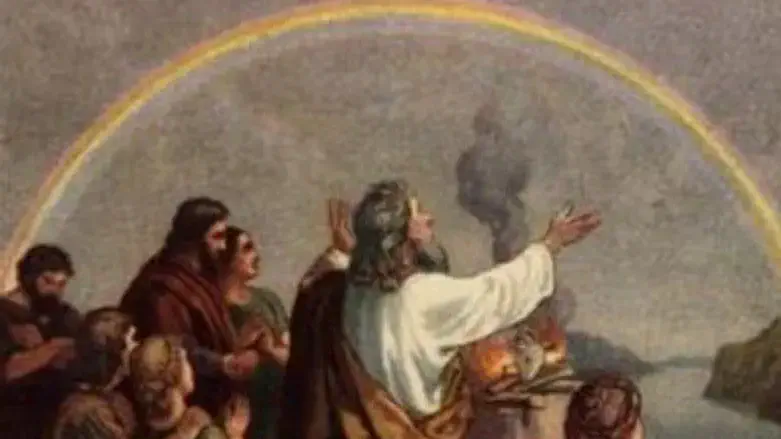
The Torah offers a different way-the idea of Bnei Noach - the Children of Noah.
Every nation keeps its language, its memory, its path - and, at the same time, all human beings can share a common foundation of core values. Not melting everyone into a single mold. A covenant.
Unity without uniformity. Partnership without erasure.
This, I believe, is one of the great things the Torah of Israel has to say to the world - not in some distant future, but now, in Huntington's world.
One more thought, before I close.
At the depth of their argument, both thinkers were really asking the same question: how do you unite the world so it finally stops fighting? Which is exactly the question the prophets of Israel handed to humanity. But one thing is slowly becoming clear: there is no scenario in which one culture - however powerful, however confident in itself - can force its character and its customs onto another.
Look at the streets of Europe today after a football match between a European national team and a team whose fans bring a different culture. Win or lose - the street burns.
And I keep asking myself: is this just fans getting out of hand? Or is something deeper hiding underneath - a mutual attempt at coercion, from both sides, looking for a stage?
Honestly? I'm still not sure. But the fact that the question won't leave me alone convinces me it's far more urgent than it looks.
This is exactly what we will explore at the First International Congress of Noahides, taking place, God willing, in Jerusalem this November-people from dozens of countries, each with their own identity, around one shared foundation.
You're invited to join us.
https://brit-olam.org/congress/
With all my blessings and greetings
"Just be strong and very courageous..."[Joshua 1.7]
Shalom from the Land of Israel,