


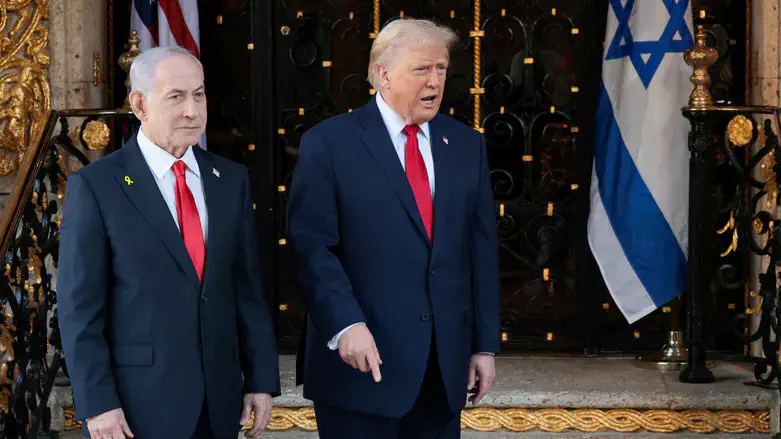
Initial findings from the July 2026 Israeli Society Index by the Jewish People Policy Institute (JPPI) indicate a sharp decline in Israeli public confidence in US President Donald Trump, alongside broad opposition to the recently signed US-Iran nuclear agreement and strong support for the agreement with Lebanon.
The survey found that, for the first time since JPPI began tracking the issue, fewer than one in ten Israelis expresses "a great deal of trust" in President Trump to do the right thing for US-Israel relations. Just 7% said they have a great deal of trust in the president, while 41% said they have some trust and 45% said they have no trust at all.
The figures mark a significant decline from previous surveys. In January 2025, following Trump's return to the White House, 32% expressed a great deal of trust in him, while 21% said they had no trust. During Operation Lion's Roar in March 2026, the share expressing high trust rose to 34%. The decline continued over recent months, falling to 19% in April, 12% in June, and 7% in July, following the signing of the Iran nuclear agreement and the president's public statements.
Among right-wing Israelis, 8% expressed a great deal of trust in Trump and 56% said they had some trust, while the share expressing high trust has dropped from 29% a year ago, shortly after Operation Rising Lion, to 8% today. The proportion expressing no trust has more than doubled.
Among centrists, 58% said they have no trust in Trump, rising to 74% among the center-left. In both groups, no respondents expressed a great deal of trust in the president. Among those who voted for Likud in the 2022 election, 15% expressed high trust, while distrust reached 58% among National Unity voters and 77% among Meretz voters.
Among Jewish Israelis alone, 5% expressed a great deal of trust in Trump, while 46% said they have no trust in him whatsoever.
Despite the decline in confidence in the president, 74% of Israelis said they still regard the United States as a true friend of Israel.
The poll also found broad agreement on how Israel should manage its relationship with Washington. Sixty-six percent of Israelis, including 77% of Jewish Israelis, said Israel should seek to coordinate with the US administration whenever possible but ultimately act according to what it believes is in its own best interests when disagreements arise. Only small minorities said Israel should always defer to Washington or disregard US positions altogether.
The survey found broad opposition to the agreement signed between the United States and Iran.
While 55% of Israelis expressed concern in June as the agreement was taking shape, 68% now believe it is bad for Israel following its signing, including 56% who described it as "very bad for Israel," up from 34% one month earlier. Fourteen percent said they believe the agreement is good for Israel.
Among Jewish Israelis, 68% described the agreement as "very bad for Israel," while no Jewish respondents selected the option that it is "very good for Israel."
Opposition extended across the Jewish political spectrum, with 72% of Likud voters, 89% of Religious Zionism voters, 91% of Labor voters and 81% of Meretz voters viewing the agreement negatively. Among Arab Israelis, 57% said they believe the agreement is good for Israel.
By contrast, the agreement with Lebanon received broad public support. Sixty-three percent of Israelis said the agreement is good for Israel, while 18% disagreed.
Support was nearly identical among Jewish and Arab Israelis, at 63% and 64% respectively. It also crossed political lines, with 68% of right-wing respondents and 62% of left-wing respondents supporting the agreement.
The survey found that Israelis remain divided over the future of Gaza.
Forty-three percent favored attempting to weaken Hamas through economic and diplomatic means, while 35% supported returning to military operations until Israel's stated objectives are achieved. Fourteen percent said the current situation should be maintained.
Among Jewish Israelis, 50% favored economic and diplomatic pressure while 41% supported renewed military operations to eliminate Hamas rule. Among Arab Israelis, 51% supported maintaining the current situation and preserving the ceasefire.
Political divisions were also reflected in responses on Gaza. Sixty-eight percent of respondents on the right favored renewing military operations, while 70% of centrists and 92% of left-wing respondents supported economic and diplomatic pressure.
A similar poll by the Israel Democracy Institute published earlier this week found that the share of Israelis who believe Israel's security is a central consideration of President Trump's fell from 44% in May to 28% in June. The survey, conducted among 603 Jewish respondents and 151 Arab respondents between June 28 and July 1, also found that among Jewish respondents, the belief that Israel can fully rely on Trump declined by 38 percentage points between March and June 2026. Just over one-third of Israelis said they believe Israel's strategic security situation is better today than it was before the war with Iran.
A separate survey by the Associated Press-NORC Center for Public Affairs Research, conducted between June 11 and June 17 among 3,040 respondents, including 1,022 Jewish adults, found continued declines in support for Israel among US adults. Forty percent said the US is "too supportive" of Israelis, while 39% said the US is "not supportive enough" of Palestinian Arabs. Among Democrats, 58% said the US is "too supportive" of Israelis, up from 45% in January 2024, while 21% of Republicans shared that view. The survey also found that one-third of American Jewish adults believe Israel has committed genocide in Gaza, while 49% said it has not. Among US adults overall, about one-third said they believe Israel has committed genocide, including roughly half of Democrats. The poll further found that 38% of US adults hold an unfavorable view of Prime Minister Benjamin Netanyahu, compared to 28% who view New York City Mayor Zohran Mamdani unfavorably. Among Jewish adults, about six in ten viewed Netanyahu unfavorably, while 39% viewed Mamdani negatively and 44% viewed him positively.