
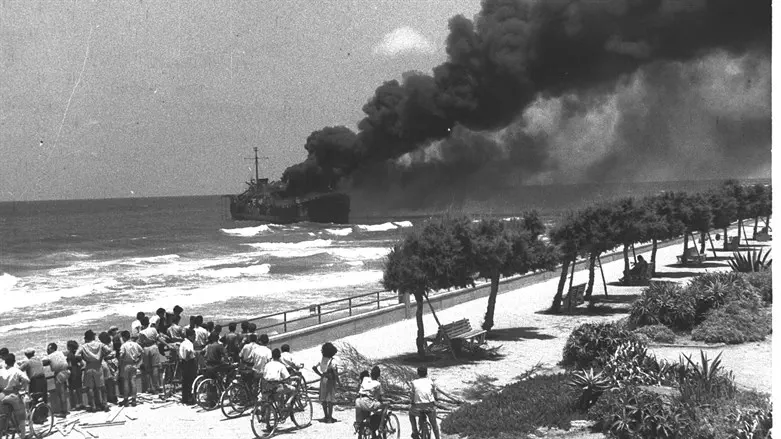
One of the most searing, frightening but ultimately instructive events in the creation of the nascent State of Israel was the attempted landing, leading to the attack and the sinking of the Altalena beginning on June 20, 1948. The ship was carrying weaponry that was going to be used by Revisionist Irgun forces as well as the newly configured IDF.
While the weaponry was desperately needed, the issue became one of ownership and control. There was a dispute between then Israeli Prime Minister and Irgun leader and future Israeli Prime Minister Menachem Begin while the ship was moored alongside Kfar Vitkin north of Tel Aviv as to the allocation of the weapons that the Irgun was bringing into the country.
Ben Gurion refused Begin’s proposal to have most of the weaponry allocated to the Irgun units that had been recently incorporated into the IDF, arguing that it would be facilitating the creation of an “army within the army."
The result was Ben Gurion’s decision to provide an ultimatum of surrender, to which, partly because of its 10 minute “or else" demand, Begin did not respond. The result was firing on both sides at Kfar Vitkin, and then the departure of the ship for Tel Aviv.
Just off the coast of Tel Aviv, the ship was heavily attacked by IDF forces. Even after a white flag was hoisted on the boat, firing continued. The result was that 16 Irgun fighters were killed, as were three IDF soldiers (one in Tel Aviv and two at Kfar Vitikin).
Begin himself was on board the boat in Tel Aviv, refusing to leave the ship until all the wounded had been rescued.
While the reality of internecine conflict among Israeli soldiers is cringeworthy, the great lesson of the day, and the lesson that must endure, was provided by Menachem Begin, who refused to let his soldiers confront the IDF.
“Civil war -never." "Do not raise a hand against a brother, not even today. It is forbidden for a Hebrew weapon to be used against Hebrew fighters." “Don’t shoot back!"
Begin’s words were, as he later said, his finest hour. He understood on an existential, even spiritual level the implications of what could have happened, and how it could have destroyed the enterprise of the defense and establishment of a Jewish State of Israel.
Recognizing the ongoing, perennial significance of the Altalena affair, Im Tirtzu, Israel’s largest grassroots Zionist organization, recently commissioned a boat and brought nearly 100 passengers to the site of the Altalena’s sinking in order to commemorate the 78th anniversary of the event, and to reflect on the significance of what did and did not happen.
The message to the passengers was clear and unequivocal: the Altalena was not just an isolated historical event, but a traumatic lesson in the fragility, the vulnerability of our national quest and enterprise.
Above all, the Altalena must continue to resonate with all who cherish the State of Israel and who seek to nurture our ongoing mission as the Jewish Homeland, the light unto the Nations, and the fulfillment of His promise to return us to our Home.
The very close call with national implosion that the Altalena represents must be seen as a continual warning, the proverbial flashing yellow light of danger. Our society is fraught with internal divisions that most of us could recite in our sleep.
While we can project great strength and effect against our external enemies, we must be oh so careful how we confront each other. And of course, confronting each other has become something of a national pastime.
This pastime is not a sport, or if it is, it is a blood sport. It is a willingness to erode the pillars of our society and to fray the bonds that hold us together.
The sovereignty of the great Kings David and Solomon lasted for 80 years. Shortly thereafter, the kingdom divided, and the course of our national self-destruction was set into motion. We are now 78 years into our sovereign return. The 80 year mark looms as a sober reminder.
We know that “sinat hinam," baseless hatred, was the cause of the destruction of the Second Temple, and remains our great vulnerability and challenge. Those who disdainfully believe that “it can’t happen here" should pay close attention to the Altalena affair.
Occurring when we all might have assumed that the newborn Israel was resolutely and solely focused on the swarming Arab threat that surrounded it, we were capable and yes, willing, to endanger and possibly abort our national quest because of internal differences over control.
The more things change the more they stay the same.
Yes, Israel is immensely powerful, but we are also immensely vulnerable. We need to internalize the understanding of Menachem Begin and understand that while we are trying to improve and rectify our society, we cannot let go of the reins of restraint, respect and acceptance of those who disagree with us.
The world is increasingly seeking to demonize Israel. We cannot afford to follow their lead and do it to ourselves.
Douglas Altabef is the Chairman of the Board of Im Tirtzu and a Director of the Israel Independence Fund