

A new 65-page report published by the left-wing organizations Peace Now and Kerem Navot details what the groups describe as a significant expansion of Israeli government activity in Judea and Samaria between 2023 and 2025.
While the report argues that the government has accelerated what it characterizes as the "annexation" of the territory, it also documents a substantial increase in settlement construction, infrastructure development, and administrative changes during the three-year period.
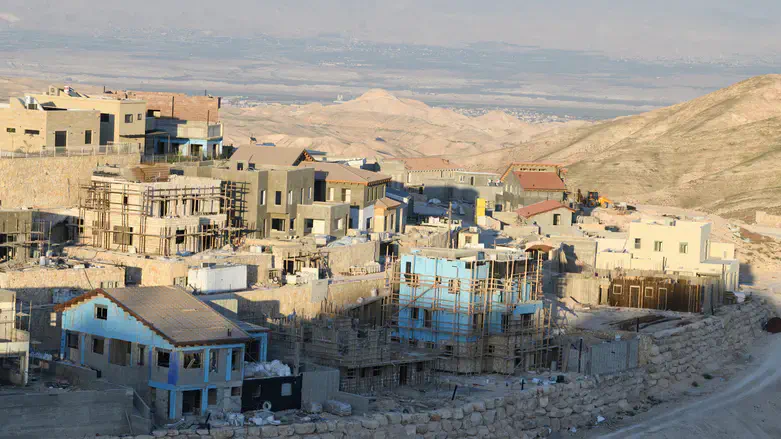
According to the report, 185 new outposts were established between 2023 and 2025, including approximately 130 agricultural farmsteads and hilltop sites. It also states that planning advanced for 40,064 housing units in Israeli communities across Judea and Samaria, including 27,941 units in 2025 alone-more than double the previous annual record, according to the report's authors.
The report further says that 102 new communities and outposts were approved or legalized during the same period.
It also notes that Israel declared 25,959 dunams as state land over the three years, an area the authors say accounts for nearly half of all land designated as state land since the beginning of the Oslo process.
According to the report, at least 223 kilometers (139 miles) of new roads were constructed or opened, while Israeli agricultural activity expanded to at least 11,520 dunams. The authors estimate that agricultural outposts now encompass more than one million dunams.
One of the report's central findings concerns changes to the governance of Judea and Samaria. It highlights the transfer of broad civilian authorities from the Civil Administration and the military chain of command to Bezalel Smotrich and the Settlement Administration within the Defense Ministry.
Smotrich has previously described the move as "a DNA change for the system." According to the report, the transferred responsibilities include planning and construction, land registration, infrastructure development, road projects, nature reserves, and enforcement.
The report also states that the requirement for the defense minister to approve each stage of settlement planning was eliminated, a change the authors say significantly accelerated planning procedures.
The document also examines the renewal of Israeli settlement activity in northern Samaria following the repeal of restrictions preventing Israelis from entering the sites of communities evacuated during the 2005 Disengagement. It says the government has renewed efforts to develop the former communities of Homesh, Sa-Nur, Ganim, and Kadim, while also investing in infrastructure, roads, and heritage projects throughout the Jenin and Samaria region.
In addition, the report claims that 118 Palestinian communities and shepherding encampments were displaced between 2023 and 2025, attributing the departures primarily to violence and restricted access to grazing land and water.
The authors argue that these developments reflect a coordinated government policy designed to strengthen Israeli control in Judea and Samaria. At the same time, the report's data documents the scale of government activity in settlement construction, land administration, infrastructure, and civil governance during the period under review.