

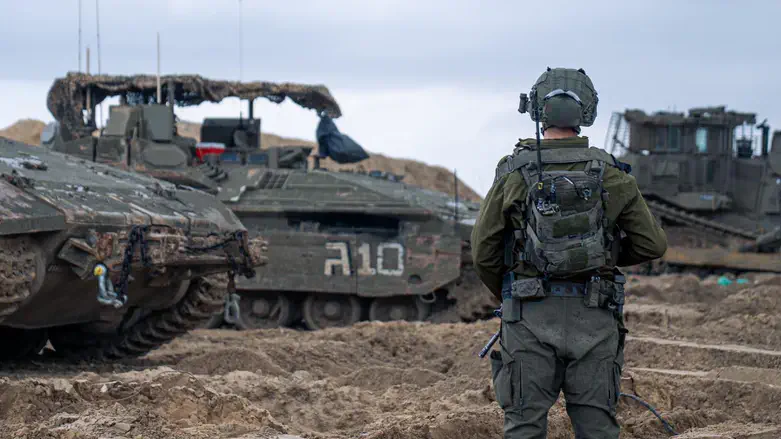
Nearly three years after the October 7th Massacre, the IDF has completed a series of major structural and perceptual changes to the readiness orders, force structure, and defense doctrine as a result of the main lessons learned from the operational and intelligence failures which led to the surprise attack.
Kan Reshet Bet radio reported that the old defense doctrine, which collapsed, has moved from static defense on the physical border to dynamic and forward defense within enemy territory.
It was further reported that since the outset of the war, the IDF has maintained operational control over approximately 1,220 square kilometers of enemy territory, and defense officials note that the scope and area of defense today are hundreds of percent greater than those before the war.
Additionally, a new General Staff readiness order, dubbed Raam (thunder), has been formulated. The order includes a separate, tested, and precise response to one-front scenarios and multi-front scenarios. Following the failure of the chain of command on the day of the massacre, the new order grants division and regional commanders the independent legal authority to swiftly mobilize regular and reserve troops during extreme scenarios without General Staff approval.
The report also states that in contrast to the set situation before the war, where every security zone had only one response order, now a wide range of possible responses have been formulated for each command, which are appropriate for various events, with the aim to improve accuracy and speed of operational responses.
In addition, the combat units' response times have been significantly shortened, and the force size of the General Staff battalions assigned to the various sectors has been increased.
Along with changing the commands on the ground, the General Staff has decided to establish a security brigade within the Operations Directorate, which would be responsible for the coordination, synchronization, and leadership of all security issues in the IDF, including information security, the defense of camps and bases, and the personal security of soldiers and commanders.
The new brigade is currently in advanced stages of its formation, and according to the operational plan, is scheduled to begin operation in the coming months.