
You'd think I'd know better by now than to read the comments section. The first few days after October 7th should have shown me that they're nothing but a cesspool of Jew hatred, conspiracy theories, and the very worst that humanity has to offer. But I must be a glutton for punishment, because I still look, and am still shocked every single time.
And it's been worse the past few weeks. Just yesterday, I read an article that had such comments attached to it as "These Jews are filthy parasites." "Hitler should have finished the job." "Good to see these freaks finally getting what they deserve." And "Keep at it. Violence is the only thing that works with these animals."
It hit harder. Not because the comments were any more disgusting the usual, but because in this case, the issue was the haredi draft protests and the commentators were other Jews.
I've gone on record as supporting haredim joining the IDF. My own son is already thinking about where he'd like to serve when the time comes in a couple of years. I have seen firsthand the positive effect that army service can have on young men, how it can give them a sense of personal pride and direction in life. I've even written critically in the past about haredi protest methods. I think the once-realistic fear of religious soldiers possibly becoming less observant in the IDF is sidelined by the Hashmonaim Brigade.
But none of my support means I want to vilify the opposition. I might disagree with them, even strongly and on fundamental issues, but that doesn't mean I think they're bad people. And it certainly doesn't mean I'd wish any harm on them.
That's why it's so shocking to see so much hatred coming from the Jewish community. So many Jews here in Israel look at the haredim as their enemies. There is deep disappointment, bordering on outright aversion, with the haredi sector's non-participation in the existential war waged in response to October 7 that caused many Israelis, including a sizable proportion of Religious Zionists, to resent haredim who are not learning Torah seriously but evade the draft. Their anger may be justified, but one would think that after October 7th, we would have learned that if the enemy doesn't see a difference between types of Jews, then neither should we. Instead, it seems like many have reverted to a pre-October 7th mindset, where divisiveness and distrust played too large a role in Israeli society.
Have we really learned nothing from the lessons of the past few years? It seems as soon as we get a break from the external enemies, we start looking for internal ones. The comments on haredi draft protestors, had they been written by non-Jews, would have been rightly and universally condemned. These comments by our fellow Jews are just as vile, just as hateful, and deserve just as much of our condemnation. Hatred against Jews doesn't become justified when it's expressed by other Jews. What is unacceptable for the world to say should be equally unacceptable to say about ourselves.
It's not possible to say that these are a few bad actors or that every community has its fringe lunatics. The poison has spread far beyond the madding crowds. Last week, National Security Minister Itamar Ben Gvir announced that he was considering firing Brak station commander Chief Superintendent Yuval Shavit over the disgraceful conduct of his officers in dealing with haredi protesters, in an altercation that left dozens of individuals, including bystanders and children, with severe police-inflicted injuries. Ben Gvir stated that he was contemplating the permanent removal of officers and commanders discovered to have breached police protocols, including the commander of the Bnei Brak station.
The minister’s comments came after videos circulated widely showing officers dragging haredi protesters by their ankles, tearing one protester’s pants, and using stun grenades and batons during the demonstration. The footage sparked widespread criticism within the haredi community and prompted renewed calls for an independent investigation into police conduct.
Israel Police Commissioner Danny Levy responded that their behaviors constituted a “significant police action" and were necessary to deal with the hundreds of protesters blocking Route 4 during the early morning hours. He further praised the police officers for their actions, stating that in a “complex operational reality," they displayed admirable real-time decision-making skills.
And if the comments section is anything to go by, a significant segment of the Israeli population not only agrees with Commissioner Levy, but is actually delighted at the extreme actions taken against their countrymen.
Imagine for a moment that the protestors the police had brutalized had been Arab (or anti-judicial reform protesting leftists). The entire world would have been up in arms against the Jewish State. Politicians from all parties would be issuing unequivocal denunciations of the event, and within the Jewish community itself, there would be wide spread unanimous condemnations against the actions. Jewish Organizations, from the haredi to the most secularly liberal, would rush to issue statements claiming that, in no uncertain terms, these actions did not reflect the values or beliefs of the Jewish people. As was rightly the case a few months ago when an Israeli soldier destroyed a Christian religious icon, the Jewish world would have been united in condemning in the strongest possible terms the violence against the other.
But because in this case the victims were Jews, it seems a totally different set of rules applies. It seems that because the offending party is one of us, anything goes and everything is justified. I gave a small sample at the beginning of this article of the copious amounts of vitriol being spewed out against haredi protestors. Imagine for a moment two things.
First, imagine that these comments were made by non-Jews. They would be roundly and rightfully condemned as the grossest of antisemitism. We would be disgusted with what was being said and fight against it to the utmost of our abilities. Why then are we Jews making the same sickening comments we reproach our enemies for?
Secondly, consider if these hateful comments were made about non-Jews. Consider how quickly we would condemn them, and justly. Think how we would do everything in our power to weed out the hatred that had infected our community. Why then, when we know it's unacceptable to make these vile comments about others, do we feel justified in making them about ourselves?
One doesn't have to support the haredi draft protestors. In a free and democratic society such as Israel strives to be, spirited and open debate are one of the foundations of free speech. One can even condemn their actions, and indeed, there is much the haredi world should be doing differently. But to vilify an entire group of people. To portray them the same way our most hateful enemies do. To become the very thing we have been fighting so hard against since October 7th, this is not, and should never be allowed to become, our way.
The world is watching us. Think with what glee they see us turning on each other. Our own hateful comments only give fuel to their own. They look at what we say and justify their own statements by arguing that we are saying the exact same thing. And the truth is, what's been said about the haredim is just as abhorrent and odious as the words the worst antisemites have been able to come up with. Are we really going to do their work for them?
We cannot let ourselves return to the divisions and disunity that have plagued the country for so long. Do we really have so few enemies that we have to fight each other? We need to be better than this. It's the only way our country can hope to survive.
In the Mishna in Yevamot, it's brought down that "Although Beit Hillel prohibit the rival wives to the brothers and Beit Shammai permit them, and although these disqualify these women and those deem them fit, Beit Shammai did not refrain from marrying women from Beit Hillel, nor did Beit Hillel refrain from marrying women from Beit Shammai. Furthermore, with regard to all of the disputes concerning the halakhot of ritual purity and impurity, where these rule that an article is ritually pure and those rule it ritually impure, they did not refrain from handling ritually pure objects each with the other, as Beit Shammai and Beit Hillel frequently used each other’s vessels."
We can disagree. Deeply. And this is how. We must disagree while still loving those we argue with. We can never see our fellow Jews as the "other", as an enemy. And we can never allow ourselves to look to them with hatred.
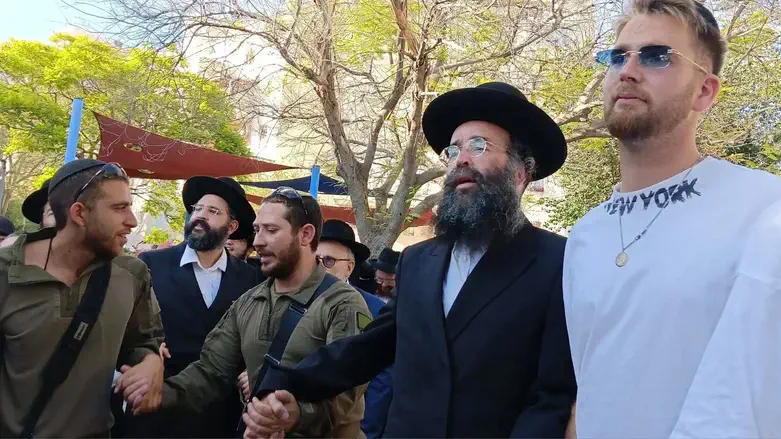
There is hope. Recently, I was privileged to attend a Hachnasat Sefer Torah. It was a bittersweet occasion as the new Torah scroll was written in honor of a fallen soldier. The soldier was himself a haredi Jew. But it was not only his co-religionists who came to honor him. His entire unit, mainly secular young Israeli men, proudly held the Torah written in his honor as it made its way down the street. I witnessed soldiers and rabbis dancing down the street together, arm in arm, singing with joy and hugging each other like the family they really were.
The haredi draft issue is a complex one. People on both sides feel passionate about it, and they should. I don't pretend to offer an easy solution to what is a complex argument. All I am saying is that we must find a different way to argue.
Ilan Goodman is a museum collections professional and exhibition curator. He also serves as a rabbi and educator. He made Aliyah to Israel in 2011 and lives with his wife and children in Beit Shemesh.