
In today’s climate of deep division and rising emotional intensity within the Jewish community, disagreements have not only sharpened-they have become corrosive. Lines are crossed in speech that would once have been unthinkable. When people are shocked or outraged by the actions of those on the other side of an ideological divide, language becomes a weapon.
Among the most severe expressions in the Hebrew language is the curse Yimach Shemo V’Zichro-“May his name and memory be blotted out."
For generations, these words were reserved for the enemies of Klal Yisrael-the Amaleks of history, the destroyers of our people. Today, tragically, they are sometimes directed at fellow Jews: political opponents, ideological rivals, or Jews who have strayed from Torah.
This is not a minor slip of language. It is a collapse of boundaries that the Torah itself draws with absolute clarity.
The Torah, Halakha, Chazal, and the conduct of our Gedolim all point in one direction with unmistakable force: no matter how sharp the disagreement, no matter how far another Jew may have fallen, this language does not belong anywhere near a fellow Jew.
The Torah draws a clear line: “You shall not curse the deaf" (Vayikra 19:14). Chazal explain in Sanhedrin 66a that the Torah is not speaking narrowly about a deaf person. It is setting the lowest possible threshold: even someone who will never hear the insult is protected. If that is true there, then all the more so when speaking about someone who hears, feels, and is wounded by every word.
The Rambam (Hilchos Sanhedrin 26:1) rules plainly: cursing a fellow Jew is a Torah violation.
But Yimach Shemo is not a regular curse. It is not merely insult or anger. It is a declaration that a person’s existence, memory, and legacy should be erased entirely. That is already a step beyond ordinary prohibition. It collides directly with ona’as devarim and with the Torah’s command, “You shall not hate your brother in your heart" (Vayikra 19:17).
To understand the gravity of this expression, one must understand where it comes from.
Its source is the command regarding Amalek: “You shall blot out the remembrance of Amalek from under heaven" (Devarim 25:19).
There, and only there, the Torah speaks in these terms. There, and only there, destruction of memory is a mitzvah.
In Torah thought, a shem-a name-is not a label. It is identity, essence, and mission. To say a person’s name should be erased is to declare that he has no place in history, no future, and no connection to anything enduring.
That language was given for Amalek-not for Klal Yisrael.
To take it and apply it to a fellow Jew is not a small misuse of words. It is a fundamental distortion of Torah categories.
Chazal state the foundation that must never be blurred: Yisrael, af al pi shechata, Yisrael hu-“A Jew, even if he sins, remains a Jew" (Sanhedrin 44a).
A Jew may fall to the lowest depths, but he is still inside the system of Klal Yisrael. No one has the authority to push him outside of it.
This is not theory-it is reflected in the story of Pinchas and Eliyahu HaNavi.
Pinchas acted with fierce zeal in stopping a public desecration of Hashem’s Name. His act halted a plague and he was granted a Bris Shalom.
The Midrash identifies Pinchas with Eliyahu.
Yet later, Eliyahu stood before Hashem and declared: “I have been very zealous… for the Children of Israel have abandoned Your covenant" (Melachim I 19:10 Haftara of Pinchas).
And here the turning point comes. Chazal explain that Hashem rejected this indictment of Klal Yisrael. According to Pirkei D’Rabbi Eliezer, Eliyahu was rebuked for prosecuting against the Jewish people and was effectively removed from his role until he accepted a different mission.
From that moment, Eliyahu becomes the witness at every bris milah. At every bris, he is forced to see what he could not deny: no matter how low Jews may fall, they continue to bind themselves to the covenant of Avraham Avinu. The connection is never severed.
That is the correction: even justified zeal becomes dangerous the moment it turns into writing off Klal Yisrael.
The same pattern appears in Chazal.
Rabbi Meir was disturbed by violent people who harmed him and prayed that they die (Berachos 10a). His wife Beruriah confronted him sharply.
She did not soften the issue. She corrected the core assumption.
The verse says: “Yitamu chata’im min ha’aretz"-not sinners, but sins. The target is evil itself, not the human being.
Rabbi Meir accepted this without argument. He changed his tefillah-and they repented.
That is the Torah’s line: eliminate sin, not people.
The Chafetz Chaim confronted the same distortion in his time, when Jews spoke with contempt about those drifting away from Torah.
He rejected it completely. His analogy is devastatingly simple: a sick child is still a child. No father declares him beyond the family because he is unwell. He treats him.
So too with Jews who have fallen away. They are not enemies to be discarded. They are ill and in need of healing.
Rabbi Yosef Chaim Sonnenfeld expressed this with even sharper clarity.
In Ish Al HaChomah, when someone used Yimach Shemo about a Jewish apostate, he cut him off immediately.
“How can you say Yimach Shemo about a Jew? You do not see what remains inside him. You do not see what can still come from him."
That is not sentimentalism. It is realism. You simply do not know the future. A Jew written off today may return tomorrow. Even if he does not, generations of Torah descendants may emerge from him. You are not allowed to erase what you cannot see.
This becomes even more urgent during the Three Weeks, when we mourn the destruction of the Beit HaMikdash.
The Gemara (Yoma 9b) states clearly: the Second Beit HaMikdash was destroyed because of sinat chinam.
But that hatred did not begin with violence. It began with speech. It began with contempt. It began with Jews deciding other Jews no longer counted.
That is exactly where Yimach Shemo belongs. It is the verbal form of exclusion from Klal Yisrael.
The response is not vague love. It is a reversal of that entire mindset.
Ahavat chinam means refusing to cross the line that erases another Jew.
This does not mean surrendering truth or blurring differences. The Torah demands clarity and strength. We must oppose wrongdoing and stand firm for what is right.
But the line is absolute:
We can reject actions.
We can reject ideas.
We can fight falsehood.
We cannot erase people.
Every Jew is created b’tzelem Elokim.
Every Jew remains part of the eternal covenant between Hashem and His people.
Every Jew retains the possibility of return.
And no human being is authorized to declare otherwise.
This is not just a question of etiquette or sensitivity. It is a question of whether we accept the Torah’s definition of a Jew or replace it with something else.
In times of tension, the test is not only what we believe-it is what we allow ourselves to say about another Jew.
We fight sin, not people.
We oppose falsehood, not erase those who hold it.
We pray for teshuvah, not destruction.
And if speech helped bring destruction in the past, then repaired speech is part of rebuilding.
The Beit HaMikdash will return when Klal Yisrael returns-not only in action, but in how we speak about one another.
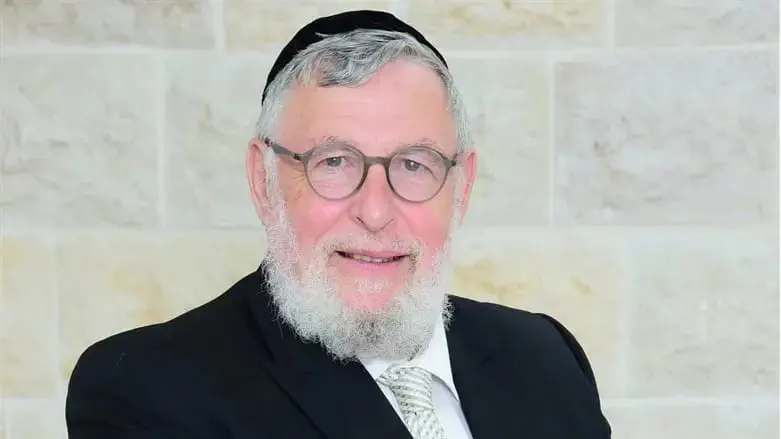
Rabbi Eliezer Simcha Weisz is a member of the Chief Rabbinic Council of Israel.