

While international delegations and local leaders assembled in the Iranian capital to honor the late Supreme Leader Ayatollah Ali Khamenei, Israel's official Persian-language social media presence openly derided the proceedings.
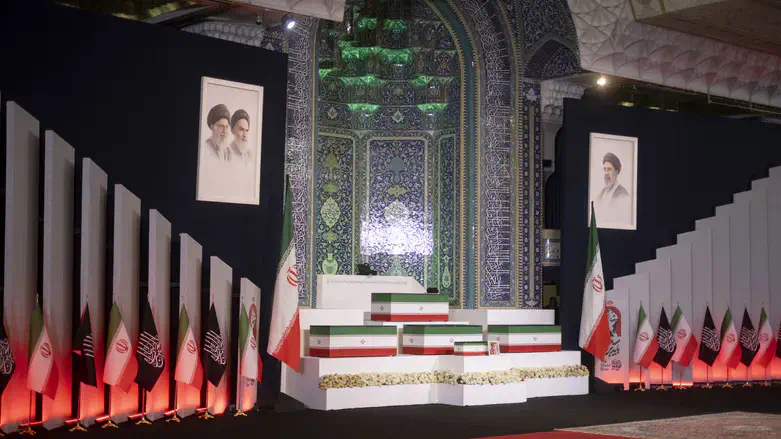
The online mocking coincided with a major gathering on Friday inside Tehran, where dignitaries viewed the coffin of Khamenei. The late leader was eliminated on February 28 during a coordinated military strike executed by the United States and Israel.
The State of Israel's official Persian-language account on X posted an inquiry targeting the state funeral, writing, “Seriously, what did they put in that coffin?"
Hours later, the same account published another message targeting the crowd size: “Many people come too - not to mourn, but to make sure he’s really dead."
Concurrently, a report from the AFP news agency detailed that Iran's highest-ranking administrative figures initiated a weeklong sequence of memorial ceremonies on Friday. Global allies and local mourners entered Tehran, where the former supreme leader's body is currently lying in state.
Domestic authorities anticipate that the public processions and viewing cycles will draw millions of participants before the final interment takes place next week.
Photographs released by AFP captured mourners holding the casket inside the expansive Grand Mosalla religious venue located in the capital city. The coffin itself was heavily draped in the national flag of the Islamic Republic, a nation Khamenei commanded for over three decades.
State-run television broadcasted images of Iranian President Masoud Pezeshkian paying respects before the casket on Friday afternoon. He was accompanied by Parliament Speaker and chief diplomatic negotiator Mohammad Bagher Ghalibaf, who was filmed weeping at the scene.
Additionally, Revolutionary Guards commander Ahmad Vahidi made his very first public appearance since the military conflict erupted in February.
Numerous foreign officials arrived to observe the proceedings. Among them were Pakistani Prime Minister Shehbaz Sharif, whose administration has consistently acted as a mediator between Iran and the United States to de-escalate the broader Middle East war; former Russian President Dmitry Medvedev; and the foreign minister representing Afghanistan's Taliban government.
Furthermore, delegation teams representing the Hamas and Hezbollah terrorist organizations - both proxies of Iran - arrived at the compound ahead of the public ceremonies.
With delegations from roughly 30 countries slated to travel to Tehran for the official services, other global partners - including China and neighboring states from the Caucasus territory - confirmed they are dispatching official representatives.
In preparation for the extensive influx of domestic and international visitors, municipal organizers are dressing the city for large displays of nationalism. Security remains heavily heightened across Tehran, with massive portraits and historical quotations from Khamenei hung along the exterior surfaces of the Grand Mosalla complex.
(Arutz Sheva-Israel National News' North American desk is keeping you updated until the start of Shabbat in New York. The time posted automatically on all Israel National News articles, however, is Israeli time.)