

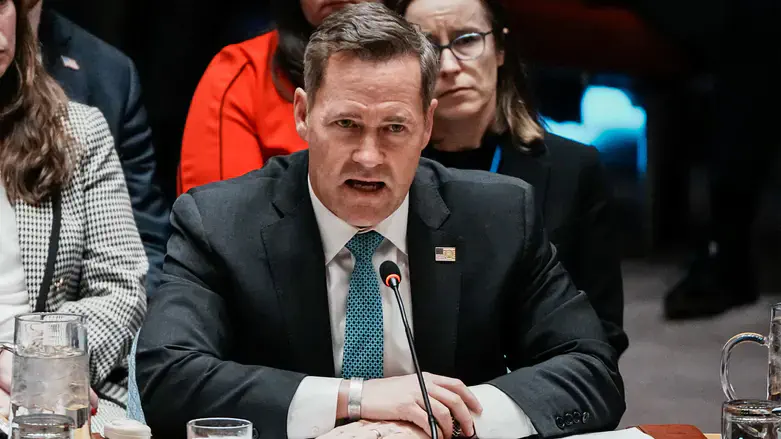
The UN Security Council convened an emergency meeting on Wednesday to discuss renewed tensions between the United States and Iran following recent military exchanges, with US Ambassador Mike Waltz warning that "President Trump's patience is not unlimited" despite ongoing diplomatic efforts.
"Iran cannot, and we cannot allow it to, hold the world's economy hostage," Waltz told the Council, accusing Tehran of halting shipping through the Strait of Hormuz. While stressing that "a real transformative positive opportunity for the nation and people of Iran is on the table," he added that "President Trump's patience is not unlimited."
Opening the session, Elizabeth Spehar, Assistant Secretary-General for Peacebuilding and Peace Support, warned that the current ceasefire remains fragile.
"Each new strike, each new interception, each new maritime incident increases the risk of miscalculation," she said. "A return to full-scale hostilities would have catastrophic consequences - for the peoples of the region, for international peace and security, and for the global economy."
Spehar reviewed developments since June 25, including attacks on commercial shipping in the Strait of Hormuz, subsequent US strikes on Iranian coastal military infrastructure, Iranian attacks on US military facilities in the Gulf, and the agreement by both sides on June 28 to halt attacks.
"Sustained political will and continued engagement will be critical to overcoming the current challenges and achieving a mutually acceptable and lasting agreement," she said, urging all parties to exercise maximum restraint.
Bahrain's Foreign Minister Abdullatif bin Rashid Al Zayani told the Council that his country has been subjected to 808 attacks since February 28, including 203 ballistic missiles and 605 armed drones.
"These attacks deliberately targeted civilian facilities, critical infrastructure and residential areas," he said, adding that they resulted in three deaths and hundreds of injuries.
He rejected Iran's assertion that its attacks targeted only military objectives, citing an April 5 drone strike on an ammonia storage tank in a residential area.
"Bahrain is an independent sovereign nation that is not a party to any conflict," he said, calling on the Security Council to establish a mechanism to monitor implementation of the recent memorandum of understanding and ensure accountability.
Kuwait also condemned what it described as repeated Iranian attacks on its territory.
"Kuwait condemns in the strongest terms the Iranian unwarranted, repeated attacks against the territory and airspace of Kuwait as well as its critical infrastructure," Ambassador Faisal Alenezi said.
According to Alenezi, Kuwait has faced 893 drone attacks and 873 ballistic missile attacks during the latest escalation, resulting in casualties and damage to critical infrastructure, including the country's airport.
Iran's Ambassador Amir Saeid Iravani rejected the accusations, accusing Washington and Israel of initiating the conflict.
"The facts are clear," he said. "The United States betrayed diplomacy twice" by launching attacks against Iran while negotiations were underway.
"Iran is the main victim of the wars of aggression launched by the United States and the Israeli regime. The role of the victim and the aggressor must not be reversed," he added.
Iravani also accused Western members of the Council and Bahrain of making "unfounded accusations" while ignoring what he described as unlawful aggression against Iran.
He maintained that Iran's priority is "the full implementation of the MoU and the continuation of negotiations towards a comprehensive deal," urging the Security Council to support diplomacy and avoid actions that could undermine negotiations.
Pakistan's Ambassador Asim Iftikhar Ahmad described the Islamabad Memorandum of Understanding as "a victory for diplomacy," saying Pakistan and Qatar had held meetings with both US and Iranian negotiators in Doha.
"The fact that the talks are continuing and the parties are at the negotiating table is a significant positive outcome," he said.
The United Kingdom voiced support for the implementation of the memorandum and the ongoing negotiations while emphasizing the importance of freedom of navigation through the Strait of Hormuz.
Panama condemned the June 27 attack on a Panamanian-flagged tanker in the Strait, calling it "absolutely unacceptable" and a serious threat to international maritime security.
Several Council members also stressed the need to restore safe passage through the Strait of Hormuz and urged all sides to preserve the ceasefire and continue negotiations.