
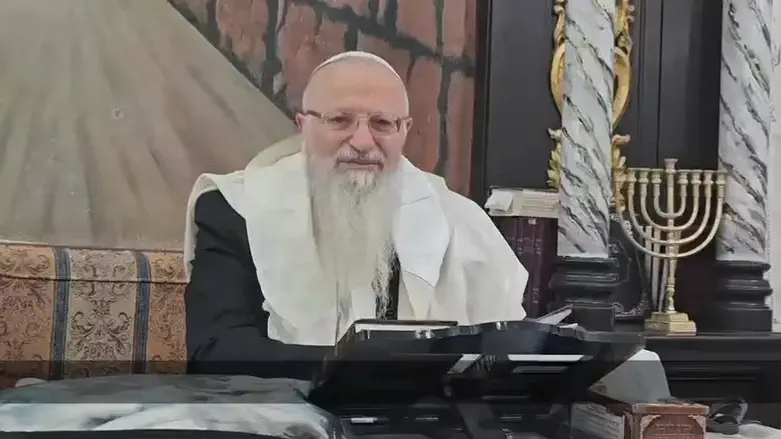
HaRav Shmuel Eliyahu is Chief Rabbi of Tzfat
The Rambam writes that in the time of the Redemption, "all these fasts will ultimately become festivals and days of joy and gladness," as it is stated in Zechariah (Ch. 8): "Thus says the Lord of Hosts: The fast of the fourth month, the fast of the fifth, the fast of the seventh, and the fast of the tenth shall become for the House of Judah joy and gladness and cheerful festivals. Therefore, love truth and peace."
The Chatam Sofer writes that they will actually become full festivals on which work is prohibited. The Turei Even writes that they will not become festivals like the pilgrimage festivals, but rather like Purim.
May it be the Creator’s will that this happen speedily in our days.
When the Fasts Are Suspended and When They Are Observed
The Gemara says that the fasts are neither completely abolished nor always obligatory. "When there is peace, they shall be for joy and gladness. When there is persecution, they are fasts (of tribulation). When there is neither persecution nor peace - if they wish, they fast; if they wish, they do not fast" (Rosh Hashanah 18b).
According to Rashi, "peace" means "that the nations no longer rule over Israel."
According to this view, that condition already exists today, and therefore one would not fast today. Most authorities ruled like the Ramban, however, who explains that "peace" means the rebuilding of the Temple, when "nation shall not lift up sword against nation," and not a peace that is made by treaties and then broken. Therefore, we fast today because the community has accepted these fasts upon itself.
Fasts to Correct Baseless Hatred
We accepted these fasts because the complete Redemption has not yet come. The Redemption has not come because of sins between one person and another.
Thus the prophet Isaiah answers the question of the people of Israel: "Why have we fasted, and You have not seen? We have afflicted our souls, and You have not taken notice?" God's answer was that although they fasted, they also quarreled with one another: "Behold, you fast for strife and contention, and to strike with a wicked fist. You do not fast this day to make your voice heard on high" (Isaiah 58).
The proper fast is to concurrently perform acts of kindness: "Is this not the fast that I choose..." - to free servants whose time has come to be released: "and let the oppressed go free"; to give charity: "Is it not to share your bread with the hungry, and bring the poor who are cast out into your house? When you see the naked, cover him, and do not hide yourself from your own flesh. Then your light shall break forth like the dawn, and your healing shall spring forth speedily. Your righteousness shall go before you; the glory of the Lord shall gather you in. Then you shall call, and the Lord will answer; you shall cry, and He will say: 'Here I am.' If you remove from your midst the yoke, the pointing of the finger, and speaking wickedness; if you extend yourself to the hungry and satisfy the afflicted soul, then your light shall rise in the darkness, and your gloom shall be as the noonday" (Ibid).
"The Reward of the Fast Is Charity"
Therefore, our Sages said (Berachot 6b) that the primary value of the fast is measured by the charity and kindness performed during the day: "The reward of the fast is charity."
Likewise, the Shulchan Aruch (Yoreh De'ah 256:2) writes: "On a fast day, food is distributed to the poor. Any fast on which the people eat and sleep without giving charity to the poor is considered as though they have shed blood. This applies when they did not give them bread and fruit; however, if they delayed giving money or wheat, they are not considered as though they have shed blood."
It is also brought in the name of the Shelah HaKadosh that one should give charity equal in value to the food one would normally eat during the day (Shelah, Ta'anit, Ner Mitzvah; see also Pri Megadim, Mishbetzot Zahav, sec. 3).
The Rabbis' Call to Stop the Rioting in the Streets
In our own day, we would intend that the purpose of the fast is to extinguish the fire of baseless hatred within us.
This is what the leading rabbis did when they called upon the public not to block roads. Among them was the Gaon Rabbi Dov Landau, shlita, leader of the Lithuanian Torah community. Likewise, the Rishon LeZion, Rabbi Yitzhak Yosef, shlita, together with Rabbi Masoud Ben Shimon, shlita, and the senior member of the Council of Torah Sages, Rabbi Moshe Maya, shlita, wrote:
"With a double and redoubled warning to yeshiva students to refrain from protest activities that are not in accordance with the way of the Torah, and under no circumstances should they go into the roads to block traffic, Heaven forbid. The assembly should be limited to a clearly defined time, and immediately after it ends everyone should disperse to their homes and sanctify the Name of Heaven."
"All other forms of protest, which we did not hear from our great teachers, whose merit protects us, are not our way. Many times such protests cause a desecration of God's Name, Heaven forbid."
Evil Speech and Strife Endanger our Soldiers
It is very important to remember that internal strife places our soldiers in danger. Especially when soldiers are fighting on the various fronts and risking their lives to save the State, it is our duty to support them.
Thus it is written in the Jerusalem Talmud (Peah 1:1) and likewise in the Midrash (Vayikra Rabbah 26:2):
"In the generation of David, they were all righteous, but because there were informers among them, they went out to war and fell. In the generation of Ahab, they were idol worshipers, but because there were no informers among them, they went out to war and were victorious."
May we see the Beit HaMikdash restored in our time, soon.