
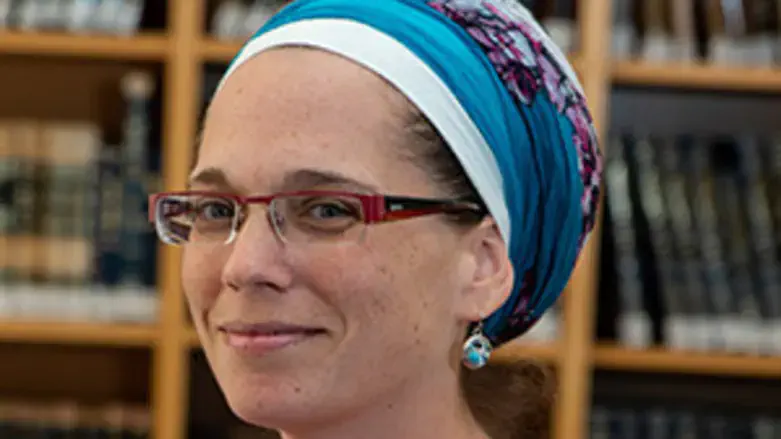
Adina Ellis is a graduate of the Matan Bellows Eshkolot Educators Institute. She has been teaching Tanakh and machshava over the last two decades, initially on college campuses and in Hebrew Schools in the New Jersey area. Since making aliyah in 2005, she has given weekly shiurim in Hebrew and English to women in her community. Adina has taught in the ALIT program and Rosh Chodesh seminars run by the OU Women's Initiative as well as in the mother-daughter "learn and art" program of OU Israel. She is known for her unique ability to facilitate in-depth textual learning along with engaging and relevant discussions. Adina lives with her husband and children in Yad Binyamin.
The state of not-knowing.
Most people wish for certainty. We like clear-cut answers, timelines, and thoughtfully crafted itineraries. We want to know where our relationships are headed, whether our children will be okay, whether a treatment will work, whether a dream will come to fruition.
Yet the reality is that much of life unfolds in uncertainty. How do we deal when it is lacking?
Perhaps this is why the central tragedy associated with Tammuz began with this familiar struggle - a failure to tolerate not knowing.
Moshe Is Late
In the book of Shemot, we are told that the people had been told that Moshe would return after forty days. According to Chazal, they miscalculated the timing and believed he was overdue. Seeing that he had not arrived, they panicked. When the people saw that Moshe was delayed in coming down from the mountain they demanded Aharon help them make a god to lead them because “we do not know what became of him" (Shemot 32:1).
The sequence is striking. First came uncertainty. It was followed quickly by anxiety. And subsequently, a desperate attempt to regain control. When put that way, it seems a bit more familiar and human, and in the realm of our personal experiences. Things can snowball quickly.
The Human Need for Certainty
Modern psychology has identified what researchers call “intolerance of uncertainty." Ambiguity can prompt individuals to get caught in the trap of “what if" questions, worrying about potential feared outcomes, a characteristic associated with generalized anxiety.
Many forms of anxiety are fueled not by actual danger but by difficulty tolerating uncertainty. People often experience “not knowing" as threatening and urgently seek ways to reduce the discomfort. Research has repeatedly found that uncertainty can be more stressful than receiving negative information. When outcomes are unclear, the mind fills the void with predictions, worries, and attempts to regain control.
In treating an individual with anxiety, the goal is not for them to become “anxiety-free"; “that’s impossible, given that anxiety is a basic and necessary system in your body, and there are many times when feeling anxious is appropriate. A more realistic goal is to have a toolbox of helpful strategies for managing worry and anxiety when they arise so you won’t experience them as excessive or distressing" (Robichaud & Dugas, Generalized Anxiety Disorder Workbook).
40 Days of Not Knowing
One of the tools in the toolbox of managing anxiety is learning to view uncertainty as non-threatening. Cultivating faith in God can foster a greater ability to sit with that discomfort and to release a false-sense of control. By accepting that God is running the show, trying to “let go and let God," the intensity of worrisome thoughts can be reduced.
We learnt this process as a nation. The first 40 day period of uncertainty began after Ma’amad Har Sinai when Moshe Rabbenu ascended to receive the luchot habrit. Upon descending and breaking the tablets at the sight of the celebrations around the golden calf, the three weeks of mourning between the 17th of Tammuz and Tisha b’Av began. These coincide with the beginning of Moshe Rabbenu’s second 40 day ascent on Har Sinai. After successfully obtaining God’s Divine pardon, Moshe ascended a third time, again for 40 days, from Rosh Chodesh Elul until the 10th of Tishrei - Yom Kippur.
It is in our modern-day recollection of this 3rd waiting period that we read daily in Psalm 27. Among other messages, David Hamelech reminds us to endure, to be patient, to find inner strength and to wait for Hashem. The Tehillim guides us to be OK with being uncomfortable in the not-knowing. “Wait for Hashem; be strong and let your heart be courageous, and wait for Hashem" (Tehillim 27:14). We acknowledge the uncertainty, and we grapple with it. This act of hopeful waiting is notably repeated twice, expressing how one builds a spiritual muscle so that we can endure the unknowing, the waiting, a bit longer.
Perhaps the enduring message is that faith can sustain us even when our lives are filled with uncertainty. It is precisely in those moments that we are called upon to be strong in heart and mind and place our trust in God.