

State Comptroller and Ombudsman Matanyahu Englman on Tuesday published a series of comprehensive and sharply critical audit reports addressing both failures during the war and home front response since the outbreak of Operation Swords of Iron, as well as long-term strategic issues related to the environment and climate.
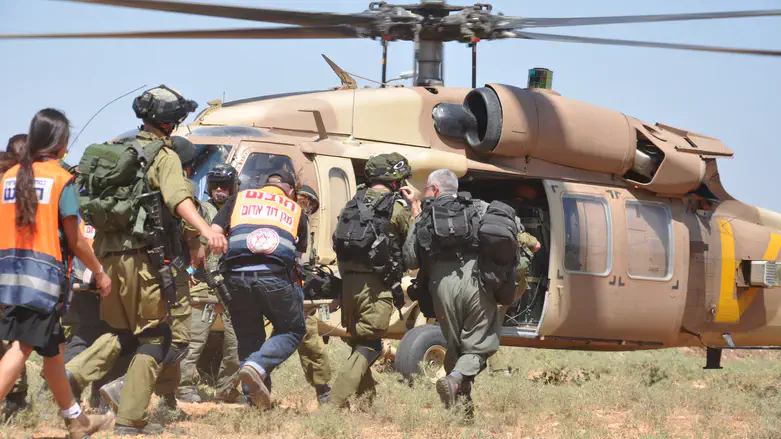
The central chapter of the report focuses on the medical evacuation system during the October 7 massacre, which the Comptroller describes as "the most severe terrorist attack since the establishment of the State of Israel."
Englman notes that operational responsibility for evacuating the wounded from the combat zones rested with the IDF Southern Command and the Gaza Division. While praising the extraordinary courage of IDF troops, Magen David Adom (MDA) personnel, and civilians who risked-and in some cases lost-their lives to save others, he states unequivocally: "The root cause of the failure in evacuating the wounded stemmed from the IDF's failure to defend the communities of southern Israel."
The audit exposes serious structural deficiencies in the evacuation system, which was marked by the absence of an organized response, severe command-and-control failures, and a complete lack of coordination between the IDF and MDA.
Among the findings was that transfer points where wounded patients were moved from military ambulances to civilian ambulances were coordinated with MDA only after a critical delay of nearly eight hours from the beginning of the terrorist attack. As a result, casualties requiring urgent hospital treatment experienced delays during the most critical hours-failures made even more severe by the scale of the disaster and the high number of fatalities and wounded.
One of the report's most troubling findings concerns the failure to utilize available real-time technology.
While information regarding wounded soldiers was transmitted directly to the Gaza Division's medical personnel, information regarding wounded civilians remained disconnected.
MDA had installed a computerized system at the Gaza Division headquarters that displayed all emergency calls and incidents received by its dispatch centers in real time, but military medical officials did not use it.
The consequences, according to the report, were deadly. Vital information that could have helped military forces locate wounded civilians in the combat zone and provide lifesaving treatment simply never reached them.
The commander of the Southern Command on October 7 acknowledged to the Comptroller's Office that information from MDA regarding the location and number of casualties would have significantly improved his operational situational awareness.
Dead Sea crisis: "The government is pursuing a patchwork policy"
Alongside the wartime reports, Englman also published a third report dealing with the climate crisis, stressing that even during a prolonged military campaign, the government cannot neglect Israel's environmental and energy future.
"The climate report once again raises a red flag for the government and its leader-the warning signs are on the wall," the Comptroller cautioned.
The report emphasizes that Israel's two most recent military operations-"Operation Rising Lion" and "Roaring Lion"-demonstrated just how vulnerable Israel's energy market is during wartime emergencies.
The Comptroller calls on the government to urgently advance the transition to renewable energy to ensure Israel's energy security, pointing to the extreme heat waves currently sweeping Europe as evidence of the issue's urgency.
Nevertheless, the audit concludes that the government's performance has been inadequate and sluggish, with its actions amounting to dozens of empty decisions that are little more than "patchwork solutions" without bringing about meaningful change on the ground.
The report also highlights a vast gap between the government's vision and allocated budgets for rehabilitating the Dead Sea and their actual implementation.
The Dead Sea's water level is dropping at an alarming rate of 1.15 meters per year, creating sinkholes and causing severe damage to infrastructure.
The Comptroller calls on the Environmental Protection Minister to immediately submit recommendations for government decisions regarding intervention to halt the declining water level, tourism development in the northern basin, protection of Highway 90, and expansion of local communities.
He also instructs the Tourism Ministry, Finance Ministry, Israel Nature and Parks Authority, and the Tamar and Megillot Regional Councils to complete the development projects assigned to them, while recommending that the Prime Minister's Office closely monitor implementation.
Care for wounded soldiers: "Forced to rely on rumors"
Another significant chapter is devoted to the medical rehabilitation of soldiers wounded during the Swords of Iron War.
Since the Comptroller's son, Haggai Englman, was wounded in combat about a month after the outbreak of the war, Englman completely recused himself from this report due to a conflict of interest. The review was instead overseen by the Director General of the Comptroller's Office, Brig. Gen. (res.) Yishai Vaknin.
The report reveals that hospitals, the IDF, and the Defense Ministry have no formal procedures governing how wounded personnel are informed of their rehabilitation options.
As a result, many wounded soldiers feel they are unaware of their full rights and are forced to rely on incomplete information passed along by word of mouth.
Vaknin called on the Health Ministry and Defense Ministry to act immediately to make information about available benefits and rehabilitation services fully accessible to Israel's war heroes who have suffered physical and psychological injuries.
Responding to the report, the Health Ministry stated: "The events of October 7 were unprecedented in their intensity, characteristics, and complexity. They occurred under conditions not included in any planning scenarios, without prior warning and without a complete operational picture. Amid chaos, blocked roads, and active combat zones that prevented the IDF from systematically carrying out its responsibility to evacuate casualties for hours, the healthcare system demonstrated responsibility, dedication, professionalism, and a profound sense of mission, saving the lives of thousands of wounded."
The ministry added that, as reflected in the Comptroller's report, the medical response was lifesaving and that many casualties owe their lives to medical teams who operated under fire and under extreme pressure.
It said the report identifies shortcomings in coordination and incident management under conditions of operational and intelligence uncertainty, but stressed that most of the gaps have already been addressed during the course of the war through a systematic lessons-learned process. The ministry added that cooperation with the IDF has since been significantly strengthened.
The Defense Ministry also responded, saying: "The Defense Ministry views the rehabilitation of wounded members of Israel's security forces as a supreme national challenge and a fundamental moral obligation to those who serve. Since October 7, the Rehabilitation Department has absorbed more than 25,000 wounded service members from the current war, and by 2028, the total number of wounded under its care is expected to reach approximately 100,000."
The ministry said the unprecedented number of casualties requires a broad national response. It noted that, following its recommendation, the Defense and Finance Ministers appointed a public expert committee headed by Prof. Shlomo Mor-Yosef, which recently submitted a comprehensive action plan addressing the issues raised by the Comptroller, among others.
According to the ministry, it is now working to bring the committee's recommendations before the government for approval so implementation can begin as soon as possible.