

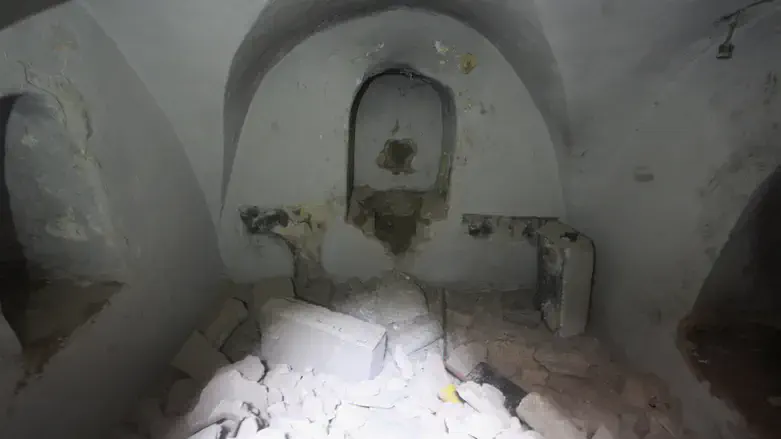
A historic ceremonial chair stolen from a synagogue in Damascus' Old City's Jewish Quarter has been recovered, according to Syrian-American Jew Joseph Jajati, who credited local residents with helping return one of the Syrian Jewish community's most important religious artifacts.
Speaking to The Media Line, Jajati described the recovery as a source of "immense gratitude, relief, and joy," calling it a significant achievement for those working to preserve Syria's Jewish heritage.
The Chair of Elijah ("Kisse shel Eliyahu") is a ceremonial chair traditionally used during Jewish circumcision ceremonies to symbolize the presence of the Prophet Elijah.
The item was handcrafted in Damascus around 1946 by Jewish artisans from the city's longstanding Jewish community and is described as an irreplaceable example of the community's cultural and artistic heritage.
According to the report, after Jajati received information that the chair had surfaced in the antiques market in Old Damascus, a local Muslim antiquities dealer named Moatez helped identify the artifact and, operating discreetly, assisted in securing its recovery.
Jajati said residents of the Jewish Quarter also played a key role in locating the chair and facilitating its return to the synagogue. He thanked those involved in the effort, saying the protection of cultural heritage is a shared responsibility that extends beyond religious affiliation.
"The recovery of this chair sends a positive message about what communities can achieve when they work together to safeguard their shared historical heritage," Jajati said. "A true community is one in which neighbors look out for one another and protect the heritage that unites them."
He did not provide details about the theft or indicate when it occurred. Syrian authorities have not issued an official statement confirming either the reported theft or the recovery of the chair.
Damascus authorities have remained officially silent and have not issued any statement about the theft or the recovery, though behind the scenes, the Syrian regime appears to allow and even encourage efforts to preserve Jewish sites. According to assessments by international media figures, the aim is to project a positive image to the West and show that Syria protects minority rights and freedom of worship.
At the same time, extensive restoration and renovation work has recently begun at the old and neglected Jewish cemetery in Damascus. One of the most notable graves to be restored is that of Rabbi Nissim Nadbo, who served as chief rabbi of Damascus and was the last person to accompany Israeli spy Eli Cohen to the gallows in 1965.
The work at the cemetery is being carried out under heavy security, especially after unknown individuals recently tried to set the site on fire at least twice, attempts that were thwarted thanks to local residents and fire crews.
Bechor Siman Tov, one of the last Jews still living in Damascus, confirmed in an interview with Kan 11 that the site is undergoing extensive renovation, but clarified that the funding and work are not government-led and instead come from civic and community organizations.