
Rotem Meir Sella is the founder and publisher of Sella Meir, a publishing house that began on the margins a decade ago and now sits at the center of Israel’s nonfiction shelf.
From the Makor Rishon Hebrew weekly.
Three radical candidates who received the support of New York City Mayor Zohar Mamdani defeated the establishment candidates of the Democratic Party this week, and they are expected to become members of the U.S. Congress after the midterm elections in November.
Meet them: Daryeliza Avila Shbleya from District 13, who on October 8, 2023 celebrated at a pro-Palestinian rally, praising the massacre of Jews; Claire Valdez from District 7, who opposes sending weapons or interceptors to Israel; and Brad Lander from District 10, the anti-Zionist Jewish representative who ousted the Jewish-Zionist Congressman Dan Goldman, a chilling proof that candidates are willing to sacrifice their own people and join the chorus of genocide to secure a coveted position.
At this point, I am supposed to write about the significance of this victory, but we don't need that to read the writing on the wall: Jews in New York are living on borrowed time.
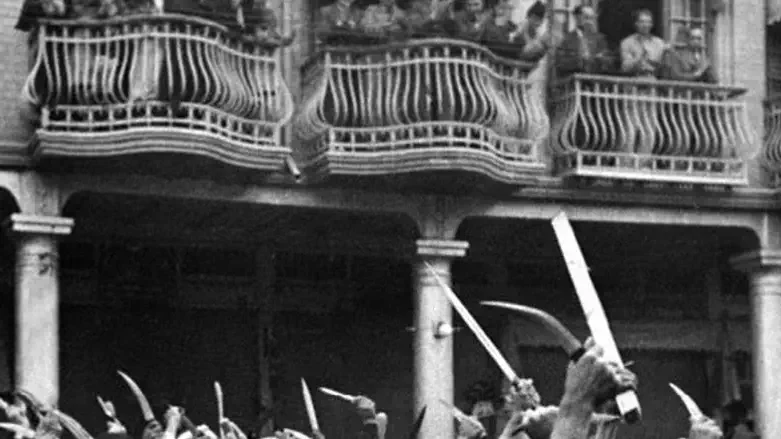
It has all happened before. In the last century, Vienna, which housed 180,000 Jews, elected Karl Lueger, an antisemitic mayor who was a model and inspiration for Hitler. We know how that ended. It happened in Baghdad, which was also home to hundreds of thousands of Jews, who drowned in blood and hatred during the Farhud, a local Kristallnacht that ended their golden age. And it happened in Thessaloniki, Warsaw, Berlin, and Spain - where Jews felt at their peak, and time and again their success gave rise to deep hatred, persecution, expulsions, and pogroms.
In New York, the same thing is happening right now. In a city that houses more Jews than anywhere else in the world, antisemitism has become an electoral asset. In districts where voter turnout is negligible, hatred for Israel and Jews is the only emotional fuel that manages to get the extremists out of their homes and to the polls. Hatred has become the most effective mobilization engine in the city.
Mamdani did not win despite his hatred of Jews, but because of it; this is the way a large public shows that notwithstanding the low quality of urban infrastructure, it is more important to them to harm their Jewish neighbor and cause him pain than to improve their city.
It's not going to change, and it's not going to become more pleasant or easy. History teaches us that such hatred, once it raises its head, does not rest until it eliminates the ability of Jews to live alongside it. In fact, there is not a single instance in history of a city, nation, or country where the rise of political and institutionalized antisemitism to leadership positions ended quietly-before it exacted its pound of flesh from the Jews.
From history, one can also learn that the Jews of New York will not leave in time. They will continue to cling to the familiar and the comfortable, telling themselves they have another decade or generation - until it is too late - and they will do so while waging a fierce war against any Jew who dares to say otherwise. The reason: They believed they belonged, that despite their Judaism there were ties of ideology, class, and culture. Connections that keep them in exile, which they have become accustomed to seeing as their home.
In Poland in the years leading up to the Holocaust, the Bund, the General Union of Jewish Workers, waged a fierce battle against calls to immigrate to the Land of Israel. The struggle was conducted under an ideology called "Dawkeit" (in Yiddish: "We stay here"), and the leaders passionately proclaimed, "Here is our home. Here we have lived for hundreds of years, here we will stay, and here we will fight for our rights as workers and equal citizens in the new Poland." In Baghdad, community leader Rabbi Sasson Kadori argued: "Zionism is a problem for the Jews of Europe. We are Arabs of the religion of Moses, flesh of the flesh of Iraqi society."
Sigmund Freud did not agree to flee from Vienna to London, claiming that the Austrians would not fall into German barbarism. In 1938, after the arrest of his daughter, he managed to escape by the skin of his teeth, but his four sisters were left behind and murdered by the Nazis.
We will not succeed in fighting the hatred of Mamdani and his supporters, but we must fight against the blindness that New York Jews have imposed upon themselves. Many of them will not like the message and will find it hard to see the Israeli Jewish community, until recently their "little sister," calling them to come home. But in the struggle for life, we must not give up: we must fight to ensure that history, at least in part, does not repeat itself.
Translated from Hebrew by Rochel Sylvetsky (using AI)