
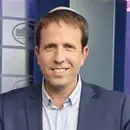
Malcolm Hoenlein, Vice Chair and CEO Emeritus of the Conference of Presidents of Major American Jewish Organizations, delivered a stark assessment of the political and social climate in the United States during an interview in the Arutz Sheva - Israel National News studio in Jerusalem, warning that antisemitism, anti-Israel sentiment, and political polarization are reaching unprecedented levels.
Reflecting on New York City's recent primary elections, Hoenlein described the results as "devastating," arguing that opposition to Israel had become a defining platform for several successful candidates. "Being anti-Israel was a fundamental platform in almost all of these campaigns. Horrible things are being said about Jews and about Israel, and yet these candidates are winning."
"When people talk about these victories, they have to remember that many of these candidates were elected with only a fraction of the electorate participating," he said, urging greater civic engagement, particularly within the Jewish community.
Hoenlein argued that the rise in anti-Israel activism did not emerge overnight but is the result of a decades-long effort to influence Western institutions. He pointed to foreign funding, particularly from Qatar, along with influence campaigns originating from Iran, Russia, and China, which he said have shaped public opinion through universities, media, and social networks. "The poisoning of young people has been going on for many years," he said. "It has become increasingly sophisticated. We took for granted that the next generation would naturally be pro-Israel. We have not educated this generation well enough."
Hoenlein drew parallels between today's political climate and developments in Europe during the early 1930s, while stressing that the Holocaust remains a unique historical event. "I rejected comparisons to the Holocaust for many years. But I do see similarities to 1933-the warning signs, the normalization of antisemitism, and the failure to recognize where these trends can lead. What is happening is not just about Israel or the Jewish people. It is about America and Western civilization."
Hoenlein praised President Donald Trump's longstanding commitment to Israel while acknowledging recent concerns over Washington's approach toward Iran. He said Trump remains fundamentally supportive of the U.S.-Israel alliance but is influenced by competing voices within and outside his administration. Hoenlein warned against allowing Iran to retain its ballistic missile capabilities or its nuclear infrastructure, arguing that any pause in pressure would enable Tehran to rebuild.
"You can't erase the knowledge," he said. "The first opportunity they have to violate any agreement, they will."
He also expressed concern over Turkey's growing regional ambitions, describing Ankara's cooperation with Qatar and influence in Syria as an emerging strategic challenge.
Despite the ongoing war, Hoenlein rejected suggestions that the Abraham Accords have collapsed. "I think they're on life support in some places, but they are not dead."
He revealed that several Arab officials privately encouraged Israel to decisively weaken Hamas and Hezbollah, even while issuing more cautious public statements.
"They told me, 'Don't listen to what we say publicly. Eliminate them,'" Hoenlein recounted.
He argued that future normalization efforts should focus less on formal diplomatic ceremonies and more on practical cooperation in areas such as water technology, agriculture, and economic development.
"When people see that Israel improves their lives, the diplomatic relationships will follow," he said.
Asked how Jewish communities should respond to growing antisemitism, Hoenlein emphasized unity, education, and institutional accountability. He called for a comprehensive review of how Jewish organizations allocate resources to combat antisemitism, arguing that significant funding has produced insufficient results.
"We win some battles," he said, "but we're losing the war."
Hoenlein also stressed the importance of investing in Jewish education, warning that many young Jews lack basic knowledge of Israeli history and Zionism. "Jews from Europe will come because they have to. Jews from America will come because they want to. There is a real revolution taking place. Now we have to nurture it."