

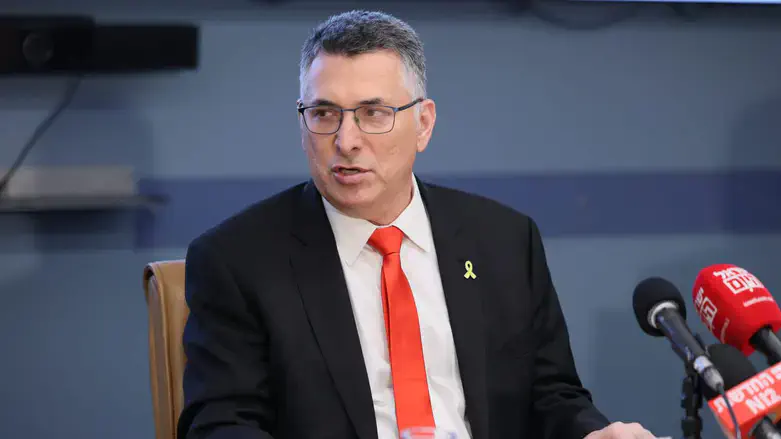
The Israeli government unanimously approved a resolution formally recognizing the Armenian Genocide, with Foreign Minister Gideon Sa'ar saying, "It is never too late to do the right thing."
Presenting the resolution to the government, Sa'ar said it "constitutes the formal recognition by Israel of the genocide committed against the Armenian people during the collapse of the Ottoman Empire."
Sa'ar said the Armenian Genocide began on April 24, 1915, with the arrest, deportation and murder of hundreds of Armenian clergy, leaders and intellectuals in Constantinople. After the elimination of the community's leadership, he said, the Ottoman government began the systematic elimination of the Armenian population. Men were conscripted for forced labor and subsequently murdered, while women, children and the elderly were expelled from their homes and sent on long death marches across the Syrian desert, where they were exposed to mass murder, rape, deliberate starvation and thirst, resulting in the deaths of approximately 1.5 million people and the destruction of thousands of years of cultural and historical heritage in the region of Anatolia.
"Despite the extensive and unambiguous historical documentation, the Armenian Genocide remains to this day the subject of an institutionalized campaign of denial and minimization, including a manipulative rewriting of history, mainly by the Turkish government," Sa'ar said.
He added that it is widely believed the Ottoman Empire committed crimes amounting to genocide in a systematic manner with the aim of destroying the Armenian people.
Sa'ar said 32 countries have recognized the Armenian Genocide, including the United States, Italy, Argentina, Brazil, Germany, France, Poland, the Czech Republic, Canada, Russia, Greece, Cyprus, the Vatican, Lebanon and Syria. Most did so through resolutions passed by their legislatures, while a minority recognized it through legislation.
He also noted that there had been previous statements by Prime Minister Benjamin Netanyahu and then-Foreign Minister Yisrael Katz supporting recognition of the Armenian Genocide. The Zionist Organization also decided about a decade ago to recognize the Armenian Genocide, he said.
Sa'ar said there had been attempts to pass resolutions on the issue in the Knesset, including during the tenure of then-Speaker Yuli Edelstein, but they did not come to fruition. He also noted that in the summer of 2016, the Knesset Education, Culture and Sports Committee, headed by MK Yaakov Margi, announced that it recognized the Armenian Genocide and called on the government and the Knesset to do the same.
"It did not happen then," Sa'ar said. "I think the time has come for Israel, as a Jewish state, to formally accept this position."
"At this time, the question - why hasn't this happened yet? - is less important to me," he said. "It is never too late to do the right thing. It is important that we do it now so that we do not continue to be asked in various places why we are avoiding it. This is both a moral and historical duty. And in my opinion, there is no strong reason to be avoiding it."
Sa'ar said the decision "is not an 'act of retaliation' for the open hostility, along with the terrible rhetoric and the hostile actions of Turkey, under Erdogan's leadership, towards Israel."
"Furthermore, the fact that Turkey promotes false narratives against Israel, does not grant it immunity from historical truths," he said.
Sa'ar also said he had received a letter of appreciation from the Armenian Church and the Armenian community in Jerusalem on Friday.
He noted that the Armenian diaspora numbers approximately 7 million to 8 million people, constituting most of the Armenian people, while fewer than 3 million Armenians live in Armenia. He said major Armenian diaspora communities are located in the United States, Russia, France, Lebanon, Iran, Argentina and Brazil.
"In Israel, there is a community of thousands, most of them in the Armenian Quarter in Jerusalem," Sa'ar said.