
Leo Pearlman is a London based producer and a loud and proud Zionist. His most recent film about the Oct 7 Nova Music Festival massacre, ‘We Will Dance Again’ has won the 2025 Emmy of the 46th Annual News & Documentary Awards for most ‘Outstanding Current Affairs Documentary’.
I want to talk about something that, on the surface, appears almost insignificant. An arts centre in London, a publicly funded board, the departure of a chairman.
It feels like the sort of story that belongs entirely within the confines of Britain’s cultural establishment. A story for the London arts pages, one for the media class, the creative industries and the self-appointed arbiters of public morality. In other words, precisely the sort of story most people would be forgiven for ignoring.
That would be a mistake.
While this week’s headlines have been dominated by stories that appear far more consequential, I believe what has happened at the Southbank Centre tells us something far more troubling about the direction of our public institutions.
Take the publication of Lord Mann's report into antisemitism within the NHS. It concluded what Jewish doctors and patients have been saying for years. That antisemitism has become embedded in parts of one of Britain’s most trusted public institutions.
One might reasonably have expected the British Medical Association’s annual conference to begin with a period of soul-searching. How did we get here? How do we restore confidence amongst Jewish doctors? How do we reassure Jewish patients that prejudice has no place in British medicine?
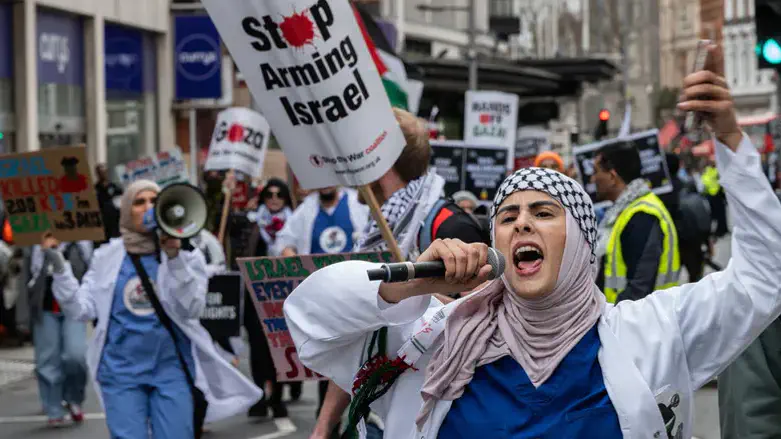
Instead, within days of the report’s publication, delegates were debating the removal of the IHRA definition of antisemitism from BMA policy and discussing greater protections for members accused of antisemitism. At precisely the moment when one of Britain’s foremost independent advisers on antisemitism had concluded that Jewish healthcare professionals had been systematically failed, parts of the profession appeared more concerned with protecting those accused than confronting the problem itself.
NHS staff marching in a Pro-Palestine demonstration
Then there was Brent Council. For years, concerns have been raised about the borough’s twinning arrangement with the Palestinian Authority city of Nablus (Shechem in Hebrew, the site of Joseph's Tomb and other biblical events). This week those concerns were vindicated.
An exhibition in Nablus celebrated some of the most notorious terrorists in modern history, including the leader of the 1978 Coastal Road Massacre, the mastermind of the Munich Olympic massacre and the founder of Hamas. The Mayor of Nablus celebrated the exhibition, saying those depicted were receiving “the recognition they deserve."
A London borough now finds itself formally twinned with a municipality that openly celebrates the murder of Jews. Faced with that reality, Brent Council had a choice, condemn it, suspend the relationship or explain why none of this fundamentally mattered. It chose the third option.
Each of these stories is deeply troubling. Yet neither concerns me as much as what has happened over the past few months at the Southbank Centre. That is a story about something much bigger than one man. It is about how our institutions have learned to launder extremism.
The chairman of the Southbank Centre, one of Britain’s foremost publicly funded cultural institutions, was Misan Harriman. His views on Israel have never been difficult to find. This is not about disagreement with the policies of Benjamin Netanyahu’s government, but about a sustained pattern of conduct.
A man who repeatedly argued that Israel itself should cease to exist in its current form. A man who shared conspiracy theories surrounding the stabbing of two Jews in Golders Green. A man who publicly declared that he could not support courageous Iranian civilians risking imprisonment and death to oppose the Islamic regime because Zionists happened to support them too. A man who described Israel as operating “one of the most advanced systems of racialised violence the world has ever witnessed", rooted in white supremacy. A man who argued that the same evil force responsible for Grenfell, Sudan, Congo, Haiti and Yemen was also responsible for Gaza. A man who compared Reform UK’s electoral success with the rise of the Nazi Party, once again reaching for Holocaust imagery to make a contemporary political point.
Individually, some will defend one statement or another, collectively, they reveal something very different. A relentless pattern of demonisation directed at the world’s only Jewish state. This wasn’t one unfortunate interview, it wasn’t one ill-judged social media post or one lapse in judgement. It was a sustained campaign of rhetoric over many months.
Misan Harriman, Chair of London’s Southbank Centre
Which brings us neatly to the Southbank Centre’s board.
Silence in the face of this behaviour was already a form of complicity. When those entrusted with leading one of Britain’s foremost publicly funded cultural institutions refused to draw a moral line, they became complicit in the hostility, the demonisation and the increased danger such rhetoric inevitably creates for Britain’s Jewish community.
But there is something worse than silence, there is the conscious rehabilitation of those who spread hate.
Allowing someone to leave entirely on their own terms, allowing them to rewrite the narrative, allowing them to present themselves as the victim of “all this craziness", allowing them to walk away not diminished, but celebrated. That isn’t neutrality, nor is it avoiding controversy, that is institutional endorsement.
There was an irony here that was almost impossible to ignore. One of the most prominent voices urging the Southbank Centre to stand by Misan Harriman was Gary Lineker, who publicly signed the letter calling on the board to back him.
Only months earlier, Lineker had himself been the beneficiary of precisely the same institutional playbook.
After years of increasingly inflammatory rhetoric about Israel and repeated social media controversies, the BBC had chosen not to draw a moral line. Instead, it wrapped his departure in warmth, gratitude and celebration. Having benefited from the institutional laundering of his own conduct, Lineker was now urging another publicly funded institution to extend exactly the same protection to someone else.
It was no longer simply a pattern, it had become a culture. Of course it sounded familiar to Gary Lineker, he had just lived through exactly the same process himself.
Lineker’s problem was never one emoji of an antisemitic comparison of Jews to vermin, nor was it one repost calling for an end to the only Jewish state. It was years of increasingly obsessive rhetoric about one country.
He has described Israel’s actions as the greatest crime, even the greatest genocide, of his lifetime. Think about that statement. A man in his sixties has lived through Cambodia, Rwanda, Bosnia, Darfur, the Yazidi genocide, Syria, Xinjiang, Ukraine and countless other atrocities. Yet somehow the event that eclipses all of them in his mind is the conduct of the world’s only Jewish state following the largest massacre of Jews since the Holocaust. Let’s not forget that on the day of that massacre Gary clearly couldn’t find his phone!
This is not perspective, it is obsession and obsession eventually distorts judgement. When that obsession is accompanied by repeated sharing of material widely criticised as antisemitic, the issue is no longer one mistaken post, but a pattern.
So what did the BBC do? Did it say that one of its highest-profile presenters had repeatedly failed to meet the standards expected of someone representing Britain’s national broadcaster? No, it celebrated him, honoured him, gave him a farewell worthy of one of the greatest broadcasters of his generation and in doing so, it sent a message. Nothing that had happened fundamentally mattered.
The consequences extended far beyond Broadcasting House. Netflix could look at the BBC’s response and conclude there was no problem, ITV could do exactly the same. If Britain’s national broadcaster had effectively signed off on Gary Lineker’s conduct, why shouldn’t everyone else?
Gary Lineker, tearfully presenting his last BBC Match of the Day
Institutions do not merely protect reputations, they manufacture them. By refusing to impose consequences, they tell the rest of society that no consequences are necessary.
That is institutional laundering.
Behaviour that once would have carried serious professional consequences passes through a process of silence, managed departures and respectful tributes before emerging cleansed of any lasting stain. The individual benefits, while society and in this case a minority pays the price and each institution that behaves this way lowers the standard for the next.
That is why I believe the Southbank Centre story matters more than many of this week’s bigger headlines. Extremists have always existed, the true measure of a democracy has never been whether extremists exist. It has been whether its institutions possess the confidence and moral clarity to say, “No further."
Increasingly, ours do not. They mistake silence for impartiality, they confuse avoiding controversy with avoiding responsibility and when silence no longer feels sufficient, they move one step further.
They celebrate, legitimise, amplify and while silence is complicity, celebration is endorsement.
Every institution that chooses silence becomes complicit in the hatred, the demonisation and the increased danger that follows. Every institution that chooses celebration goes one step further. It legitimises that behaviour, rehabilitates the individual, encourages others to follow and in doing so, it doesn’t simply fail to confront antisemitism, it helps normalise it.
That is why what happened at the Southbank Centre matters. Not because of one man, but because it showed us, once again, how Britain’s institutions are quietly teaching the country what they no longer have to condemn.