

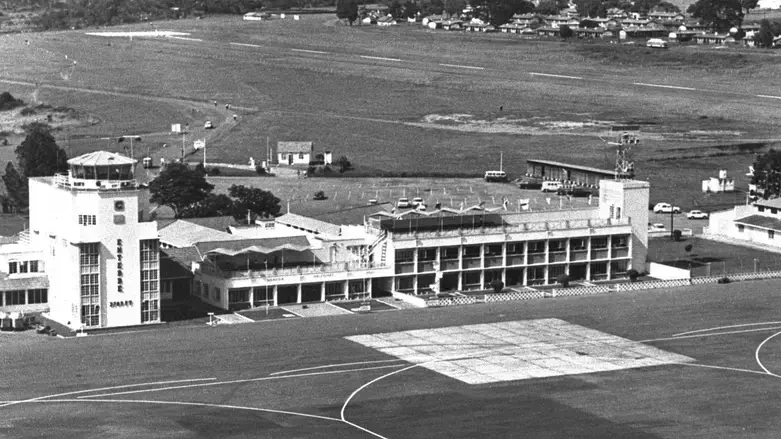
The Israel State Archives in the Prime Minister's Office on Friday revealed Operation Entebbe (also known as Operation Thunderbolt, or Operation Yonatan after its fallen commander) protocols for the first time, in honor of the operation's 50th anniversary.
"Before we continue, I have an announcement." Thus begins the announcement made by the late Prime Minister Yitzhak Rabin at the government meeting regarding the hijacking of the Air France plane.
The Israel State Archives file on Operation Entebbe includes an extensive collection consisting of thousands of pages containing the complete protocols of meetings by the Government and the Security Cabinet, as well as consultations by the special security team established by Prime Minister Rabin on the day of the hijacking to address the crisis. Alongside the new documents now being revealed for the first time, the State Archives is releasing all the files pertaining to Operation Entebbe (some of which were previously disclosed), thereby presenting the public with the full picture regarding the government's conduct at that time.
Examining the protocols in the collection sheds light on the deliberations and concerns, the various scenarios that were considered, and the agonizing decision-making process that ultimately led to the successful operation, as well as one dramatic incident that occurred several months earlier in Nairobi, Kenya, and had a direct connection to the Entebbe affair. The collection also includes the record of a candid conversation between the Prime Minister and newspaper editors, in which he requested their cooperation in preventing the publication of details that would endanger the lives of the hostages.
The end is well-known: A mere week after the hijacking, in the early hours of July 4, IDF forces raided the terminal in Entebbe and liberated the Israeli hostages and French aircrew, airlifting them back to Israel. Four people were killed during the operation, including IDF General Staff Reconnaissance Unit Commander, Lieutenant-Colonel Yonatan Netanyahu, of blessed memory.
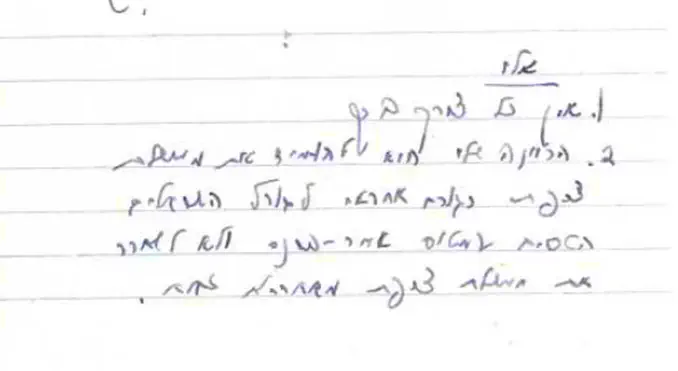
"Before we continue, I have an announcement." The late Prime Minister Yitzhak Rabin interrupted a Government meeting, relaying that contact with the Air France plane, which had departed from Israel en route to Paris, was lost after a layover in Athens. "It seems that the plane has been hijacked."
During the meeting, the Prime Minister was informed that the plane had landed in Benghazi, Libya, but at that stage, it was unclear whether Libya was the destination, who the hijackers were, or what their intentions were.
Eli Mizrahi, Rabin's chief of staff, recommended that the ministers update the Cabinet Secretary on their further activities that day.
Rabin replied: "There is no need whatsoever for that. My intention is to hold the government of France responsible for the fate of the Israelis flying on the Air France plane and not to absolve the government of France from this responsibility."
In the intensive discussions held by the Government since the hijacking, and in correspondence with the authorities in France, the responsibility of the French government was emphasized time and again. Two days later, however, the rest of the hostages were separated from the Israeli hostages, and after another day, the former were released. At that point, it became apparent that other avenues for addressing the crisis, which had already been reviewed at the onset, now needed to be explored more vigorously. To this end, Israel had to buy time and delay the ultimatum as much as possible.
On Wednesday, July 1, the Israeli government, which until then had adhered to the principle of not negotiating with terrorists, was forced to announce its willingness to enter talks for the hostages' release. Negotiations continued right up to the last moment, even as a military operation to rescue the hostages was deemed a viable option and stood ready to launch.
For the first time, the State Archives is also revealing audio recordings of 26 phone calls that Eli Mizrahi held with the Prime Minister, the Foreign Ministry Director General and others during that week; and transcripts of five phone calls held by Colonel Baruch Bar-Lev, who had served some years earlier as the IDF and Ministry of Defense attaché in Uganda, with the then-ruler of Uganda, Idi Amin, in an attempt to leverage the relationship established between them toward resolving the crisis.
The second conversation between Baruch Bar-Lev and Idi Amin, 30/6/1976, at 23:05
Bar-Lev: I have asked a friend of mine to get in touch with the government. But the reason why I called for you is that I believe you have a G-d given opportunity to save people and prove to the world that the things others said and wrote about you were untrue. You see, this is the only reason why I’m talking to you: If you recall, I have always given you good advice and never the wrong advice, is that correct?
Amin: I know that well, but you know the difficulties I am having now. But you can help me save the people’s lives by releasing all their demands.
Bar-Lev: I will do my best through my friend, but this is your country, you are the President and you have the power. If something happens, you will be blamed, and if you save the people, you will be a holy man. What is the situation now, Your Highness?
The collection also includes an interview with Yitzhak David, a hostage who was wounded during the rescue operation. David was a Holocaust survivor, and how the segregation between the Israelis and the rest of the hostages stirred up traumatic memories for him. In contrast to most items in the collection - which naturally reflect what was happening in the State of Israel, primarily in the deliberation rooms of decision-makers - the interview provides a glimpse of the hostages' perspective on that week’s events.
The correspondence found in the Ministry of Foreign Affairs files - with the government of France, with the other countries whose citizens were kidnapped, and with countries that were subject to demands for the release of detainees - rounds out the picture emerging from the protocols and allows for a better understanding of what was said or hinted at between the lines during the meetings. The files also include correspondence on the discussions at the UN Security Council in the aftermath of the operation.
The State Archives further reveals files from the office of the Prime Minister at the time, containing hundreds of letters from leaders and private individuals from all over the world following the success of the operation. The collection also includes photographs whose copyrights have recently expired; files on the production of films about Operation Entebbe; and later files on the commemoration of Lt.-Col. Yonatan Netanyahu, of blessed memory.