
Late at night, when the noise of the day finally recedes, a different world begins to emerge.
The cell phone has stopped pinging. The meetings have ended. The endless stream of obligations that fill our waking hours has fallen silent. A scientist remains alone in his laboratory, staring at a problem that refuses to yield. An artist studies a blank canvas. A writer sits before an empty page. A physician turns off the light in his hospital office and walks beneath a star-studded dark sky, carrying questions too personal to ask aloud. Somewhere high above the earth, an astronaut gazes through the window of a spacecraft and sees the fragile silent blue planet suspended in an ocean of darkness.
From the outside, nothing appears to be happening.
Yet it is often at such moments that the deepest acts of creation begin. In existential loneliness.
We surround ourselves with conversation, activity, responsibilities, and noise. The noise is comforting because it reassures us that we belong to a world that is familiar and predictable. Yet when the noise fades, another reality slowly emerges. Questions that have remained buried beneath routine begin to surface. We begin to ask not merely what we are doing, but why we are doing it. Not merely where we are going, but who we are.
Most people experience such moments as loneliness.
Because loneliness can be unsettling, we instinctively seek to escape it. Yet some of humanity's greatest thinkers, artists, and religious leaders discovered that loneliness, when embraced rather than avoided, can become a doorway. What first appears as silence may become an encounter and a conversation. What first appears as isolation may evolve into a creative gesture.
The Bible tells precisely this story.
Abraham enters history not as the father of a nation but as a solitary wanderer. The first divine command addressed to him is not to build, conquer, teach, or lead. It is simply to leave. He is asked to walk away from his land, his birthplace, and his father's house toward an unknown destination. No one else hears the voice he hears. No one else sees what he sees. Before he becomes Abraham the patriarch, he is simply a man walking alone into uncertainty with nothing but a promise.
The same pattern appears again in the life of Jacob.
The night before he confronts Esau, Jacob escorts his family across the Jabbok River. One by one they disappear into the darkness. The camp grows quiet. Then the Torah records a sentence of extraordinary simplicity:
"And Jacob was left alone."
The verse contains no drama, yet the silence surrounding it is immense. No family member can accompany him. No servant can assist him. It is precisely there, in the darkness of loneliness, that he wrestles with the mysterious stranger who changes his life forever. By dawn he carries a wound, a blessing, and a new name. Israel is born not in a palace or on a battlefield, but in a lonely struggle beside a river.
Again and again, the Bible returns to this theme. Moses encounters God while tending sheep in the wilderness, removed from power, removed from society, removed even from his own people . Elijah experiences something similar. Pursued, exhausted, alone and spiritually depleted, he flees into the wilderness. There, on the mountain, he encounters wind powerful enough to shatter rocks, an earthquake that shakes the earth, and a fire that fills the horizon. Yet God is found in none of these. Only after the noise has passed does Elijah hear the "still, small voice."
The great discoveries of faith occur not at the center of the camp but at its edges.
This may be the deeper meaning of one of the Torah's most enigmatic promises:
"ובקשתם משם את ה' אלקיך."
"And from there you shall seek the Lord your God."
The word "there" carries extraordinary weight.
The Torah does not state that God is found in moments of certainty, comfort, or accomplishment or after all questions have been answered. Rather, it suggests that the journey begins from there-from the wilderness, from uncertainty, from standing alone before questions that no one else can answer on our behalf. From existential loneliness.
More than three thousand years later, modern psychology arrived at a strikingly similar conclusion.
Clark Moustakas described existential loneliness as an unavoidable dimension of human existence. Every person eventually discovers that there are experiences that cannot be fully shared. There are hopes that remain unspoken, fears that remain private, and questions that no one else can answer. The Rav’s grandfather Reb Chaim spoke about the Holy of Holies in the human soul that must remain an unshared private secret. Moustakas insisted that loneliness need not be viewed merely as a burden. It can become a source of creativity. When a person stops fleeing from loneliness and begins listening to it, hidden dimensions of the self begin to emerge and loneliness becomes a fertile ground for creativity.
Donald Winnicott recognized something similar. He argued that the capacity to be alone is not a weakness but a sign of maturity. The psychologically healthy person is not someone who never experiences loneliness. Rather, it is someone who can inhabit it without being diminished by it.
Martin Buber carried this insight into the realm of philosophy and religion. Genuine encounter, he taught, begins only after a person becomes capable of standing alone. Before one can enter an authentic I-Thou relationship, one must first become a self. Loneliness is not merely the birthplace of creativity. It may also be the birthplace of relationships.
The Hasidic masters understood this long before modern psychology gave it a name. Rabbi Nachman of Breslov encouraged his followers to leave the crowded streets and enter a field, a forest, or a quiet place where they could speak honestly before God. At first there is only silence. Then there is loneliness. Yet if one remains present long enough, loneliness gradually becomes conversation. Emptiness reveals itself as presence.
Rabbi Joseph B. Soloveitchik transformed this insight into one of the most profound religious meditations of the modern era.
In The Lonely Man of Faith, the Rav describes the loneliness that accompanies genuine faith; “I am lonely because in my humble, inadequate way, I am committed to God and His covenant and because I am burdened with a message which I find difficult to convey to my fellow man." The believer lives simultaneously in two worlds. One is the world of achievement, technology, and practical success. The other is the world of covenant, holiness, and transcendence. These worlds overlap, yet they can never fully merge. The person of faith therefore experiences a loneliness that cannot be entirely overcome.
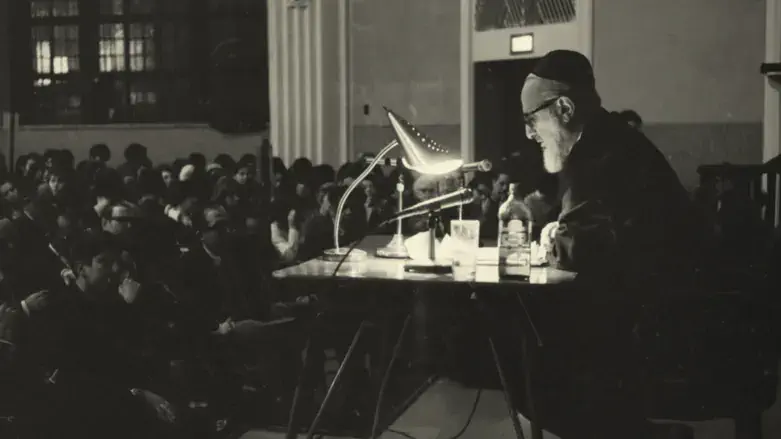
The Rav often distinguished between loneliness and isolation. Surrounded by family, friends, and thousands of students, he nevertheless carried a profound sense of being alone. It was not the loneliness of a man without companionship, but of one whose deepest experiences of faith could never be fully shared. Appropriately, the biographical film about his life is titled The Lonely Man of Faith, and one of his closest students remarked that he was the loneliest person he had ever known.
Yet for the Rav, loneliness was not merely a burden; it was the condition that made covenant possible and creativity necessary. Standing alone before God, the individual is called not only to believe but to create. Creativity occupies a central place in the Rav's thought, both in humanity's mission to perfect the world and in the process of teshuvah, which he viewed as an act of self-creation. The lonely person seeks God because nothing else can satisfy the deepest thirst of the soul, and in that search discovers the power to renew both the self and the world.
What is true of the individual may also be true of an entire nation.
Few nations have experienced loneliness as persistently and tenaciously as the Jewish people or the State of Israel.
Standing on the heights of Moab, Balaam gazed upon Israel and uttered words that would echo across centuries of Jewish history:
“People that shall dwell alone and will not be reckoned among the nations."
The phrase is often understood politically. However, Balaam was describing not merely a geopolitical reality but an existential condition. The Jewish people’s identity would never be exhausted by language, territory, economics, or politics. At the heart of Jewish existence stand loneliness and a covenant.
Rabbi Soloveitchik understood this loneliness as one of the defining features of Jewish history. Just as the individual person of faith inhabits two worlds, so too does the Jewish people. They live within history while remaining bound to a destiny that transcends history. The lesson of Jewish history is not that the nations rejected the Jews, but that the Jewish story could never be fully reduced to the categories by which nations ordinarily understand themselves.
Yet the remarkable fact of Jewish history is that periods of isolation repeatedly became periods of extraordinary creativity. When the Second Temple was destroyed and Jerusalem lay in ruins, Judaism did not disappear. Instead, the rabbis created the Mishnah and the Talmud constructing a portable civilization capable of surviving exile.
When the Jews were expelled from Spain in 1492 and scattered across the Mediterranean world, they carried with them not only memories of loss but seeds of renewal. Within a few generations, Safed became one of the great centers of Jewish creativity. The teachings of Rabbi Isaac Luria reshaped Jewish spirituality. Rabbi Joseph Karo composed the Shulchan Aruch. Mysticism, law, and poetry flourished.
Centuries later, after the greatest catastrophe in Jewish history, many assumed that Jewish civilization could never recover. Yet from the ashes emerged the State of Israel, the revival of Hebrew as a living language, new centers of Torah scholarship, and unprecedented achievements in science, medicine, technology, and culture.
The pattern is difficult to ignore. Again and again, loneliness became searching.
Searching became encounter.
Encounter became creativity.
Creativity became renewal.
The same process that unfolds within the individual soul unfolds within the life of a people.
Perhaps this is the deeper meaning of the Torah's promise. “From THERE."
Epilogue: The Lion That Rises
The Kotzker Rebbe offered a remarkable interpretation of Balaam's blessing:
“He crouched and lay down like a lion, and like a lioness; who shall raise him up?" (Numbers 24:9)
Most commentators understood the verse as a statement of strength. A sleeping lion is still a lion. Who would dare awaken it?
The Kotzker heard the verse differently.
The real question, he suggested, is not who would dare awaken the lion. The real question is: when the lion lies down, when it appears exhausted, defeated, exiled, or asleep-who can raise him?
The answer is no one but the lion with the help of God.
With a subtle shift in emphasis, the Kotzker transformed the verse from a statement about power into a meditation on renewal. The mystery of Israel is not that it possesses strength when it stands. The mystery is that Israel rises after exile. It rises after persecution. It rises after destruction. It rises after every prediction that its story has ended. It rises after their friends turn their back on them.
The lonely individual discovers depths of imagination and faith previously unknown. The lonely nation discovers reservoirs of resilience hidden beneath the surface of history.
And the people whom Balaam described as dwelling alone rise once again, like a lion, sustained not merely by memory or survival, but by a covenantal destiny that transforms loneliness into faith, faith into creativity, and creativity into renewal.
Itzhak David Goldberg is a Professor Emeritus at Albert Einstein College of Medicine