

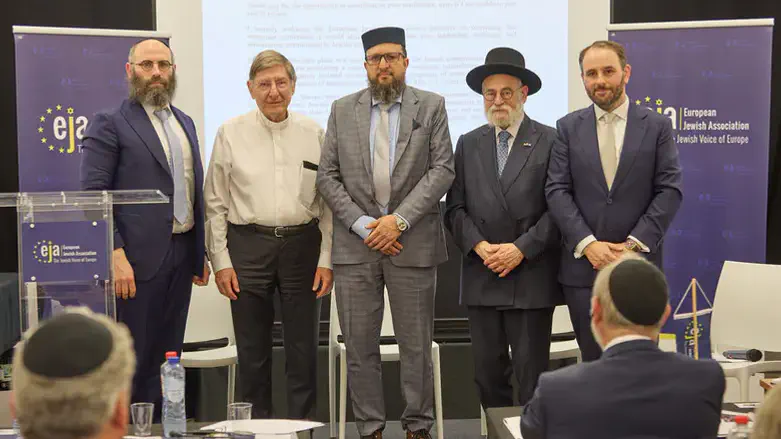
The European Jewish Association (EJA) convened an emergency conference in Brussels on Wednesday amid ongoing legal proceedings against Jewish religious circumcision practitioners in Belgium, warning that the case could become a defining test of religious freedom, minority rights, and the future of Jewish life across Europe.
At the conference, convened with the input of Belgian MP Michael Freilich, the EJA’s Special Diplomatic Envoy for Intercultural Dialogue and Holocaust Remembrance, the Association unveiled a new position paper setting out the fundamental democratic choice being faced by Belgium: whether a religious practice observed safely by Jewish and Muslim communities for centuries should face criminal prosecution. The physicians and scientists who participated in the conference declared that there is no evidence of increased harm, and the rate of complications associated with ritual circumcision is substantially lower than the rate of complications reported among infants circumcised by physicians in hospital settings.
The paper therefore calls for legal certainty, recognition of trained practitioners, appropriate safeguards and standards, and dialogue rather than criminalization.
Opening the conference, EJA Chairman Rabbi Menachem Margolin said, “This is not really a debate about circumcision. It is a debate about the limits of freedom in Europe. The real question is whether democracies protect minority rights only when they are convenient, or whether they protect them when they are challenged. What happens in Belgium will be watched far beyond Belgium." He added, “For Jews, circumcision is not simply a medical procedure. It is one of the foundations of Jewish life and identity.
“Decisions on circumcision are being taken, without the facts, without proper discussion, and without the proper weighing of the evidence of what is, fundamentally, a minor medical procedure. This conference today seeks to fill this knowledge gap. Above all, governments must be properly informed to protect the right of Jews to live as Jews."
As part of filling the knowledge gap, the conference heard evidence from leading medical experts challenging claims that religious circumcision constitutes a public health concern. Dr. Michael Ben Akon, Director of Pediatric Department Laniado Hospital, Member of Israel's Ministry of Health Committee for the Certification of Mohalim, noted that an estimated two billion men worldwide have undergone circumcision and pointed to extensive international medical data showing extremely low complication rates. Published literature places overall complication rates at below 0.4%, with infection rates of less than 0.06%. Data presented from Israel showed that among more than 70,000-75,000 circumcisions performed annually, only 35 complications were reported in 2018, representing an incidence rate of approximately 0.5 cases per 1,000 procedures.
Dr. Ben Akon further noted that approximately 70% of circumcisions in Israel are performed by certified religious practitioners, operating within a rigorous training, examination, and oversight system jointly supervised by the Chief Rabbinate and the Ministry of Health.
Dr Barmoshe, a senior urologist in Belgium, and Dr Nuphar Veiga, a senior Biomedical expert at Leuven University, both highlighted research linking circumcision to significantly lower rates of urinary tract infections, certain cancers, and some sexually transmitted infections, arguing that the available evidence does not support the characterization of religious circumcision as a significant public health problem
The significance of the gathering was underscored by a message from European Commissioner for Health and Animal Welfare Olivér Várhelyi, who reaffirmed the European Commission's commitment to protecting Jewish life and traditions across Europe. “Jewish life belongs in Europe. Jewish tradition belongs in Europe," Várhelyi wrote in a message to participants. He added that Jewish communities must be able to practice their faith in security, dignity, and freedom, with their religious traditions fully respected.
A central feature of the conference was an interfaith panel featuring Dutch Chief Rabbi Binyomin Jacobs, Chairman of EJA's Committee Against Antisemitism, Imam Nordine Taouil, President of RMG Muslim Scholars of Belgium, and Rev. Rik Hoet, Episcopal Vicar for Ecumenical Dialogue and President of the Belgian Catholic Commission for Dialogue with Judaism. Despite representing different faith traditions, all three speakers delivered a united message that circumcision is a core religious practice for both Jewish and Muslim communities and that democratic societies must protect the ability of minorities to practice their faith freely. The panel warned that restricting longstanding religious traditions would set a troubling precedent not only for Jews and Muslims, but for religious freedom and social cohesion across Europe.
The conference also heard from Belgian political and legal figures, including MP Jinnih Beels, constitutional scholar Prof. Rik Torfs, former Antwerp Alderman André Gantman and legal expert Ralph Pais, who argued that the debate should be viewed through the broader framework of constitutional rights and democratic freedoms. Speakers stressed that freedom of religion includes the right to practice one's faith, that fundamental rights should not be ranked against one another, and that the role of policymakers is to reconcile children's rights, parental rights, and religious freedom rather than treating them as mutually exclusive. Several warned that allowing courts or politicians to redefine essential religious practices would set a dangerous precedent for minority communities throughout Europe.
European Commission Coordinator on Combating Antisemitism and Fostering Jewish Life Katharina von Schnurbein, addressing the conference, said: “The European Commission is aware that circumcision is one of the most important traditions for Jews. Banning this ancient practice would, in effect, ban the possibility of Jewish life flourishing in any member state. We acknowledge the threats and difficult public discussion, and we do not underestimate its effect on European Jews.
“The Commission is aware that B’rith Milah of male babies on the 8th day after birth is central for Jewish communities, regardless of their level of observance, whether religious or secular. In line with the EU strategy on combating antisemitism and fostering Jewish life, we will continue to do everything in our power to ensure that Jewish life can continue to flourish in Europe. In fact, Europe can only flourish when its Jewish communities flourish, too."
Participants repeatedly warned that the Belgian proceedings risk transforming a domestic legal case into a European precedent, with implications extending far beyond Belgium's Jewish and Muslim communities.
Concluding the conference, Rabbi Margolin said, “Human rights are not tested when they protect the majority. They are tested when they protect minorities. When the protection of one minority is weakened, the protections enjoyed by all minorities become less secure. The question facing Belgium today is not what kind of Jews can live in Europe. The question is what kind of Europe Europe wants to be."