
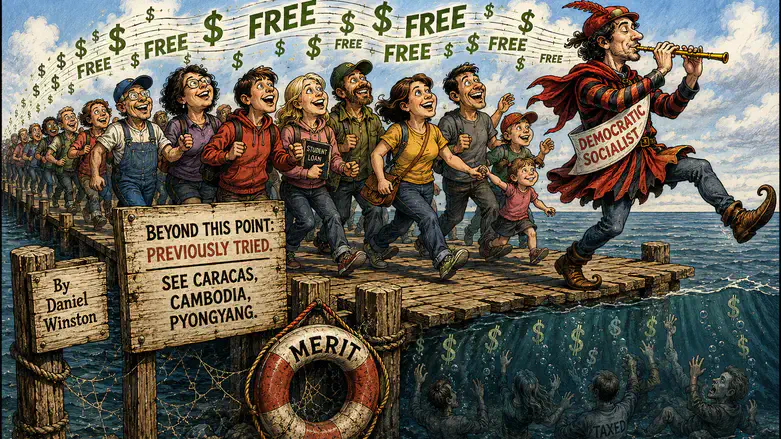
Every successful con needs two things: a promise that costs the mark nothing to want, and a threat terrifying enough that he stops asking questions. Socialism has perfected both. It is a politics engineered for the least common denominator - not the lowest people, but the lowest impulses in all of us, the two reflexes that require no thought, no information, and no courage to feel:
The first is the desire for something we did not earn. The second is the fear that the world is about to end. Socialism runs on these two currents the way a grift runs on greed and panic, and it wins not by elevating the electorate but by reaching for the floor beneath it.
Consider the genius of free stuff as a political product. It demands nothing of the voter. You do not need to understand marginal tax rates, capital formation, or the difference between a wage and a transfer payment. You need only to want. Free buses. Free childcare. Free housing. Free college. Free groceries at a city-run store. The pitch is frictionless precisely because it bypasses the part of the brain that asks who pays.
Zohran Mamdani did not become a phenomenon by explaining how New York would fund universal everything while hunting its millionaires out of their own penthouses. He became a phenomenon because to a desperate person, and to a low-information one, "free" is not an economic claim. It is an emotional one. It feels like compassion and rescue. The desperate are not stupid. They are squeezed, exhausted, and scared - all of which makes them the perfect audience for a smiling snake-oil shyster selling the one thing that sounds like relief and requires no scrutiny to accept.
That is the first lever.
The second is darker, and it is why socialist movements always escalate rather than persuade. If you cannot win the argument on the merits, you abolish the argument and replace it with an emergency. The planet is burning. Democracy is dying. Fascism is at the gate. The other side is not a coalition of fellow citizens who weigh trade-offs differently. It is an apocalypse with a ballot line.
And against an apocalypse, ordinary objections become obscene. You do not haggle over the price of the lifeboat while the ship goes down. You do not ask whether rent control produces housing or whether a wealth tax raises revenue, because to ask is to fiddle while Rome burns. The apocalypse is the answer to every inconvenient question. Vote for us, the saviors say, or face the end of the world. It is us or the deluge.
There is a name for politics conducted as existential theater, and it is not democracy. It is a hostage negotiation in which the captor has convinced the captive that he is the rescuer. Once you accept that the only alternative to socialism is catastrophe, you will accept almost anything socialism asks of you, because anything is preferable to the end.
And here is the part the saviors never mention. The apocalypse they hotly warn you about will necessarily turn out to be the one they bring.
This is not rhetoric. It is arithmetic, written in the largest numbers the twentieth century produced. The most careful accounting, the Black Book of Communism, compiled from opened Soviet and Eastern Bloc archives, placed the cumulative human toll of communist rule at between 85 and 100 million dead, with other researchers pushing higher once famine and demographic collapse are counted in full. Roughly 65 million in China under Mao. Twenty million and more in the Soviet Union. Two million in Cambodia, a fifth of the entire population, in under four years.
These are not the casualties of socialism's enemies. They are the people socialism promised to save, sorted into the gulag, the killing field, and the man-made famine by the same governments that promised them bread. The body count is not a perversion of the system by bad men. It is the system arriving on schedule, because it has no other destination.
The mechanism is not mysterious. Socialism severs the link between effort and reward, and a human being who cannot improve his own situation eventually stops trying. Ludwig von Mises observed that no one acts without the expectation that purposeful behavior can change his condition. Take that expectation away, as every socialist scheme must, and you do not get the New Soviet Man. You get the demoralized one. Ayn Rand dramatized it in a single factory that adopted "from each according to his ability, to each according to his need" and watched its best workers leave and its production collapse within four years.
We do not need the novel. We have Venezuela, which sat atop the largest oil reserves on earth and produced mass starvation, a doubled suicide rate, and more than six million people fleeing on foot. Economic apocalypse first, then the physical one, in that exact order, every single time.
So the threat is real. The accuser simply has the direction reversed.
Which brings us to the cruelest irony of the American version, the one that wraps itself in anti-racism while manufacturing outcomes for poor minorities that are not merely disappointing but structurally abysmal and always quite deadly. A system that destroys upward mobility cannot be the friend of the people who most need to move up. And so the policies arrive dressed as compassion, land as sabotage, then rip like a wildfire in a hurricane through the poorest populations before moving on to all.
-Defund the police was sold as the protection of black lives and produced surging violence in black neighborhoods, while the activists who championed it kept their own streets policed.
-erit was reframed as bias, so the answer to unequal outcomes became the demolition of the standards themselves, gutting the gifted programs and exam schools that were the surest ladder a poor child of any color ever had.
-Expectations were lowered in the name of equity, which is the most expensive insult a society can pay a child, because it tells him in advance that he cannot be expected to rise.
This is the least common denominator as governing philosophy. Not the elevation of the poor but the management of them. Not a ladder but a holding pen with better signage. The promise to the low-income voter is the same two-lever con offered to everyone else, only more devastating: here is something free, and there is an apocalypse coming for you, and only we can hold it back. The free thing keeps him dependent. The apocalypse keeps him afraid. And the dependency and the fear, carefully maintained, keep him voting for the people whose policies guarantee he never escapes.
The current Democratic Socialist prophets of apocalypse usher that very outcome in on a rising tide of free everything, baptizing dependency as justice and fear as conscience, and they keep smiling as the water climbs toward the rooftops.
A serious civilization asks its citizens to rise. It tells them, as Churchill told a frightened nation in its darkest hour, that they are capable of greatness, and it watches the best in them answer the call. The least common denominator does the opposite. It finds the lowest impulse, the want and the dread, and builds a permanent politics on top of them. It promises paradise and delivers, with grim historical reliability, the morgue.
The saviors will tell you it is them or the apocalypse. They are half right. It is them, and then the apocalypse. The free stuff was never free. And the end of the world was never coming from the other side. It was riding in the whole time on the shoulders of the men who promised to save you from it.
Daniel Winston is an American-Israeli marriage therapist, trainer of therapists, lecturer, and author. He volunteers in the IDF reserves, as an MDA medic, in ZAKA, and in the Israel Police Search and Rescue Team. His articles have appeared in Jewish News Syndicate, Israel National News, The Jerusalem Post, Breitbart, and elsewhere.