
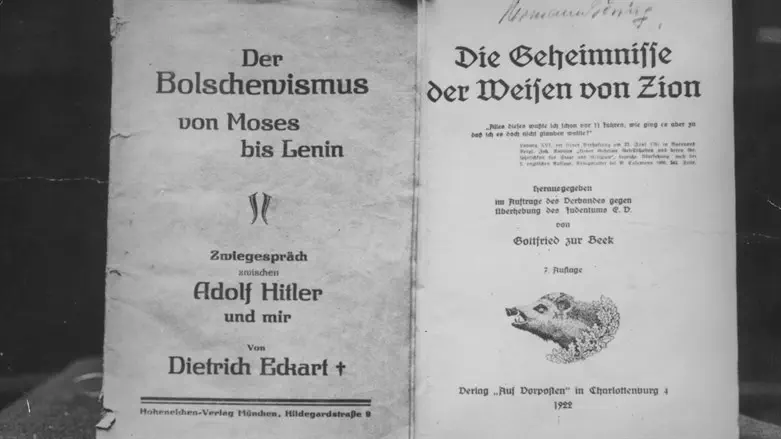
Holocaust denial was never a search for truth. It has always been an ideological project: to erase Jewish suffering, whitewash German guilt, and confuse those who do not know the historical record well enough to fight back.
Deniers use a wide range of arguments, but one of their favorite claims is this: if the Holocaust had really happened, everyone would have known about it during World War II. It would have been as obvious, they insist, as D-Day, the Allied invasion of Normandy on June 6, 1944.
That argument collapses under even minimal scrutiny.
D-Day itself was not “commonly known" before it was underway. It was a closely guarded military secret. The same principle applied, even more forcefully, to the Nazi machinery of annihilation. The camps were wrapped in secrecy precisely because they concealed horrors the regime did not want publicly exposed: systematic beatings, starvation, disease, slave labor, and industrial-scale murder. These were not matters casually discussed over dinner by Nazi officials.
Albert Speer, Hitler’s armaments minister and one of the regime’s most senior figures, later wrote in his Spandau Diary that it was naïve to imagine the Nazi leadership openly boasting to one another about their crimes. He rejected the cinematic fantasy of gangsters in evening dress sitting around discussing murder and conspiracy. That, he explained, was not how the regime functioned. In personal dealings, such matters were not openly discussed.
That silence was not accidental. It was enforced.
SS guard Theodor Malzmueller recalled arriving at the Kulmhof (Chelmno) extermination camp and being told by the camp commandant that the Jews-described in grotesque dehumanizing language-were being exterminated there. He and the other guards were warned to remain silent about everything they saw and heard. If they did not, they were told, their families could face imprisonment and they themselves could face death.
Rudolf Höss, the commandant of Auschwitz, provided additional confirmation. He noted that Germans who spoke carelessly during the war about the concentration camps were warned that they might “go up the chimney"-a chilling phrase that clearly referred to the crematoria. Höss also pointed out the obvious: civilians, technicians, factory foremen, guards, and executioners were all exposed in different ways to what was happening. Some went home at night. Some talked. Some hinted. Some bragged. As he put it, “The bully is the braggart."
So the real issue is not whether information existed. It did. The issue is how much was known, by whom, and under what conditions.
Historian David Bankier concluded, based on wartime and postwar testimony as well as contemporary diaries, that large sections of the German population-Jews and non-Jews alike-either knew or suspected what was happening in Poland and the Soviet Union. Historian Walter Laqueur reached a similar conclusion: while only a handful may have known every detail of the “Final Solution," very few knew nothing.
Millions of Jews could not be murdered without perpetrators, helpers, bystanders, and witnesses. Thousands of people cannot keep a secret forever.
At the same time, fear mattered. The severity of punishment for discussing what was happening ensured that rumors, suspicions, and fragmentary knowledge did not easily become open public discourse. A regime built on terror does not need universal ignorance; it only needs enough fear to suppress honest speech.
The Nazis also worked methodically to erase the evidence of their crimes.
Historian Shmuel Spector documented Aktion 1005, the German effort to destroy the physical traces of mass murder. Beginning in mid-1942 and continuing through the end of the war, the Nazis exhumed bodies from extermination camps and mass graves in the East and attempted to burn them. This was not the behavior of men with nothing to hide. It was the behavior of criminals trying to eliminate the evidence.
But they were too late. There were too many graves, too many bodies, too many witnesses, and too many survivors. Even German efficiency could not fully erase a crime of such scale.
Nor is it true that the Allies knew nothing.
Historian Richard Breitman demonstrated that British intelligence had evidence of mass murder as early as the summer of 1941.
Soon after Germany invaded the Soviet Union on June 22, 1941, British intelligence intercepted and decoded radio messages sent by the German Order Police and their SS superiors. These units were heavily involved in the mass shooting of Jews in the East.
The reason the British were able to intercept this material is significant. The Order Police often did not use the sophisticated Enigma machine for these transmissions. Instead, they relied on a simpler hand cipher based on an older system. As a result, the British obtained what Breitman called unimpeachable evidence of wholesale Nazi killings of Jews.
By contrast, Reinhard Heydrich-the chief architect of the Holocaust and head of the Reich Security Main Office-used the more advanced Enigma system when communicating with the Einsatzgruppen. Those messages were harder to crack and remained protected for longer. But by mid-September 1941, Breitman concluded, it was already too late to conceal the scale of the massacres from British intelligence.
One intercepted message from August 7, 1941, is especially revealing. Erich von dem Bach-Zelewski, Higher SS and Police Leader for Russia Center, reported on the actions of the SS Cavalry Brigade and noted that thousands more had been executed, bringing the total in his area beyond 30,000. This was not rumor. It was documentary evidence from the perpetrators themselves.
So why did the British not immediately publicize everything they knew?
Because war imposes brutal choices. Had Britain revealed the full extent of what it had intercepted, the Germans would have realized their codes were compromised. That could have damaged Allied intelligence capabilities, prolonged the war, and in turn enabled even more killing.
Silence was not proof that the murders were unknown. It was part of the strategic calculus of total war.
This matters because Holocaust denial still operates by exploiting gaps in public knowledge. It cherry-picks fragments, ignores context, and pretends that secrecy, censorship, and wartime intelligence constraints somehow disprove the murder of six million Jews. They do not. The historical record is vast, convergent, and devastating.
Holocaust denial is not merely false. It is morally obscene. It is an assault not only on the dead, but on truth itself.
And today, denial has evolved. Sometimes it appears in crude, old-fashioned forms. Sometimes it comes dressed up as “revisionism," selective skepticism, or malicious attempts to relativize the Nazi genocide. But the objective remains the same: to strip the Holocaust of its historical reality and, with it, to strip the Jewish people of their memory.
That is why the response must be firm, factual, and unambiguous. The Holocaust happened. The Germans and their collaborators murdered six million Jews. They tried to hide their crimes while committing them and erase the evidence afterward. They failed on both counts.
Truth survived. And it must be defended.